


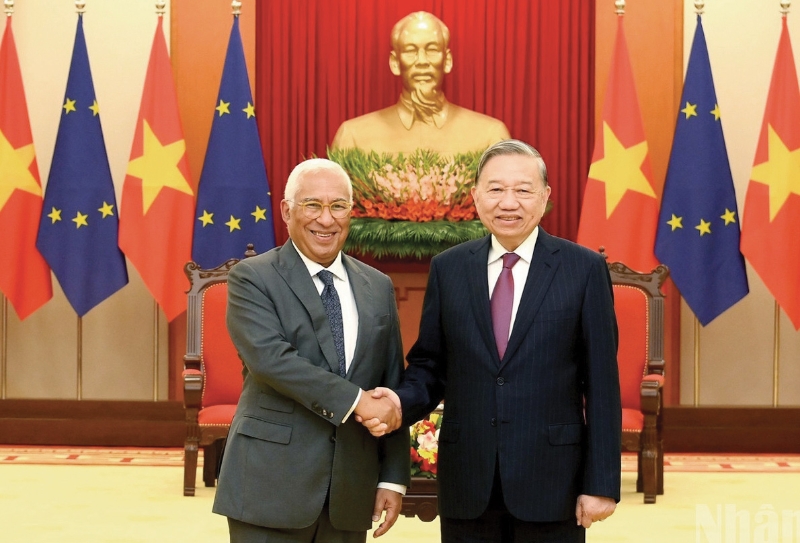
Vietnam and the EU announced the upgrade of their bilateral relationship to a Comprehensive Strategic Partnership on January 29, during the official visit to Vietnam by the President of the European Council António Costa, marking a significant milestone in their 35 years (November 28, 1990 - November 28, 2025) of bilateral relations and shared commitment to peace and prosperity. The upgrade reflects the breadth and depth of cooperation developed over more than three decades.
“For 35 years, our partnership has grown in depth and ambition,” President Costa said. “This upgrade fully captures the breadth and depth of our collaboration to date and our expectations for its future evolution - on trade, on green and digital transformation, on security, and on people-to-people ties.”
Bright spots.
One of the highlights in Vietnam - EU relations is trade and investment cooperation. After more than five years of implementation, the EU-Vietnam Free Trade Agreement (EVFTA) has led to remarkable growth in bilateral trade.
The most-recent figures from the National Statistics Office at the Ministry of Finance put trade turnover between Vietnam and the EU at $73.8 billion in 2025, an increase of 7.8 per cent against 2024. Of this, Vietnam’s exports to the EU totaled $56.2 billion, an 8.6 per cent increase, while imports reached $17.6 billion, up 5.4 per cent. The trade balance for the year was in surplus to Vietnam, by $38.5 billion, a 10.1 per cent ($3.5 billion) increase compared to the previous year and a record high for this market.
According to the Vietnam Chamber of Commerce and Industry (VCCI), significant milestones such as the Framework Agreement on Cooperation (FCA) in 1995 and the Vietnam - EU Comprehensive Partnership and Cooperation Agreement (PCA) signed in 2012 have contributed to shaping an increasingly stable legal framework for bilateral relations.
“The cooperative relationship between Vietnam and the EU since 1990 is seen as a strong, comprehensive, and increasingly in-depth development process,” said Mr. Dau Anh Tuan, Vice Secretary-General and Director of the Legal Department at VCCI. “Starting from humanitarian issues, cooperation between Vietnam and the EU has gradually expanded to many key areas, especially trade and investment.”
From a bilateral trade volume of less than $200 million in the early 1990s, he continued, this figure had reached nearly $74 billion by 2025, reflecting the increasingly close economic ties between the two sides. “Notably, in the context of a volatile global economy, the EVFTA has contributed to maintaining the positive growth momentum of bilateral trade, with an average growth rate of approximately 10 per cent a year,” he added. “The EU is currently Vietnam’s largest trading partner and an important export market for many of its key products, such as electronics, textiles, footwear, and agricultural products (coffee, cashews, and seafood), and is also a major source of machinery, technology, pharmaceuticals, and industrial equipment.”
Regarding investment, the EU is the sixth-largest investor among 153 countries and territories investing in Vietnam, with total FDI from EU enterprises in Vietnam standing at $32.39 billion. Thousands of EU investment projects operate effectively in Vietnam, and the EU business community continues to expand its investments in the country. Conversely, Vietnam currently has 98 investment projects in the EU, with total capital of $434.88 million.
According to Mr. Tuan, the EU is one of Vietnam’s important foreign investment partners, with a significant presence of investors from the Netherlands, Germany, France, Luxembourg, and Denmark. “EU capital flows are primarily concentrated in the manufacturing and processing industries, energy, infrastructure, and high-quality services,” he added. Notably, EU projects often feature high technology content, advanced governance standards, and a commitment to sustainable development, thereby making a positive contribution to Vietnam’s growth model transformation.
According to Deputy Minister of Foreign Affairs Le Thi Thu Hang, looking to the next 35 years and beyond, with a solid foundation and shared vision, along with the upgrade of relations to a Comprehensive Strategic Partnership, there is confidence in a journey of continued growth for Vietnam - EU relations, with broader cooperation space and increasingly high and sustainable quality.
New horizons.
Given ongoing development trends worldwide, Vietnam - EU cooperation faces open doors in various fields. In particular, the Comprehensive Strategic Partnership will provide a strengthened framework for cooperation across a wide range of areas, including trade and investment, climate action, energy transition, digital transformation, security and defense, human rights, and people-to-people exchanges.
Under the Partnership, both sides have great potential for cooperation in the fields of trade, sustainable development, innovation, the maritime economy, governance, security, and people-to-people exchanges. The EU wishes to strengthen cooperation with Vietnam in traditional areas such as trade and investment, agriculture, sustainable development, and climate change response, while expanding cooperation into new areas such as the green transition, the digital transformation, a just energy transition, infrastructure, and transport connectivity, commensurate with the level of the Partnership and becoming a model of cooperation between the EU and a Southeast Asian country.
From a European perspective, Mr. Alain Cany, Chairman of the EuroCham Advisory Board and Country Chairman of Jardine Matheson Vietnam, said this progress brings greater confidence, especially in the long term. “When making major investment decisions far from home, involving not just a few million dollars but substantial capital commitments, stability is essential,” he added. “Vietnam has consistently offered political stability, a talented workforce, and a strong position as a regional hub.”
Vietnam had also previously established comprehensive partnerships with several European countries, including France and Germany. However, he continued, having this framework at the EU level - where decisions on trade and investment are driven - provides stronger assurance for long-term engagement. It signals to European boardrooms that Vietnam is a market where long-term strategies can be confidently developed.
Mr. Tuan believes that building upon traditional areas of cooperation such as trade, investment, and agriculture presents both sides with opportunities to expand cooperation strongly into new, high-potential, and strategic areas such as the green transformation, the digital transformation, a just energy transition, infrastructure development, and connectivity.
Notably, cooperation in science, technology, and innovation is expected to become a new pillar in bilateral cooperation, leveraging Europe’s strengths in science and technology, digital transformation, and connectivity to support Vietnam in enhancing its competitiveness and transforming its growth model.
At the same time, upgrading the relationship will facilitate more effective utilization of the EVFTA and accelerate the ratification process of the EU-Vietnam Investment Protection Agreement (EUVIPA), thereby improving the business environment, increasing investor confidence, and attracting high-quality capital flows from the EU to Vietnam.
Areas such as environmental protection, the green economy, the circular economy, the marine economy, and clean energy will also continue to open up many opportunities for substantive cooperation, contributing to shaping Vietnam - EU economic relations in a sustainable, balanced, and long-term direction.
According to the Ministry of Industry and Trade, in its sixth year of implementation, fulfilment of the terms within the EVFTA has nearly reached 100 per cent. This is a “golden opportunity” for Vietnamese businesses to maximize the advantages of the Agreement, and also a crucial stage for transforming themselves toward the green and sustainable development trends found in the EU.
To further exploit the benefits of the EVFTA in the future, industries and businesses must continue to standardize production, better meet the technical standards of EU buyers, and promote exports while focusing on increasing added value, especially in sectors where Vietnam holds advantages, such as agriculture, fisheries, and manufacturing.
Next practical steps.
Mr. Cany said Vietnam offers political stability and is a dynamic and growing market, meaning that European investors can commit for the long term and select the right partners. “Vietnam offers much more than low-cost labor,” he added. “It has a young and capable workforce, a stable political environment, and strong growth ambitions. For investors who commit for the long term and choose the right partners, the opportunities are substantial.”
To promote Vietnam - EU economic relations in a more substantive and effective manner in the future, Mr. Tuan pointed out that Vietnam needs to implement a comprehensive set of solutions with clear and consistent policy directions. Firstly, continuing the effective implementation of the EVFTA while simultaneously urging the bloc to expedite the ratification of the EUVIPA is crucial in strengthening the legal framework and creating a transparent and stable investment environment, thereby attracting more high-quality capital flows from the EU.
It is also necessary to strengthen cooperation in green transition and sustainable development, considering this a strategic pillar of cooperation. Leveraging the EU’s strengths in technology, green finance, and environmental standards will not only help Vietnam accelerate the transition to a green growth model, develop a circular economy, and reduce carbon emissions, but also open opportunities for it to participate more deeply in global green value chains and better meet the increasingly stringent requirements of the EU market.
Furthermore, it is necessary to strengthen business connections, especially for small and medium-sized enterprises, through trade promotion activities, partner networking, supply chain development, and technology transfer promotion, thereby transforming commitments into concrete and sustainable business opportunities.
Meanwhile, the continued improvement of the investment environment, the enhancement of human resources quality, and infrastructure development play a crucial role in improving the capacity to absorb and effectively exploit opportunities from the EU. These reforms will not only increase the attractiveness of high-quality investment capital but also promote technology diffusion and enhance production capacity and added value in the economy, thereby creating a solid foundation for the stable, sustainable, and long-term development of Vietnam - EU economic relations.





 Google translate