


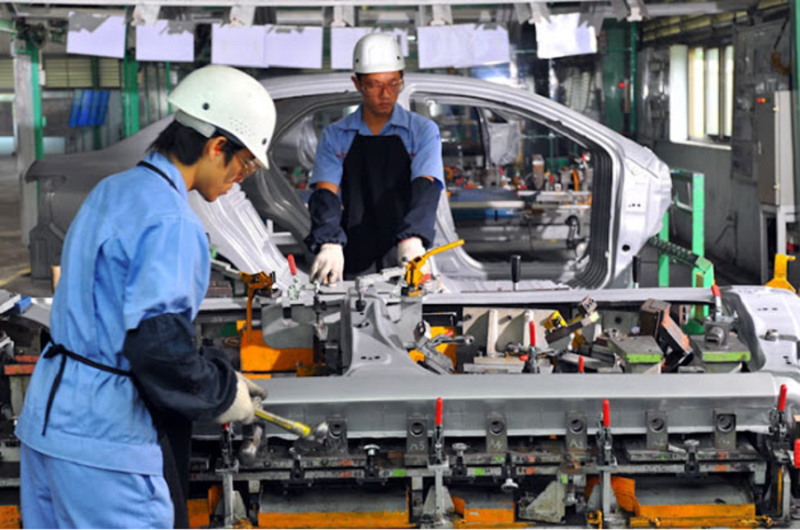
The export of machinery, equipment, tools, and other parts continues to be a highlight in trade activities in 2025, according to the Ministry of Industry and Trade.
Effectively utilizing preferential Certificates of Origin (C/O) has enabled Vietnamese machinery and equipment to expand markets, reduce tariff costs, and integrate more deeply into regional and global supply chains.
Specifically, within the structure of issued C/Os, the non-preferential C/O form B, primarily used to confirm Vietnamese origin, reached an export value of $1.5 million. Although the value is not large, it remains a necessary tool to meet origin requirements in markets that do not apply tariff preferences under FTAs.
In the group of preferential C/Os, the standout is C/O form D under the ATIGA (ASEAN Trade in Goods Agreement) with an export value of $368.3 million. The reduction of intra-ASEAN import tariffs to 0% has facilitated deeper penetration of Vietnamese machinery and equipment into neighboring markets, serving the increasing production and infrastructure investment needs in the region.
C/Os under new-generation FTAs continue to play a crucial role. The export value using C/O form CPTPP (Comprehensive and Progressive Agreement for Trans-Pacific Partnership) reached $150.4 million, indicating that Vietnamese enterprises have gradually adapted to stringent origin rules to effectively exploit markets such as Canada, Australia, Japan, and Mexico.
Notably, the export value of machinery and equipment using C/O form EUR.1 under the EVFTA (EU-Vietnam Free Trade Agreement) reached $1.06 billion. This demonstrates the ability of Vietnamese industrial goods to meet increasingly high technical and origin standards when accessing the EU market—a region with strict requirements on quality, environment, and traceability.
Among regional FTAs, the AANZFTA (ASEAN-Australia-New Zealand Free Trade Area) recorded an export value using C/O form AANZ of up to $4.38 billion, accounting for the largest share. Australia and New Zealand continue to be stable markets for machinery and equipment, especially in high-tech agriculture, mining, and processing industries.
Additionally, exports using C/O form RCEP reached $277.6 million, reflecting the trend of businesses flexibly utilizing regional commitments to optimize supply chains. Other bilateral and regional C/Os, such as form AI (AIFTA) at $441.7 million and form VK (VKFTA) at 441.4 million USD, also highlight the growing role of the Indian and Korean markets for Vietnamese machinery and equipment.
In traditional and neighboring markets, C/O form S under the Vietnam-Laos bilateral trade agreement reached $1.9 million, contributing to maintaining stable trade flows. Meanwhile, the export value using C/O form AK under AKFTA remains modest, reflecting strong competition in the Korean market for this product group.
Data from the Vietnam Customs (Ministry of Finance) also shows the steady growth of the machinery and equipment sector. In the first half of December, the export value of this product group exceeded$2.4 billion, bringing the total export value from the beginning of the year to December 15, 2026, to $55.9 billion.
Experts assess that the export of machinery and equipment is closely linked to the trend of increasing industrial content in the export structure. Utilizing preferential C/Os not only helps businesses reduce costs but also promotes investment in technology, component production, and localization, thereby enhancing Vietnam's position in the global value chain.



 Google translate