


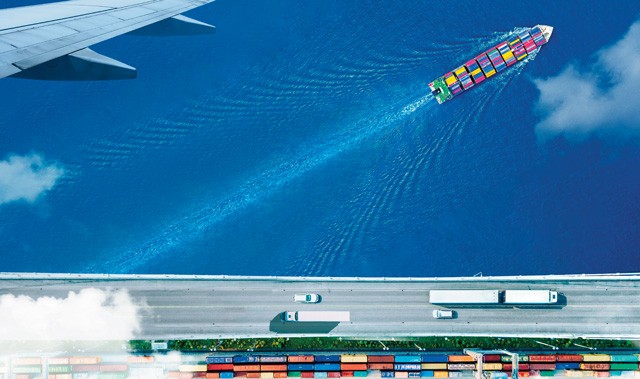
As global supply chains restructure and sustainability requirements tighten, logistics companies are moving beyond transport and warehousing toward automation, digitalization, and lower-emission operations. For Vietnam, the next challenge is not simply adopting individual technologies but integrating infrastructure, data, and services to improve efficiency, resilience, and sustainability.
According to Mr. Nguyen Anh Son, Director General of the Agency of Foreign Trade at the Ministry of Industry and Trade, logistics remains a foundational sector for economic development. However, digital transformation, digital trade, smart transportation, and connected digital ecosystems are emerging as key drivers of the industry’s next stage of growth. At the Vietnam International Logistics Exhibition (VILOG) 2026, Mr. Son said the priority is no longer simply to expand logistics capacity but to develop coordinated operational solutions that reduce costs and improve supply chain efficiency. Such an approach, he noted, would help Vietnamese logistics companies strengthen their competitiveness and integrate more deeply into global value chains.
Alongside digitalization, the government is also placing greater emphasis on green and sustainable logistics infrastructure and services. Technologies such as AI and cloud computing, together with smart warehousing and low-emission logistics solutions, are being adopted as part of efforts to develop a more comprehensive green logistics ecosystem.
Connected systems
Mr. Dao Trong Khoa, Chairman of the Vietnam Logistics Business Association, told Exhibition participants that global supply chains are undergoing profound restructuring, bringing new requirements around digitalization, green development, resilience, and transparency. “While logistics competitiveness was once measured purely by speed and cost, today it is determined by technology, data, and sustainability,” he said.
That shift is changing the investment priorities of logistics companies. Rather than using technology simply to automate individual processes, businesses are increasingly looking to connect different stages of the supply chain.
For domestic logistics companies, this means the challenge is moving beyond the adoption of individual technologies to building interconnected and scalable systems. The ability to combine infrastructure, data, automation, and sustainable operations will increasingly determine how effectively companies respond to changes in supply chains and compete in regional and global markets.
Companies at VILOG 2026 showcased a range of green and smart logistics solutions aimed at improving coordination across the ecosystem while controlling operating costs. Mr. Nguyen Ha Anh, Chief Operating Officer at GHN Logistics, said the company was presenting AI-powered solutions at the Exhibition. “In my view, the solutions here are presented in a very accessible way, so even people who do not work in logistics can understand what AI can do,” he said.
He also noted that changing consumer behavior was creating a different distribution challenge. As technology develops, purchasing is becoming more dispersed, with more sales points, smaller orders, and higher delivery frequency. “That is the challenge that Giao Hang Nang (GHN) has to address,” he said. “We provide nationwide distribution solutions with daily delivery frequency and delivery times that are almost precisely predictable.”
Integrated North-South network
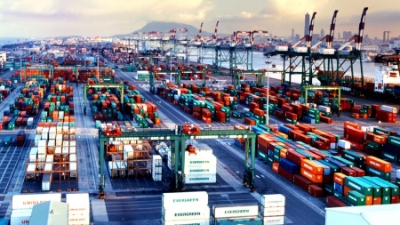
The transformation is particularly visible in the port sector, where digitalization and decarbonization are increasingly being considered alongside cargo-handling capacity.
Mr. Vo Quoc Huy, Chairman and CEO of Long An International Port, said the competitiveness of a modern seaport can no longer be measured solely by cargo throughput; its ability to digitalize operations, reduce emissions, and create value across the supply chain is becoming equally important.

While logistics competitiveness was once measured purely by speed and cost, today it is determined by technology, data, and sustainability.

Strategically located as a gateway connecting Ho Chi Minh City, the Mekong Delta, the Southern Key Economic Region, and international shipping routes, Long An International Port is developing an integrated 1,935-ha seaport-industrial park-logistics ecosystem, with the ambition of becoming a major logistics and transshipment hub for Vietnam’s southern region.
Alongside expanding its infrastructure and handling capacity, the port has invested in digital platforms, including a Terminal Operating System (TOS), AutoGate, E-Port, and SAP S/4HANA, to streamline operations, improve data connectivity, and increase transparency. At the same time, it is advancing its green port strategy through the electrification of cargo-handling equipment, rooftop solar power systems, Euro 5-compliant truck fleets, and energy-efficiency initiatives aimed at reducing carbon emissions.
Mr. Huy said technology, green transformation, and operational efficiency would remain central to the port’s longer-term development. According to the company, Long An International Port was recently recognized with Frost & Sullivan’s “Smart Green Port Company of the Year 2026” award for the Asia-Pacific region, and has also been selected as the host port for the ASEAN Ports & Logistics 2027 conference and exhibition. At the broader industry level, Mr. Nguyen Manh Ha, Marketing Director at Gemadept, identified four factors that will shape the competitiveness of Vietnam’s maritime and logistics sector. The first is strategic infrastructure, particularly deep-water ports. The second is digital transformation. The third is the green transition, and the fourth is ecosystem connectivity and human resources.
Alongside policies supporting the maritime economy and the relocation of global supply chains toward Southeast Asia, he sees a significant opportunity for Vietnam’s maritime and logistics sector.
For Gemadept, the response is to connect its infrastructure and logistics services into a broader network rather than operate individual assets separately. Mr. Ha described the model as “a single point of contact - an integrated north-south ecosystem offering end-to-end solutions to optimize cost, time, and emissions.”
Gemadept’s biggest advantage is its large-scale, modern port network located at strategic sites that few other companies in the industry can match. In Vietnam’s northern region, the Nam Dinh Vu Port cluster serves as a hub for intra-Asia routes in Hai Phong, benefiting from the Ha Nam channel and an integrated logistics ecosystem in the Dinh Vu area. In the south, the deep-water Gemalink port in Cai Mep-Thi Vai can accommodate the world’s largest container vessels and provides direct connectivity to European and US markets. “This is complemented by a network of Inland Container Depots (ICDs), depots, distribution centers, and inland waterway and road transport fleets linking key economic hinterlands,” Mr. Ha said.
The key difference, he noted, is that these assets are designed to operate as connected links rather than separate services. Customers can work through a single point of contact for door-to-door solutions covering port handling, inland waterway and road transport, warehousing, and distribution, with data connected across the chain through smart-port platforms.
Gemadept is also bringing its shipping operations back this year as a link connecting its port network nationwide while expanding inland waterway transport and Mekong Logistics. The latter can reduce both transport costs and emissions compared with road transport. Construction of the second phase of Gemalink began in April 2026 and is expected to become operational in the fourth quarter of 2027, raising total capacity to more than 3 million TEUs a year. A 33-ha project in Nam Dinh Vu and new river port projects in southern Vietnam are also being developed.
For importers and exporters, the impact of these changes is ultimately measured in practical terms: more resilient supply chains, lower costs, shorter transit times, and a smaller carbon footprint. Vietnam’s next phase of logistics development will depend less on adding isolated capacity and more on how effectively infrastructure, technology, data, and services can be connected into a single operating system.



 Google translate