


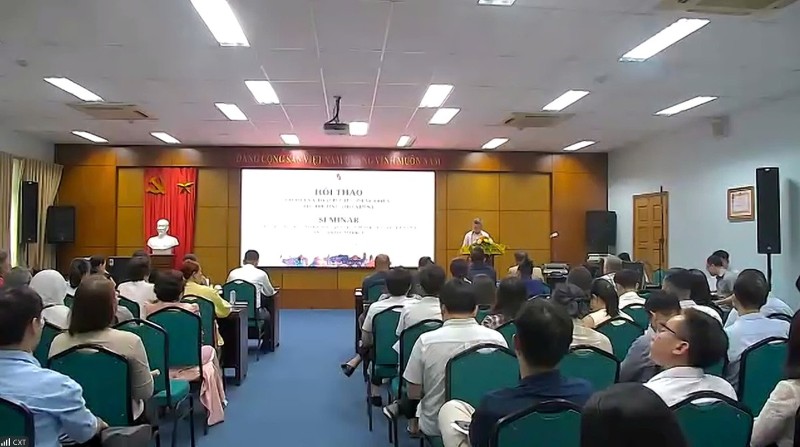
Amidst significant fluctuations in global supply chains, Turkey has emerged as a key market and a vital trade gateway connecting the three continents of Asia, Europe, and Africa. However, to convert this potential into actual orders, Vietnamese enterprises must proactively identify challenges regarding technical barriers, financial risk management, and the standardization of Halal requirements.
Speaking at the workshop "Opportunities and Challenges in Developing the Turkish Market" held on July 21, Mr. Ta Manh Cuong, Director of the Trade Promotion and Investment Support Center (Vietnam Trade Promotion Agency, Ministry of Industry and Trade), noted that Turkey is a large-scale economy serving as a regional hub and has an increasing demand for Vietnam’s core strengths, such as agricultural products, food, tea, coffee, spices, and seafood.
In the first half of 2026, where bilateral trade turnover reached $1.39 billion, Vietnam's exports saw an impressive growth of 32% year-on-year. Of note, Vietnam's food and beverage export turnover to this market reached $950 million, a 12.1% increase over the same period last year.
From a macroeconomic research perspective, Assoc. Prof. Dr. Dinh Cong Hoang of the Institute for South Asian, West Asian, and African Studies (Vietnam Academy of Social Sciences) assessed Turkey as a G20 economy with a scale exceeding $1 trillion and a population of approximately 86.1 million.
The country possesses a unique advantage through its Customs Union Agreement with the EU, allowing goods entering Turkey to circulate easily into European markets without facing double tariff barriers, said Mr. Hoang.
“Furthermore, it boasts massive logistics infrastructure—such as the Bosphorus Strait and Istanbul Airport—and an extensive network of Free Trade Agreements (FTAs) with nearly 40 countries. With an annual trade deficit exceeding $100 billion, Turkey has a substantial demand for raw materials and semi-finished goods for processing and re-export.”
Despite the vast room for growth, penetrating deep into the Turkish market poses several difficult questions. Ms. Nguyen Viet Hang, Head of the Vietnam Trade Office in Turkey, pointed out major challenges: phytosanitary barriers, stringent customs procedures, mandatory Halal certification, logistics volatility, high transport costs, and risks of delayed payments.
Starting in July 2026, the Turkish Ministry of Agriculture and Forestry began implementing a 10-step digital inspection process via the GGBS system for imported food, requiring risk management measures to be in place even before goods arrive at the port.
Additionally, high inflationary pressure (with CPI reaching 37.9%) has led Turkish businesses to adopt a "Shrinkflation" strategy—maintaining prices while reducing product volume—and extending payment terms. Exporters often have to provide capital upfront and wait 2–3 months to receive payment, creating a serious "liquidity trap."
Furthermore, a new consumer trend is emerging: Turkish consumers are shifting toward a "spend less, buy smarter" logic. They are prioritizing domestic products over high-end imports, switching from brand loyalty to hunting for promotions and low prices, and favoring natural, additive-free products with sustainable packaging. Convenience and ready-to-eat foods are also on the rise. Consequently, it is difficult for Vietnamese goods to compete solely on high-end brand prestige; instead, they should focus on value for money, competitive pricing, and the integration of B2B channels.
Turning potential into reality
One of the fundamental prerequisites for conquering the Turkish market and the 57 member states of the OIC (Organization of Islamic Cooperation) is compliance with Halal standards. Discussing the new legal framework, Mr. Ramlan Bin Osman, Director of the National Halal Certification Center (HALCERT) under the Vietnam Ministry of Science and Technology, emphasized: "Halal is not just a story about meat or money. In its broader definition, Halal is a quality management system implemented throughout the entire supply chain."
According to Mr. Ramlan Bin Osman, under Decree No. 127/2026/ND-CP, the Government has designated the ministry as the focal point for State management of Halal. This mandate unifies four key stages: Testing, Certification, Labeling, and Traceability. To date, Vietnam has issued seven National Standards (TCVN) regarding Halal and developed a national database to ensure information transparency. Notably, HALCERT has officially received accreditation from the Gulf Accreditation Center (GAC), opening significant opportunities for Vietnamese goods to enter the Middle Eastern and Turkish markets.
Drawing from practical commercial experience, Director of Hanoi Green Cooperative and CEO of HalalViet, Ms. Ba Thi Nguyet Thu, said that the Halal market holds immense potential and vast room for growth for Vietnam’s raw agricultural products, processed foods, and cosmeceuticals.
From her experience, she outlined a six-step roadmap for businesses to effectively penetrate the market: clearly identify product segments; prepare export capacity and certifications early; obtain Halal certification as the strongest "guarantee of trust" for Muslim consumers; standardize documentation, packaging, and labeling (mandatory in English or Arabic); vet partners and select appropriate distribution channels; and provide ample samples during trade promotion activities to allow partners to experience the products firsthand.
To ensure effective entry into the Turkish market, Ms. Thu recommended that the Government promote mutual recognition of Halal standards between Vietnam and international bodies to maximize the impact of Decree 127. She also suggested building a Halal market information portal to help businesses access accurate data. Additionally, she called for training and financial support for small and medium-sized enterprises (SMEs) to maintain long-term Halal certification.



 Google translate