


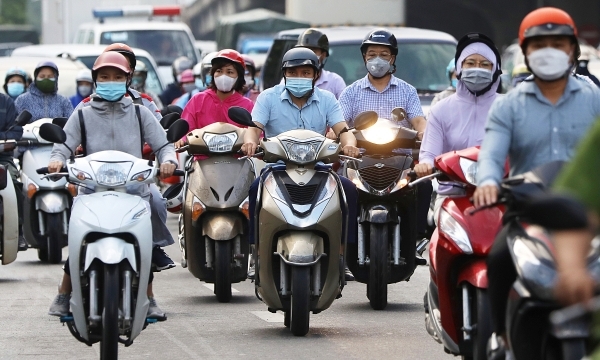
Hanoi will not immediately ban fossil-fuel-powered motorbikes within the Ring Road 1 area starting July 2026. Instead, the city will implement a pilot roadmap with a specific scope and targeted groups of vehicles.
According to the city Department of Construction, the control of vehicles using fossil fuels within Ring Road 1 will not follow a "blanket ban" approach. Instead, it will be rolled out step-by-step, following a roadmap tailored to real-world conditions. This adjustment is a significant shift in response to public concerns regarding the feasibility of applying simultaneous restrictions on private vehicles in the city center.
Choosing a phased roadmap over immediate drastic measures reflects not only considerations for infrastructure and social stability but also demonstrates the link between urban transport policy and broader goals for energy, technology, and green growth.
Under the current plan, starting July 1, 2026, Hanoi will begin piloting "Low Emission Zones" (LEZ) in certain areas within Ring Road 1. The implementation is defined as a controlled emission strategy with a specific scope, timeframe, and designated groups of subjects, rather than a uniform application across the entire route.
The Department of Construction evaluated that this approach aligns with Resolution No. 57/2025/NQ-HĐND of the city People’s Council. Under this resolution, Low Emission Zones are determined based on criteria such as urban planning, traffic congestion levels, and air quality. These areas are characterized by high activity density and significant environmental pressure, making them the starting point for restructuring urban transport.
By avoiding a comprehensive ban and instead limiting restrictions to specific hours, areas, and vehicle groups, the city is adopting an experimental approach. The municipal government will monitor and evaluate the impact of the pilot to adjust policies for each subsequent stage.
The expansion roadmap has also been established in stages following the city's concentric rings: expanding from Ring Road 1 to Ring Road 2 by 2028, and reaching Ring Road 3 by 2030.


 Google translate