


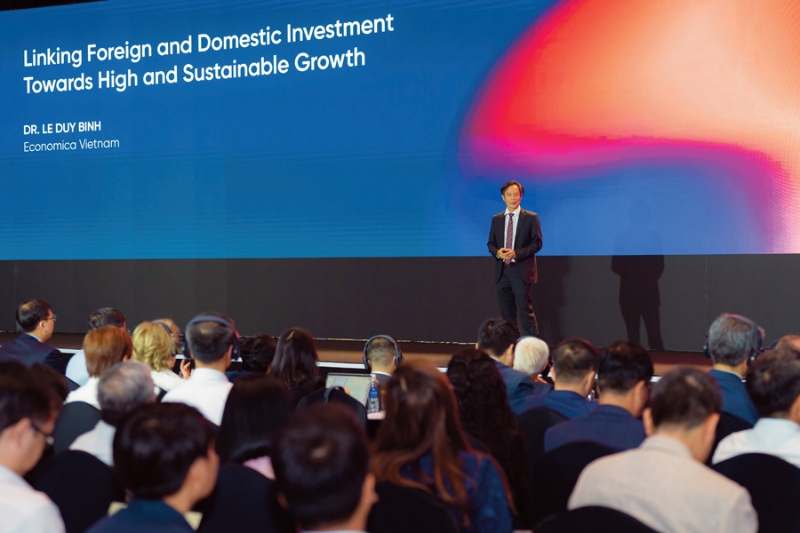
Amid shifts in global capital flows, Vietnam has maintained its appeal among FDI and broader social investment resources. During the 2021-2025 period, total social investment expanded significantly, with the private sector and FDI increasingly serving as key growth drivers.
Entering a new phase of development, the priority is no longer high growth alone but higher-quality and more sustainable growth. This will require larger volumes of capital, alongside a recalibration of FDI attraction strategies toward high-quality investment aligned with green transformation and stronger domestic economic capabilities.
During the 2021-2025 period, total social investment capital reached approximately VND17,000 trillion ($654 billion). Within the capital structure, the State sector accounted for only around 27 per cent, while the remaining 73 per cent came from the private sector, including domestic enterprises, FDI enterprises, and foreign indirect investment. This underscores the increasingly important role of the private sector, particularly FDI, in the economy.
Notably, FDI remained one of the key drivers supporting economic growth. During the same period, FDI capital expanded by roughly 1.5-fold, from VND2,900 trillion ($112 billion) to approximately VND4,200 trillion ($162 billion), and now accounts for some 16 per cent of total social investment.
Investment trends
Total registered FDI capital reached approximately $184 billion, of which around $158 billion was disbursed, equivalent to roughly 85 per cent of the total. This is considered a strong disbursement rate compared to many countries in the region, reflecting Vietnam’s effective capacity to absorb and implement investment capital.
Most FDI capital was concentrated in manufacturing and processing, accounting for around 56.5 per cent, while real estate business represented 21.2 per cent. Beyond housing, real estate investment also flowed into tourism and resort projects, industrial parks, and export processing zones, contributing to enhanced production capacity and strengthening Vietnam’s attractiveness for subsequent investment inflows.
Against a backdrop of slowing global FDI flows, Vietnam has continued to maintain considerable appeal among international investors, ranking in the world’s Top 15 developing economies for FDI attraction last year, further reinforcing its standing among international investors and its increasingly prominent role on the global investment map.
Foreign investment flows are projected to continue growing during the 2026-2030 period, though major surges in scale are unlikely. Instead, investment trends are expected to shift more clearly, as global companies increasingly prioritize reshoring production closer to domestic markets or relocating to countries considered reliable partners with stable investment environments and development orientations aligned with their strategic priorities.
This shift also requires Vietnam to reassess its position within global supply chains and adjust its investment attraction strategy in line with emerging capital relocation trends.
At the same time, next-phase FDI is expected to place greater emphasis on green investment, secure supply chain development, technological self-reliance, and projects linked to economic security objectives. Investors are increasingly focused not only on business efficiency but also on resilience and supply chain security, creating new opportunities for Vietnam to strengthen its investment appeal.
The country has set ambitious growth targets alongside sustainable development requirements, with total investment demand estimated at approximately VND38,500 trillion ($1.48 trillion) during this period. Of this, the domestic private sector and FDI are expected to contribute around 80 per cent, while the State sector will account for roughly 20 per cent.
This structure suggests that the private sector will continue to play the leading role, while FDI remains a critical source of capital for sustaining growth. To achieve these goals, Vietnam will need to attract around $45-50 billion in registered FDI annually and approximately $35-40 billion in disbursed FDI to ensure sufficient resources for long-term growth.
However, the challenge is not merely to increase scale but also to improve the quality of capital inflows. Vietnam is now orienting itself toward attracting a new generation of FDI that delivers not only scale but also higher added value to the economy. Accordingly, FDI should prioritize green growth, sustainable development, and social responsibility, while contributing to greater technological self-reliance and facilitating knowledge and technology transfer.
Domestic enterprises also continue to face significant internal challenges. Around 60-70 per cent of enterprises are still using outdated technologies, creating difficulties in meeting increasingly stringent requirements of global supply chains.
At the same time, localization rates remain modest, at around 35 per cent in the electronics sector and 25-30 per cent in mechanical engineering. Average enterprise capital stands at only around VND82.5 billion ($3.17 million), while spending on R&D averages around 1 per cent of revenue; significantly lower than the 4-5 per cent commonly seen in high-tech economies.
These figures underscore the urgent need to strengthen links between domestic enterprises and the FDI sector in order to improve competitiveness and increase domestic value creation.
However, this process cannot rely solely on the initiative or goodwill of foreign enterprises. Vietnamese companies must prepare more systematically, from production capacity and corporate governance to development strategies and the ability to meet increasingly demanding global supply chain standards.
Promoting links
Strengthening links between domestic enterprises and the foreign-invested sector must be built on the principle of harmonized interests, ensuring value creation for both sides. In this regard, a “win-win” mindset and principle of mutual benefit should become the foundation for both policy design and practical implementation, creating incentives for long-term and sustainable cooperation.
At the same time, trade principles and market mechanisms should serve as the basis for enhancing connectivity, not only at the policy-making level but also in implementation. Partnership models operating under market-based mechanisms tend to be more stable and sustainable over time.
Another notable issue is the role of foreign indirect investment (FII). Links between domestic and foreign enterprises are formed not only through supply chains but also through financial activities such as mergers and acquisitions, equity ownership, and capital investment. This has become an important channel for strengthening ties between Vietnamese enterprises and international capital flows.
In practice, FII inflows into Vietnam have shown considerable potential in recent years. Over the past decade, the scale of FII in Vietnam has reached approximately $75 billion, reflecting substantial room for growth in this funding channel going forward.
According to forecasts, Vietnam’s stock market could attract up to $25 billion in international investment capital by 2030. Market upgrades by FTSE Russell and MSCI alone could trigger around $5 billion in capital inflows from exchange-traded funds (ETFs) and mutual funds during the initial phase.
Given this potential, attracting more foreign indirect investment should become a priority in the coming period. Beyond serving as an important financial resource, it can also help expand channels of connectivity between Vietnamese enterprises and international investors.
However, the number of FDI enterprises listed on Vietnam’s stock market remains limited, restricting opportunities for investment through equity ownership or capital contributions in this segment. At present, only ten or so FDI enterprises are listed, equivalent to approximately 0.6 per cent of all listed companies and just 0.03 per cent of total active FDI enterprises operating in Vietnam.
In terms of scale, these enterprises have a combined market capitalization of some $320 million, equivalent to approximately 0.13 per cent of Vietnam’s total stock market capitalization.
Going forward, strengthening connectivity through financial investment mechanisms, including cross-investment between FDI enterprises and domestic investors or between foreign investors and Vietnamese companies, could become an important direction for further promotion. This represents a new strategic mindset for attracting foreign investment in general and for deepening links between the foreign-invested sector and the domestic economy in particular.
(*) Dr. Le Duy Binh is the Director of the Economica Vietnam



 Google translate