



At the recent “Hormuz Shock: Energy Security Challenges for Vietnam” seminar, organized by Tap chi Kinh te Viet Nam / Vietnam Economic Times / VnEconomy, experts and policymakers agreed that after nearly two months the Middle East conflict has evolved from a regional geopolitical hotspot into a major shock to global energy security, with direct implications for Vietnam’s growth outlook and macro-economic stability.
Volatility in the Strait of Hormuz is creating far-reaching impacts on the global energy market. For Vietnam, these developments not only pose immediate challenges to fuel supply but also highlight the urgent need to strengthen strategic reserves and enhance its autonomy in the national energy security strategy.
Global shock and cascading impacts
Associate Professor Pham Hoang Luong, Senior Lecturer at the Hanoi University of Science and Technology and Vice President of the Vietnam Clean Energy Association, said the disruption in the Strait of Hormuz, through which around 20 per cent of global crude oil and gas flows, has interrupted energy supplies and triggered sharp repricing in oil markets, putting pressure on supply chains, commodity prices, and macro-economic stability worldwide.
He noted that Brent crude surged from $78-80 a barrel to $120-125 within a matter of weeks, before easing to $101-102, driving up transport costs and indirectly increasing the prices of other goods. The International Energy Agency (IEA) has described this as the largest supply chain disruption in the history of the global oil and gas industry.
Citing analysis from the Federal Reserve Bank of Dallas, the Associate Professor added that if the disruption persists through the second quarter its economic impact will extend into the second half of the year. If prolonged even further, global GDP in 2026 could decline by up to 1.5 percentage points.
He emphasized that the Asia-Pacific is particularly vulnerable due to its heavy dependence on Middle Eastern energy, with about 83 per cent of crude oil and 84 per cent of LPG imports in 2024 originating from the region. For Vietnam, this vulnerability is amplified by its import structure, with around 85 per cent of crude oil sourced from the Middle East, particularly Kuwait.
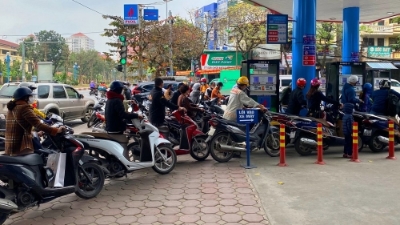
The Associate Professor also highlighted structural constraints in Vietnam’s energy system. The Nghi Son Oil Refinery, a key component of domestic fuel supply, is optimized for Kuwaiti crude, making it difficult to switch feedstock quickly. As a result, domestic fuel prices have risen more sharply than global crude prices. While Brent increased by about 1.3-1.6-times, gasoline prices in Vietnam and Singapore rose 2-2.5-times and diesel by 3-3.8-times, while fuel oil doubled and Jet A1 surged more than 3.5-times and even faces shortages.
He further warned that rising oil prices are feeding through the economy in three layers: transport costs, production costs, and inflation expectations - the latter posing the greatest risk due to its potential to trigger an inflationary spiral. This comes at a critical time as Vietnam enters 2026, with CPI already reaching 4.63 per cent in the first month of the year and exceeding the 4.5 per cent target.
Maintaining supply stability
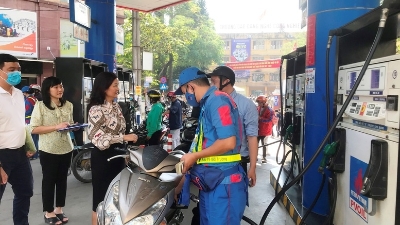
From a regulatory perspective, Mr. Nguyen Anh Tuan, Head of the Petroleum and Gas Business Management Division at the Domestic Market Management and Development Department under the Ministry of Industry and Trade, said Vietnam’s domestic fuel supply remains within control despite external pressures.
He attributed this resilience to two pillars: stable domestic production and flexible imports. The Dung Quat and Nghi Son refineries are operating steadily, supplying most domestic demand, while key petroleum traders have proactively diversified import sources and developed supply plans to reduce disruption risks.
According to Mr. Tuan, the Ministry has implemented coordinated measures, including enforcing commercial reserve requirements, strengthening oversight of distribution systems, and coordinating across agencies to address emerging issues.
In response to potential price spikes, the Ministry has prepared detailed scenarios. If global oil prices exceed $100 per barrel, a combination of the price stabilization fund and fiscal tools will be deployed to limit economic spillovers. The fund will act as a flexible “shock absorber” while tax measures, including environmental protection tax, import duties, and excise tax, may be adjusted to stabilize prices.
He added that even under extreme scenarios, where oil prices reach $200 a barrel, the Ministry has prepared a “multi-tool” approach to ensure uninterrupted supply and control inflation. Domestic refineries will be directed to operate at full capacity, while imports will be adjusted flexibly to compensate for any shortfalls. Enterprises are required to strengthen reserves, diversify supply markets, and maintain stable supply flows. The allocation of minimum petroleum supply quotas to key traders is also used as a regulatory tool, linking supply responsibility to individual enterprises, with authorities closely monitoring implementation.
Mr. Tuan further noted that despite the Middle East conflict, Vietnam’s import activities have remained stable. Contracts have been executed as planned without widespread cancellations, and in March alone, imports exceeded 3.2 million cu m, which together with domestic inventories ensure supply through April and May.
He highlighted diversification as a key strength in Vietnam’s response. Enterprises have actively sought alternative sources, including crude from Russia, to maintain stable feedstock for domestic refineries. This approach has improved flexibility and reduced reliance on the Middle East.
In sensitive segments such as aviation fuel (Jet A1), Mr. Tuan said supply has remained stable despite price pressures, ensuring uninterrupted operations in the aviation sector. Looking ahead, he emphasized that the Ministry of Industry and Trade will continue to enhance forecasting capacity, develop proactive regulatory scenarios, and manage supply to ensure market stability amid ongoing global uncertainty.
Strengthening long-term energy security
Looking at the longer-term picture, Associate Professor Luong stressed that while the current crisis has exposed vulnerabilities in Vietnam’s import structure, a larger gap lies in strategic reserve capacity. He pointed out that international experience shows strategic reserves are a core pillar of energy security. Japan maintains reserves equivalent to 354 days of consumption and China about 120 days, while the IEA recommends a minimum of 90 days.
By comparison, Vietnam still relies largely on enterprise-based commercial reserves, which, while effective in the short term, are insufficient for prolonged disruptions. Associate Professor Luong emphasized the need to develop a comprehensive reserve system, including expanded storage infrastructure and more flexible distribution networks.
He added that a more resilient energy security strategy should rest on three pillars: diversifying import sources, improving refinery flexibility to process different crude types, and strengthening reserve capacity to absorb medium-term shocks.
Policy direction going forward, he said, should focus on “efficiency, autonomy, diversification, and flexibility” - improving energy use, expanding domestic energy sources, including renewables, strengthening energy diplomacy, and refining pricing and distribution mechanisms. These measures are essential not only for addressing the current crisis but also for building a more sustainable and resilient energy security framework for Vietnam in the long term.





 Google translate