


The Palladium Hotel Group, a Spanish hotel chain with over 50 years of experience, recently inked agreements for two hotels in Vietnam and established its Asia-Pacific headquarters in Ho Chi Minh City. Palladium’s decision to enter the Vietnamese market is a result of the country’s strong tourism fundamentals, including its burgeoning luxury hospitality sector and its strategic position within Southeast Asia.
“Southeast Asia represents one of the most dynamic hospitality markets globally, with growing demand for distinctive luxury experiences, strong domestic travel, and increasing international connectivity,” said Mr. Farah Jaber, Managing Director, Southeast Asia, at Palladium. “The Group’s approach is centered on selective expansion, operational excellence, and differentiated guest experiences, leveraging its portfolio of brands to meet the evolving demands of both travelers and investors.”
Broader wave of international brands
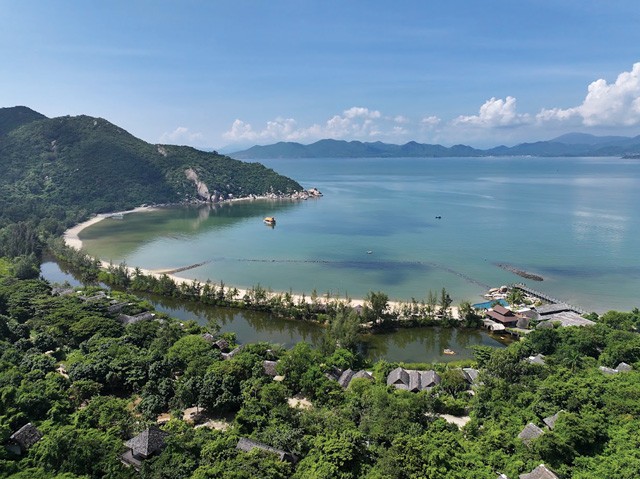
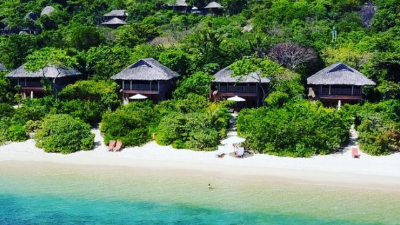
Palladium’s first project is with the CONASI Property Management and Development Corporation and involves the redevelopment of the L’Alya Ninh Van Bay as BLESS L’Ayla Ninh Van Bay. Set to open in the summer of 2027, the all-villa resort north of the beach city of Nha Trang in south-central Khanh Hoa province is located amid lush jungle with private white sand beaches. As part of the rebrand, an additional 54 villas will be added to the 5-star property. Palladium acquired the hotel in July 2026 and will operate on a white label basis until the renovation is completed next year.
The Group has also acquired the Hoa Binh Hotel and will transform the one-time Hanoitourist asset into BLESS Hotel Hanoi, opening in 2028. The century-old hotel will undergo a comprehensive renovation that will balance preservation of the building’s historic appeal with a contemporary Vietnamese design, elevating the property from a 3-star to a 5-star foundation. Palladium followed a similar approach with its Only YOU Madrid hotel, restoring a 19th-century building in the city’s Chueca district, pivoting off its historic charm while transforming it into a contemporary lifestyle hotel.
Together, these developments will introduce BLESS Collection Hotels to Vietnam, showcasing the brand’s signature combination of contemporary luxury, design-led experiences, gastronomy, and destination immersion.
Palladium’s regional office will oversee business development, operations, and stakeholder engagement throughout Vietnam and support future expansion opportunities throughout the region. “Choosing where to begin in Asia was a deliberate decision, and Vietnam was clear,” said Mr. Jesús Sobrino, CEO of the Palladium Hotel Group. “Its growth is remarkable, but what convinced us is the shift in what the market values: distinctiveness and experience over scale alone. That is where our strengths lie. We enter Vietnam with a long-term commitment, a distinctive portfolio, and every intention to grow alongside partners who share our ambition.”
Over the past five decades, Palladium has evolved from a Spanish hospitality company into an international group with more than 40 hotels operating across nine different countries and territories. Palladium’s hotel brands include BLESS Collection Hotels, The Unexpected Hotels, Only YOU Hotels, TRS Hotels, and Grand Palladium Hotels & Resorts. “Expanding into Asia is a natural continuation of that journey,” Mr. Sobrino added. “We are approaching this opportunity with a long-term vision centered on quality, differentiation, and sustainable expansion.”
Palladium is not arriving in isolation. Previously, in March, Marriott International signed an agreement with the Sun Group to develop ten new hotels and resorts in Phu Quoc and Vung Tau in Vietnam’s south. The projects will add nearly 4,500 rooms and are expected to open between 2026 and 2030. The portfolio introduces eight brands across multiple segments, including first W Hotels and Moxy Hotels, alongside Marriott Hotels, Westin, Le Meridien, Courtyard, Fairfield, and Four Points by Sheraton.
Mr. Rajeev Menon, President, APEC, at Marriott International, said Vietnam is emerging as one of the world’s most dynamic tourism markets, with the group’s managed hotel portfolio doubling since 2022. “Our continued collaboration with the Sun Group reinforces our commitment to the long-term future of Vietnam, including Phu Quoc, which is rapidly emerging as one of Asia’s most dynamic tourism destinations, with unsurpassed facilities for leisure, business, and global events,” he said.
Marriott International also signed agreement with the Masterise Group to open four hotels and one branded residence in Vietnam. The launch of The Ritz-Carlton, Saigon, and The Ritz-Carlton Residences, Saigon, is poised to set a new benchmark for luxury hospitality in Vietnam, while a pioneering eco-resort complex in Can Gio, a natural retreat within Ho Chi Minh City, will include JW Marriott and Four Points by Sheraton Hotels, in alignment with the district’s long-term development vision.
In Hanoi, the Co Loa Marriott Hotel is set to introduce the flagship Marriott Hotels brand to Hanoi. Currently under construction next to the National Exhibition & Convention Center, it is expected to feature 494 keys, offering an outstanding option for business travelers and meeting planners.
The new expansion of luxury hotel brands underscores its long-term commitment to Vietnam’s fast-growing tourism market as well as offering guests even more inspiring options across Vietnam. “Through this multi-property agreement, we hope to create destinations that deliver memorable and meaningful experiences for domestic and international travelers alike,” said Mr. Gautam Bhandari, Chief Development Officer, Asia Pacific excluding China, at Marriott International.
“Our expansion into the hospitality and resort sector represents a strategic milestone in our journey to build a fully-integrated real estate ecosystem, underscoring our long-term commitment to advancing Vietnam’s position as a premier global destination,” added Ms. Nelly Phuong Ta, Head of Hospitality & Entertainment at the Masterie Group.
Ahead of target
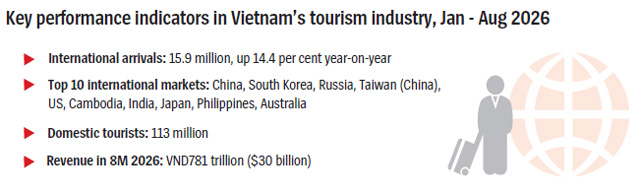
The brand pipeline tracks a still-strong visitor recovery. According to the Vietnam National Authority of Tourism (VNAT), Vietnam’s tourism sector continued to maintain its growth momentum in the first eight month of 2026, welcoming 15.9 million international visitors, up 14.4 per cent year-on-year. This is the highest number of international arrivals recorded in the first eight months of any year in recent times. This exceptional growth can be attributed to a combination of factors, including Vietnam’s growing reputation as a safe, friendly, and highly-attractive destination in Asia. The country has set a target of welcoming 25 million international visitors in 2026.
It welcomed nearly 21.2 million international arrivals and served 137 million domestic tourists last year. Tourism revenue reached about $38.5 billion, up 38 per cent from 2019, while the sector contributed nearly 8.8 per cent directly to GDP and generated about 4.41 million jobs.
Politburo Resolution No. 26 NQ/TW on the development of tourism into a spearhead economic sector in the new era sets the goal of the sector directly contributing 10-12 per cent of GDP, welcoming 45-50 million international visitors, serving 160 million domestic tourists, and generating $80-90 billion in tourism revenue. By 2045, Vietnam aims to rank among the world’s Top 30 countries and territories in tourism competitiveness.
The Resolution also calls for a strong shift in thinking and approaches to tourism development toward greater depth, quality, efficiency, sustainability, and added-value, while promoting tourism as a growth driver closely linked with digital transformation, green transition, cultural development, national defense and security, and enhanced national competitiveness.
There can be no doubt that global operators are no longer treating Vietnam only as a volume market. They are competing for distinctive assets, historic buildings, and destinations that can command longer stays and higher spend - the same shift Politburo Resolution No. 26 now asks of the industry as a whole.



![[Interactive]: Economic overview - September 2026](https://premedia.vneconomy.vn/files/uploads/2026/10/06/9e0f403040dd4384ad690004bc1911ab-124594.png?w=400&h=225&mode=crop)
 Google translate