


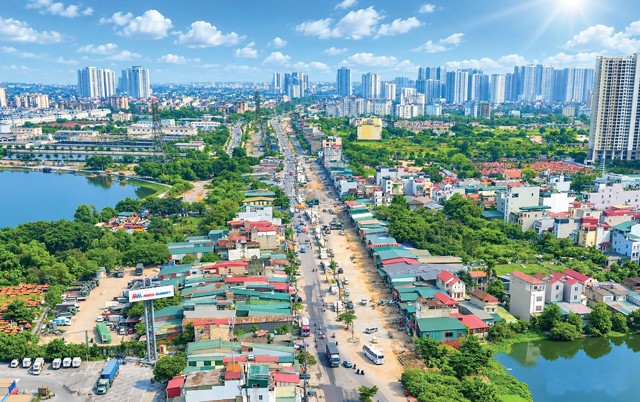
The Global Real Estate Transparency Index (GRETI) 2026 report, released recently by JLL, showed that Vietnam currently ranks 50th out of the 88 countries and territories surveyed, with a transparency score of 3.15 that sees it remain in the “Semi-Transparent” category. Notably, Vietnam is one of ten markets with the strongest score improvement globally during the 2024-2026 survey period, alongside Poland, Thailand, Australia, Qatar, South Korea, India, Saudi Arabia, Dubai, and Abu Dhabi. “Vietnam’s inclusion in the Top 10 most-improved transparency markets globally in the 2026 GRETI reflects years of consistent effort,” said Ms. Le Thi Huyen Trang, Country Head and Head of Research and Advisory for Vietnam at JLL.
Positive signs
Globally, two-thirds of the 88 markets surveyed recorded increases in their transparency score over the past two years. However, the gap between leading and other markets continues to widen: the “Highly Transparent” and “Transparent” groups now attract over 98 per cent of total global commercial real estate investment, with the “Highly Transparent” group accounting for some 81 per cent.
In contrast, the “Semi-Transparent” group, where Vietnam currently sits, accounts for about 1.3 per cent of global capital flows, indicating significant potential to attract more investment as the market continues to enhance its transparency.
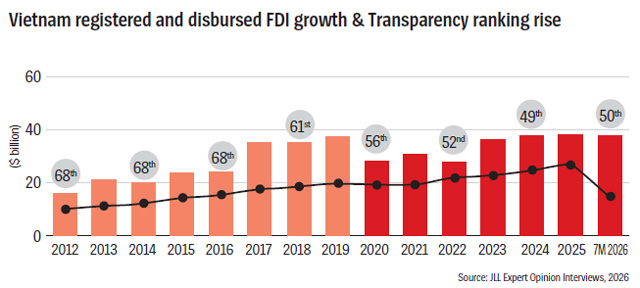
Vietnam was in the “Low Transparency” group prior to 2020, with typical challenges including limited market data and a complex legal framework, particularly for foreign investors on property ownership matters, according to JLL and LaSalle data.
From 2020 to present, the country moved into the “Semi-Transparent” group, with 2024 serving as a critical year for the development of the legal framework: the amended Land Law, Law on Housing, and Law on Real Estate Business all took effect; the new Law on Prices requires appraisers to hold professional certificates and maintain verifiable valuation records; and real estate transactions must be conducted through the banking system.
Decree No. 357 regulating the establishment, management, and operation of information systems and databases on housing and the real estate market officially came into effect in 2026, with the goal of completing the national land database by the end of the year. Vietnam has also seen increasing adoption of sustainable development practices in the real estate sector.
Mr. Vo Van Huu Phuoc, Head of Valuation & Risk Advisory for Vietnam at JLL, said the country is gradually digitizing land records and establishing a unified real estate registration system, moving toward the adoption of international valuation standards such as International Property Measurement Standards (IPMS). “These are key factors that help bridge the gap, enhance the reliability of valuation results, and strengthen foreign investors’ confidence in the market,” he added.
Ms. Trang said that from 2012 to now, the market has evolved from its early stages to establish a much stronger foundation due to ongoing legal reforms. “In particular, the comprehensive changes from 2025 - from improving the legal framework and streamlining administrative procedures to economic policy reforms - have delivered initial positive results, as evidenced by continually increasing total registered FDI figures,” she continued. “Notably, seven-month 2026 figures came in at $38.1 billion; nearly equal to total registered FDI for the entire previous year and a record high over the past decade. This clearly demonstrates that Vietnam remains one of the most attractive destinations in the Asia-Pacific region.”
However, she added that the rapid pace of regulatory change reflects both positive developments and certain challenges. While legal regulations previously remained unchanged for extended periods, the recent acceleration in the pace of change requires stakeholders to take time to adapt. For foreign investors, this situation fosters a degree of caution, as they must weigh whether the regulations currently in effect will remain applicable and suitable in the future.
Cost no longer an advantage
Amid rising global economic and geopolitical instability, JLL views real estate market transparency as increasingly critical for investors. However, cost is no longer Vietnam’s primary advantage; a trend clearly reflected in the industrial real estate sector.
According to JLL research, while Vietnam was previously known as a low-cost destination, the post-Covid-19 era has seen a shift in focus away from cost and toward the efficiency and production capabilities of the Vietnamese workforce. A key issue has arisen - though labor costs in Vietnam remain lower than in many other countries, they are rising faster than labor productivity is improving. This matter is particularly significant as Vietnam seeks to attract high-value FDI, which demands higher levels of labor efficiency and workforce capability.
Ms. Trang pointed out that Vietnam’s property market is currently prioritized due to various competitive advantages. Vietnam boasts a highly-strategic geographical location. Research into the industrial real estate sector reveals that its location and extensive coastline play a pivotal role in linking international maritime networks with the manufacturing bases of the entire region, not just Vietnam itself. This is an advantage that is difficult to replicate and remains a key factor keeping Vietnam firmly on the map in FDI attraction.
While it possesses a young workforce that continues to grow in size, the growth rate is decelerating while labor costs are rising. Though labor productivity has improved, it has not yet reached the necessary levels. While these issues warrant attention, the positive aspect is that there is still room for improvement.
A high degree of economic openness, as evidenced by the presence of numerous FDI enterprises and an extensive network of signed trade agreements, represents another advantage for Vietnam. A business establishing production facilities in the country gains access to a global market of over 5 billion people across nations with which Vietnam has signed trade agreements. This offers a distinct advantage over other countries in the region.
Connectivity infrastructure is another crucial factor. When compared to other Southeast Asian nations and taking into account geographical characteristics and recent investments, Vietnam retains certain advantages. However, this edge could be lost if the country fails to maintain its focus on investment and infrastructure development. “Overall, when all these factors are considered, Vietnam remains among the leaders in the region,” said Ms. Trang. “However, Vietnam also needs to make further efforts to leverage its existing advantages while improving factors that can make a difference in the near future.”
Route to a transparent market
Among the nearly 260 criteria used to assess the GRETI 2026, the first four indicators play a decisive role and account for approximately 80 per cent of the total weight: performance measurement (25 per cent), regulatory & legal (23.5 per cent), market fundamentals (16.5 per cent), and transaction processes (15 per cent). According to Mr. Phuoc, Vietnam is currently making solid progress on the middle three indicators, including regulatory & legal, market fundamentals, and transaction processes.
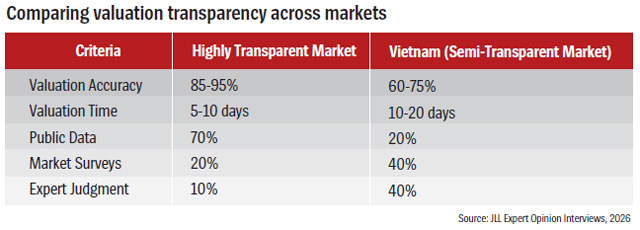
However, the combined weight of these three factors is only around 55 per cent, while the first indicator - performance measurement - accounts for 25 per cent of the total and is an area where Vietnam has seen little improvement. “This suggests that to enhance transparency, the primary focus should be on these initial factors, as they carry significant weight and are crucial for improving the country’s ranking,” Mr. Phuoc said.
Based on the experience of more advanced markets, JLL believes the roadmap to bring Vietnam closer to Transparent Market status will continue to focus on six key areas: completing land record digitization; establishing a unified nationwide real estate registration system; adopting IPMS; publishing data on the commercial real estate credit market; promoting green building certification linked to master planning and clear databases; and strengthening disclosure requirements for listed companies.
JLL noted that amid increasing global economic and geopolitical uncertainty, real estate market transparency has become more important than ever for investors, especially as factors such as AI applications, capital reallocation into structural growth segments, energy security, and credit market transparency are reshaping investment decision-making globally.





![[Interactive]: Economic overview - September 2026](https://premedia.vneconomy.vn/files/uploads/2026/10/06/9e0f403040dd4384ad690004bc1911ab-124594.png?w=400&h=225&mode=crop)
 Google translate