


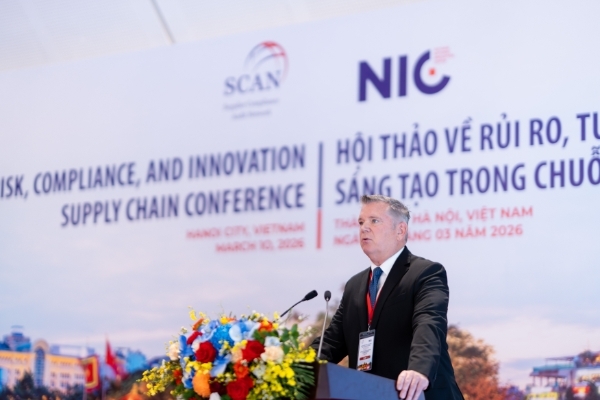
At the Risk, Compliance, and Innovation Supply Chain Conference, held in Hanoi on March 10 by the National Innovation Center, in coordination with the Supplier Compliance Audit Network (SCAN), discussions were focused on social responsibility and cybersecurity of export enterprises.
In the ever-evolving landscape of global trade, compliance with social responsibility and cybersecurity has transitioned from being optional to a fundamental requirement for Vietnamese enterprises aiming to maintain their foothold in key markets such as the United States and the European Union.
According to experts from the Supplier Compliance Audit Network (SCAN), these elements are now essential for businesses to thrive in these demanding markets.
Social responsibility compliance - a key to tightly regulated markets
By 2025, Vietnam's import-export landscape has reached record figures, with a total turnover of $930.05 billion, of which exports account for $475.04 billion. The United States remains Vietnam's largest export market, with a turnover of $153.2 billion. However, to sustain this export flow, businesses face unprecedented pressure from new legal regulations. The shift in purchasing mindset among major importers is becoming increasingly evident, especially amid geopolitical uncertainties and tightened technical barriers.
Mr. Do Tien Thinh, Deputy Director of the National Innovation Center (NIC), emphasizes that goods aiming for key markets must not only be of high quality but also "ethical and transparent." This means that products must meet high standards of human rights, free from forced labor and child labor, and ensure occupational safety and hygiene conditions.
The shift from voluntary to mandatory social responsibility compliance in many countries means that businesses unable to demonstrate transparency in their supply chains risk having their goods detained at customs, resulting in significant financial and reputational damage. Participation in networks like SCAN helps Vietnamese enterprises build trust with buyers, enhance competitiveness, and secure long-term cooperation opportunities.
SCAN, a global non-profit organization with 63 members and an annual revenue totaling $2 trillion, includes giants like Walmart, The Home Depot, and Amazon. It has been implementing the Social Compliance Assessment Program to support manufacturing plants. This program not only alleviates "audit fatigue" by sharing assessment data among members but also helps businesses save significant costs. In 2025, SCAN's program saved members over $15.6 million in assessment costs and reduced hundreds of tons of CO2 emissions by optimizing inspection processes.
Ensuring data security
However, for the social compliance assessment and inspection process to be swiftly implemented, data sharing among members must be secure to ensure the stable operation of the supply chain. In the digital era, cyberattacks targeting logistics infrastructure and trade data are increasing in sophistication. In 2025 alone, there were at least 32 large-scale global cyberattacks in the maritime sector, disrupting operations at major ports from Italy to Nigeria.
According to Mr. Carlos E. Ochoa, CEO of SCAN, trust is the "passport" in global trade. To build this trust, data must be securely shared among stakeholders. SCAN's cybersecurity program focuses on protecting computers, networks, and data from unauthorized access or destruction through a range of physical, technical, and organizational safeguards.
Current cybersecurity standards require businesses to have clear written policies, conduct regular inventory and destruction of sensitive data storage devices weekly, use virtual private networks (VPNs) for remote employees, and especially back up data weekly in encrypted form. The use of unlicensed software is also a serious risk closely monitored by SCAN and U.S. importers.
A breakthrough in ensuring the immutability of assessment records is SCAN's application of blockchain technology. Mr. Dan Purtell, Director of Innovation and Technology at SCAN, highlighted that blockchain enhances trust and data transparency by providing a decentralized ledger, effectively preventing the sharing of fraudulent audit reports. All factory assessment results are recorded on blockchain platforms like Ethereum, allowing importers and regulatory agencies to verify data authenticity almost instantly. This is particularly important as the U.S. Customs and Border Protection (CBP) has signed an MOU with SCAN, allowing CBP access to SCAN's assessment data repository for risk assessment in the CTPAT (Customs-Trade Partnership Against Terrorism) program.
Implementation challenges for Vietnamese enterprises
Currently, the number of Vietnamese enterprises participating in SCAN's network is limited, but this number is on the rise (SCAN's assessments in Vietnam increased to 15% in 2025, up from 10% in 2024). In the context of new regulations from key export markets soon to be applied, customs experts recommend that Vietnamese businesses proactively take three steps to avoid being left behind.
Ms. Nguyen Khanh Hong, Expert of the Authorized Economic Operator (AEO) Program of the World Customs Organization (WCO), suggests:
Firstly, comprehensive digital transformation is necessary not only to optimize productivity but also to build a digital "production log" system (blockchain) to prove the origin of labor and materials immutably.
Secondly, serious investment in internal control systems is needed, aligning with the recommendations of the WCO's SAFE Framework of Standards and Vietnam's amended Customs Law No. 90/2025/QH15.
Thirdly, participating in international compliance networks like SCAN to reduce assessment costs and gain recognition from business partners and international customs authorities.
"In the new era of trade, compliance and transparency are no longer cost burdens but the greatest assets for businesses to confidently and sustainably enter the global market," said Ms. Nguyen Khanh Hong.


 Google translate