


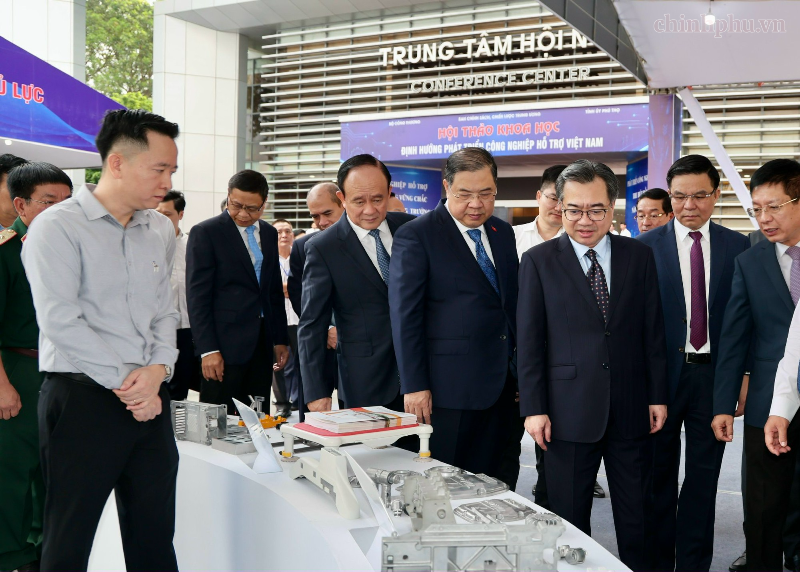
Amid demands to renew the national growth model, accelerate industrialization and modernization, and upgrade domestic production and technological capacity, supporting industries are not secondary elements, but rather foundational pillars shaping national industrial strength.
Mr. Nguyen Thanh Nghi, Politburo member and Head of the Central Commission for Policy and Strategy Commission, emphasized this imperative during the national scientific conference titled "Orientations for Developing Vietnam’s Supporting Industries," held on September 30.
"A robust industry is not measured solely by production output and end-product export volumes, but more critically by the capacity to master advanced materials, components, equipment, core technologies, design, technical standards, specialized services, and high-value-added segments," Mr. Nghi said, as quoted by the Government News.
According to the official, ambitious national growth targets—paired with a series of strategic infrastructure projects spanning high-speed rail, energy, defense and security industries, digital infrastructure, data centers, electronics, automotive manufacturing, mechanical engineering, and emerging tech sectors—will generate immense domestic demand for materials, equipment, components, and specialized engineering services.
If domestic supply capabilities scale up accordingly, this procurement demand will cultivate homegrown technology enterprises and domestic supply chains. Conversely, if rising demand continues to be met overwhelmingly through imports, expansion in top-line economic scale will fail to translate into durable endogenous capability.
Against this backdrop, Mr. Nghi urged shifting the strategic focus from merely "having products" to "possessing capabilities." He called for placing enterprises at the center of the supporting industry ecosystem and transitioning from rigid category-based support lists to supply chain-, order-, and outcome-driven support mechanisms.
Alongside maximizing the private sector's role, foreign direct investment (FDI) attraction must shift decisively toward higher quality, operational efficiency, and spillover impacts. Advanced technology, research and development (R&D), high-skilled workforce development, and meaningful linkages with domestic suppliers must be established as core benchmarks of investment effectiveness.
Vietnam must also prioritize strategic industries and critical technologies. Beyond upgrading existing supporting supply chains, the country needs to proactively build capabilities across emerging frontiers—such as semiconductors, artificial intelligence, robotics, industrial automation, advanced materials, batteries and energy storage, unmanned aerial vehicles (UAVs), aerospace, and smart manufacturing.
Simultaneously, the country must construct internationally standardized, shared industrial and technical infrastructure, while reforming state support instruments to be targeted, conditional, and performance-tied.
Mr. Nghi underscored that industrial autonomy does not imply domestic self-sufficiency across every single component. In an open economy, strategic autonomy means the capacity to select, master, and control strategic core capabilities, while securing diverse and resilient supply sources for essential inputs and leveraging domestic strengths to establish Vietnam as an indispensable node within regional and global supply chains.
Moving forward, he urged conference participants to address three fundamental questions: Which core industrial capabilities must Vietnam decisively master during the 2026–2030 period, with a vision toward 2045?; What structural bottlenecks are hindering domestic enterprises from upgrading their positions within global value chains?; and How should coordination mechanisms among the State, lead anchor corporations, supporting manufacturers, research institutes, and universities be designed to transform market demand into tangible domestic production capacity?






 Google translate