


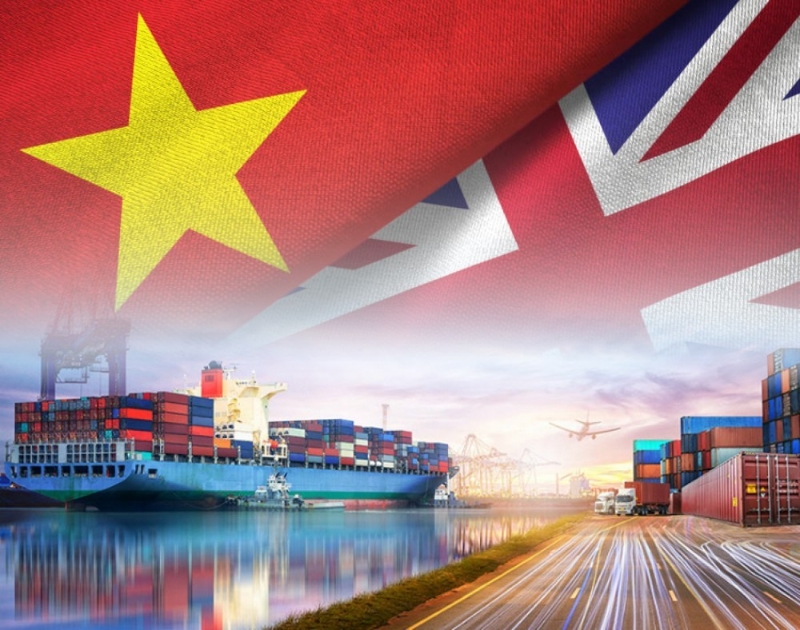
The UK’s accession to the Comprehensive and Progressive Agreement for Trans-Pacific Partnership (CPTPP) last weekend, following five years of negotiations since it first expressed an interest in joining, was a fantastic result, H.E. Iain Frew, British Ambassador to Vietnam, told a webinar entitled “The UK’s Accession to CPTPP - Opportunities for Businesses in Vietnam”.
Co-organized by BritCham and the British Embassy in Vietnam and hosted by Chairman and CEO of KPMG Vietnam, Warrick Cleine, on July 20, the webinar aimed to explore the potential benefits for British businesses in Vietnam following the UK’s official membership of the CPTPP. The move opens up new horizons for businesses, presenting myriad opportunities for growth and cooperation across the Asia-Pacific region. CPTPP membership grants the UK access to a dynamic network of 12 economies, enhancing its trade and investment prospects. Emphasizing sustainable practices, the partnership aligns with the UK’s commitment to responsible trade and bolstering environmental and labor protection efforts.
Noting that the UK’s accession to the CPTPP took place during the 50th anniversary of diplomatic relations between Vietnam and the UK, the British Ambassador expressed his appreciation of Vietnam’s role as a consistent supporter of the UK membership of the agreement.
“In fact, the Vietnamese Government and people have been very supportive throughout, and I would say that represents a kind of continuity in cooperation in terms of trade,” he said. “It goes back many decades. And as many of you know, until the CPTPP, our greatest achievement was the UK-Vietnam Free Trade Agreement (UKVFTA), which has been in force for several years now. In addition to that bilateral trade agreement, the relationship between the two countries has continued to broaden and deepen across a range of areas, such as climate and sustainability, energy transition, security and defense, regional issues, and migration challenges, etc. I’m delighted to see the bond between the UK and Vietnam continuing to deepen, both in the political context and in these kinds of agreements.”
With the UK’s accession, the CPTPP will have a combined GDP of £12 trillion ($15.4 trillion) and truly become a global progressive agreement. It’s truly exciting because of the amount of potential, as Southeast Asia and the Indo-Pacific region are actually some of the most rapidly-growing regions in the world, noted Mr. Harry Rawicz-Szczerbo, Head of Trade and Investment at the British Embassy.
In terms of key CPTPP benefits for the UK, he went on, by becoming the first European member to join the agreement the UK will have wider access to the Indo-Pacific region and the Americas. Joining will play to British strengths and unlock opportunities for its globally-respected services and digital sectors, which employ over 80 per cent of the UK’s workforce. The agreement will also encourage investment between the UK and other CPTPP members.
Regarding trade benefits, over 99 per cent of current UK goods exports to the CPTPP will be subject to zero tariffs. British exporters to Vietnam will have access to the same tariff preferences that Vietnam grants to CPTPP members, with benefits beyond the existing UKVFTA. There are also benefits in terms of Rules of Origin provisions, which deepen the UK’s participation in supply chains and diversifies its trade. In particular, the CPTPP allows for cumulation, which allows traders to cumulate content from other CPTPP members without losing their originating status of their final products from the purposes of application of preferential tariffs.
Vietnam also benefits from the UK’s accession to the CPTPP, notably in traditional areas such as goods, said Mr. Rawicz-Szczerbo. For example, Vietnam will have greater market access on some agricultural products, such as rice and seafood. The CPTPP will help to reinforce mutual economic security by creating regional supply chains and deepening everyone’s participation in them, which is quite exciting and beneficial for Vietnam and also for the membership as a whole. The CPTPP also represents potential to support investment. The UK in Vietnam already has existing commitments under the ongoing UK-Vietnam agreement in the area of investment but the CPTPP will push these commitments even further. In terms of services, the CPTPP helps recognize the vital role of the digital economy and trade in services. There will be further opportunities for remotely delivered services between the UK and Vietnam.
In terms of sectors expected to see the biggest wins for UK businesses in Vietnam and other CPTPP countries and vice-versa, he highlighted life sciences, particularly healthcare and pharmaceuticals. Automotive is also considered as an exciting sector of potential in terms of accumulation of content, as well as services, particularly financial and fintech services.
Ambassador Frew also noted that Vietnam is on a development curve and is actually moving from a lower value-added manufacturing sector to a higher value-added industry. In doing so, it needs all sorts of increasingly sophisticated forms of manufacturing, and its economy needs to be built in order to take advantage of the technologies.
“This presents opportunities for UK firms, with the CPTPP and its future evolution helping us in the digital services area,” he said. “Furthermore, as some of the bigger Vietnamese corporates think about their international profile and markets in which they want to invest as well as sell to, I think the UK is an attractive destination. And the CPTPP is going to help us build some partnerships. We are probably in an early stage of that journey, but I believe that the CPTPP provides a really good basis.”

 Google translate