


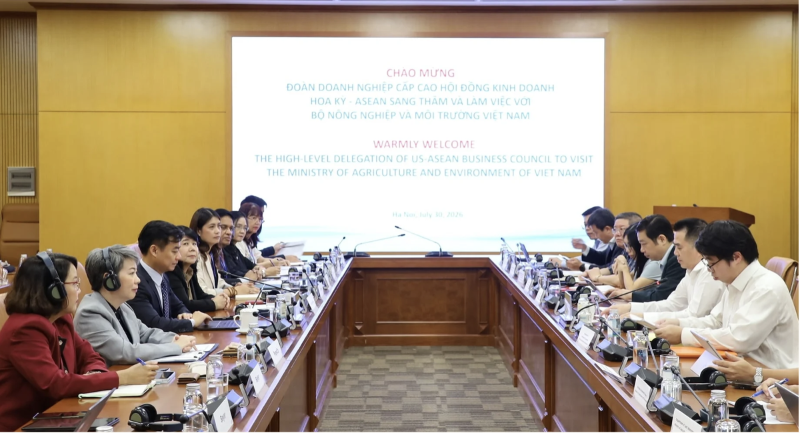
A high-level delegation from the Agriculture and Food Committee of the US-ASEAN Business Council (USABC) on July 30 held a working session with the Ministry of Agriculture and Environment (MAE) to discuss solutions for boosting cooperation and business investment in Vietnam.
Speaking at the meeting, Vice Minister of MAE Dang Ngoc Diep affirmed that the ministry is committed to supporting and creating favorable conditions for the business community—including US enterprises—to invest and grow sustainably in Vietnam.
Representing the USABC delegation, Acting Regional Managing Director & Chief Country Representative of Vietnam for the USABC, Mr. Vu Tu Thanh, acknowledged Vietnam’s recent institutional reform efforts. However, he noted that certain bottlenecks remain in the implementation process, leading to increased time and compliance costs for businesses.
Participating enterprises emphasized the need for regulations to be more synchronized, transparent, and predictable. They also called for the simplification of administrative procedures, the acceleration of digital transformation in document processing, and the assurance of consistency in enforcement across different regulatory agencies.
Beyond administrative hurdles, many companies expressed a strong interest in expanding cooperation to implement low-emission and climate-resilient agricultural models. Proposals were also made to resolve issues related to seed imports, market access, and plant quarantine, as well as to refine mechanisms and policies for emerging agricultural technologies.
Addressing these concerns, Mr. Phan Quang Minh, Deputy Director of the Department of Livestock Production and Animal Health, informed businesses that the ministry is currently perfecting its electronic management systems. These systems are expected to be officially operational by August 2026. Additionally, the ministry is reviewing and updating specialized regulations to further facilitate production and business activities.
Ms. Nguyen Thi Thu Huong, Deputy Director of the Department of Crop Production and Plant Protection, urged businesses to share specific technical difficulties regarding seed imports to ensure timely resolution. She also requested a list of target markets to allow the department to coordinate with the plant protection agencies of importing countries in building technical dossiers and accelerating market access negotiations.
In the environmental sector, Mr. Le Hoai Nam, Deputy Director of the Environment Department, stated that many recommendations have been incorporated into the revision of legal documents. Notably, policies on green credit, incentives for manufacturing recycled materials, the Extended Producer Responsibility (EPR) deduction mechanism, and the roadmap for adjusting recycling targets are being finalized to better align with practical realities.



 Google translate