


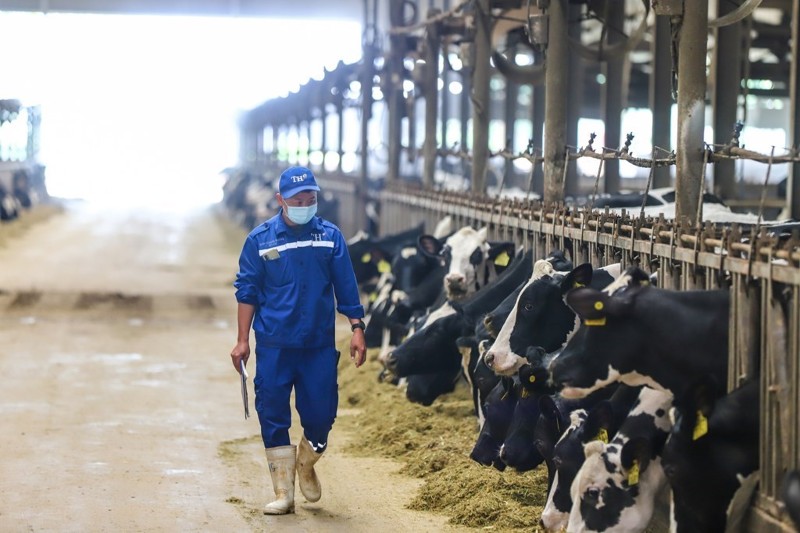
Vietnam aims to significantly boost its domestic raw milk self-sufficiency and optimize production costs to build a sustainable dairy processing industry, as highlighted during a conference, held in Hanoi by the Ministry of Industry and Trade on October 8, to disseminate the Vietnam Dairy Industry Development Strategy through 2030 with a Vision to 2045.
At the event, State management representatives and business leaders agreed that securing domestic raw milk supply serves as the cornerstone for the long-term growth of the national processing sector.
The newly unveiled national strategy outlines specific technical metrics, targeting domestic raw milk supply to reach 2,600 million liters by 2030 and 8,000 million liters by 2045.
Correspondingly, domestic raw material self-sufficiency for processing must rise from 60 to 65 percent by 2030 to 80 to 85 percent by 2045. To realize these ambitious goals, expanding dairy herd sizes and enhancing farming productivity have been identified as decisive solutions.
However, as dairy producers accelerate expansion, land availability for farm infrastructure and feed cultivation presents the primary bottleneck for concentrated cattle farming operations. Industry giants report an urgent need for land allocation.
For instance, TH Group currently manages 80,000 dairy cows with plans to expand to 150,000 head. Given the extensive land required for forage crops, the enterprise proposed that authorities consider regulatory mechanisms allowing low-efficiency agricultural land to be converted into pasturelands for livestock feed production.
Alongside land constraints, smallholders and farming cooperatives tied to enterprise off-take agreements face rising input costs and local zoning pressures.
At Moc Chau Dairy Cattle Breeding JSC, local tourism development has directly encroached upon raw material farming areas. Reduced farmland combined with fixed off-take price commitments increases corporate input expenses while limiting immediate consumer price adjustments. These operational realities underscore the need for dedicated zoning policies to safeguard supply chain sustainability.
Despite spatial constraints, large Vietnamese dairy groups maintain strong international cost competitiveness.
According to the Vietnam Dairy Association, raw milk production costs in New Zealand average between $0.31 and 0.33 per kilogram, whereas closed-loop integrated producers in Vietnam such as Vinamilk and TH True Milk achieve comparable costs of $0.30 to 0.32 per kilogram. Conversely, smallholders and cooperatives require targeted state financial support for breeding stock, grass acreage, and feed processing technology to remain viable.
To ensure long-term raw material security, domestic producers are expanding farming footprints into neighboring countries. Strategic orientation encourages Vietnamese firms to invest in high-potential markets like Laos and Cambodia, leveraging regulatory frameworks such as the 2015 Vietnam-Laos Border Trade Agreement to import tax-free raw materials. Concurrently, government agencies are working to streamline quarantine procedures and optimize tariff corridors to facilitate raw milk imports from overseas farms operated by domestic firms in Russia, Australia, and the United States.
At the market oversight level, Deputy Director General of the Domestic Market Surveillance and Development Department (the Ministry of Industry and Trade), Mr. Nguyen Thanh Binh, revealed that market management forces handled nearly 200 dairy violations from 2025 through the first quarter of 2026, imposing administrative fines exceeding VND1.8 billion ($72,000) and confiscating non-compliant goods valued at over VND1.7 billion ($68,000).




 Google translate