


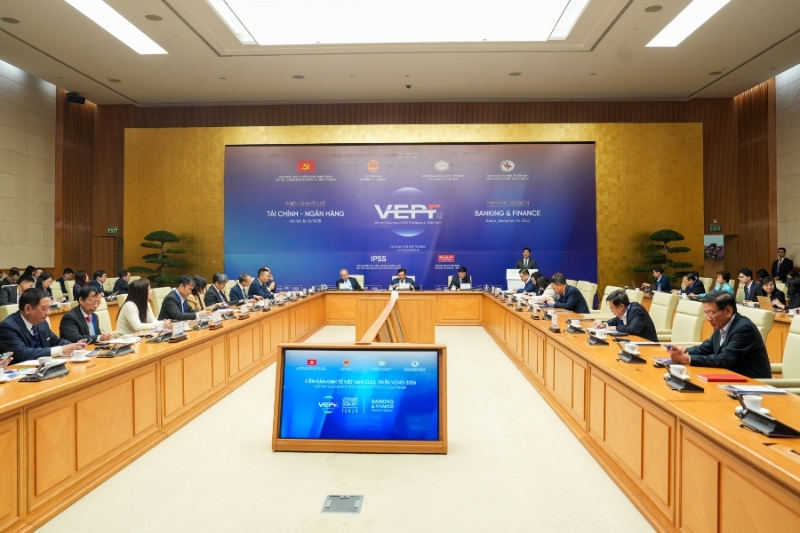
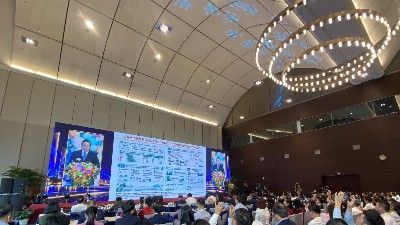
The Vietnam Economy in 2025 and Prospects in 2026 Forum (VEPF) was held in Hanoi on December 16, with the Government and the Party Central Committee’s Commission for Policies and Strategies acting as co-host.
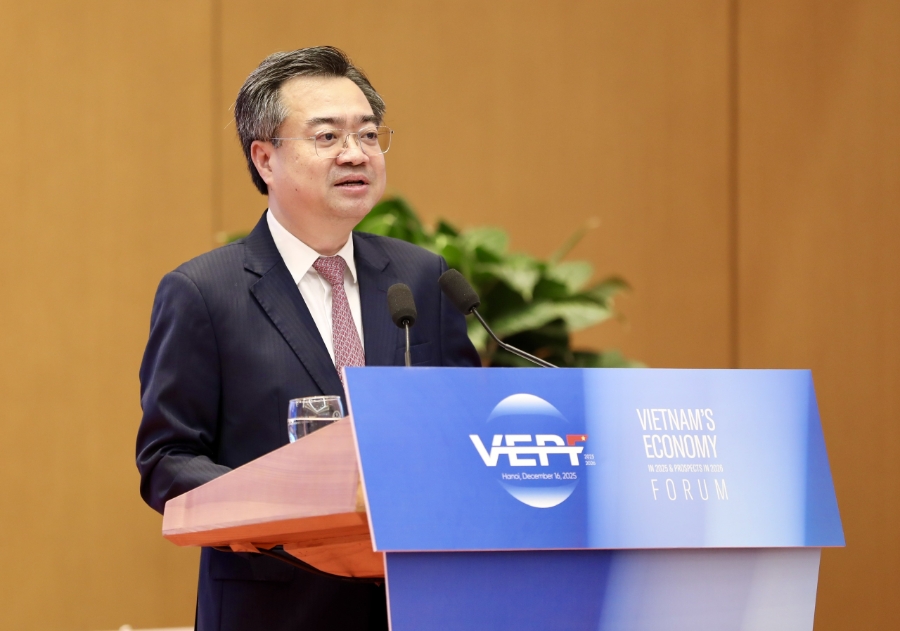
In his opening speech, Mr. Nguyen Thanh Nghi, member of the Party Central Committee and Chairman of the Party Central Committee's Commission for Policy and Strategy, stated that the VEPF is an important annual event that attracts the participation of policy-making agencies, the business community, diplomatic missions, international organizations, and research institutes.
The event this year attracted more than 500 delegates in person and over 1,000 online participants from all the 34 cities and provinces nationwide.
During the thematic session on finance and banking, discussions focused on solutions for financial resources and economic growth targets in the 2026-2030 period, with effective mobilization of financial resources identified as a key prerequisite for the country to realize its target of double-digit economic growth during the period.
In his remarks, Mr. Pham Thanh Ha, Deputy Governor of the State Bank of Vietnam, said that the Party and the State have set a target of achieving at least 8% economic growth in 2025 and moving towards double-digit growth in the 2026–2030 period.
This will provide a crucial foundation for Vietnam to join the group of upper-middle-income countries by 2030 and progress towards becoming a high-income country by 2045, according to Mr. Ha.
He noted that one of the decisive challenges for achieving high growth is ensuring sufficiently large capital resources for the economy, while using them efficiently to promote a growth model driven by science and innovation.
Meanwhile, Deputy Minister of Finance Do Thanh Trung affirmed that while mobilizing sufficient capital is a major task, allocating it to the right priorities and ensuring effective use to generate high added value must be given top priority.
Dr Can Van Luc, Chief Economist of BIDV and a member of the National Financial and Monetary Policy Advisory Council, for his part, presented a paper on breakthrough solutions to mobilize financial resources for high growth in the 2026–2030 period. He noted that the development model in the coming phase needs to shift from one that is heavily dependent on capital and labor to one driven more by science, technology, innovation, and productivity.
Participants reached a common agreement that the capital market needs to be developed as the primary channel for mobilizing medium- and long-term resources for the economy, easing pressure on the banking credit system. Strengthening coordination between fiscal and monetary policies is crucial to maintaining macroeconomic stability, controlling inflation and supporting high growth amid rising risks. In addition, significant improvements in the investment and business environment, together with institutional reform and the development of a stable legal framework, were identified as solutions to attract and retain long-term, high-quality financial resources.
At the session on the circular economy, Mr. Pham Dai Duong, Deputy Head of the Party Central Committee's Commission for Policies and Strategies, stressed that to realize strategic development goals, Vietnam needs a strong push to innovate its growth model. He said the new model must be sustainable, comprehensive and inclusive, focusing not only on speed but also on quality, efficiency and competitiveness. Its core lies in transformative shifts, including digital transformation to build a digital economy and digital society, and green transformation to ensure harmonious development with nature, adapt to climate change, and fulfill international commitments, particularly the goal of achieving net-zero emissions by 2050.
He affirmed that digital and green transitions are objective requirements of development. These two processes are closely interconnected and mutually reinforcing, forming a “dual transition” that will serve as a global growth driver for decades to come. He also highlighted that the circular economy, as a key driver of green transformation in the digital era and closely linked with science, technology, innovation and digital transformation, has been identified as a strategic pillar of the new growth model.
Meanwhile, Deputy Minister of Agriculture and Environment Le Cong Thanh said Vietnam has established a relatively comprehensive orientation framework and legal corridor for the development of the green and circular economy. The merger of the Ministry of Agriculture and Rural Development with the Ministry of Natural Resources and Environment reflects a shift towards integrated management thinking based on ecological space, closely linking resources and climate, and creating an important foundation for promoting sustainable green economic development.
However, he noted that Vietnam’s green transition still faces numerous challenges, as many enterprises, cooperatives, and farmers continue to rely on traditional practices and face constraints in capital, technology, and governance capacity. Meanwhile, emerging markets such as carbon and biodiversity credit markets have yet to operate in a synchronized manner.
Ms. Francesca Nardini, Deputy Resident Representative of the United Nations Development Programme (UNDP) in Vietnam, for her part, said international forecasts indicate that the circular economy could help Vietnam reduce 30–34% of urban waste and cut 40–70% of greenhouse gas emissions during the 2030–2060 period, while creating jobs and reducing dependence on imported raw materials. She added that UNDP recommends implementing the circular economy through pilot models to quantify risks and benefits before scaling up.
Experts at the Forum agreed that green transformation and the circular economy represent the only viable path for Vietnam to achieve high growth in tandem with sustainable development in the digital era.
The potential and measures for advancing the circular economy were also the focus at a panel discussion of the forum.
A representative of the United Nations Development Programme (UNDP) was quoted by the Vietnam News Agency as saying that Vietnam still has substantial room to improve resource efficiency, cut waste, and promote industries that create green value. The consumer plastics sector, for example, generates large volumes of plastic waste but has yet to fully utilize these materials, while the country continues to import significant quantities of scrap each year. Better use of domestic waste streams could considerably accelerate the development of the circular economy.
Vietnam generates around 25 million tones of solid waste annually, while agricultural by-products alone reach about 150 million tones—six times the volume of solid waste. If left unrecycled, these by-products represent a major economic loss. A similar problem could be seen in construction materials or industrial wastewater, according to the UNDP representative.
A representative of the United Nations Industrial Development Organization (UNIDO) said the organization has supported the transformation of six eco-industrial parks in Hai Phong, Dong Nai, Da Nang, Tay Ninh, and Bac Ninh, with both State-owned and foreign-invested enterprises participating in. The industrial symbiosis model offers strong potential as companies within the same zones can use each other’s waste as production inputs.
Early implementation faced challenges in terms of persuading businesses to engage in, reviewing legal frameworks, and assessing economic efficiency. Over time, however, understanding improved and tangible results emerged, the UNIDO representative stated.
Representing the domestic business sector, Mr. Ngo Minh Hai of TH Group said the company has pursued sustainable development from the outset as a core value aligned with public health and environmental protection. TH’s investments focus on high and green technologies, with closed-loop chains in dairy processing. The group has replaced fossil fuels with biomass boilers and expanded the use of solar power to support clean energy.
Investment in the circular economy, Mr. Hai noted, helps lower costs by optimizing material inputs.
Mr. Hoang Manh Cam, head of strategy at the Vietnam National Textile and Garment Group, said weaker consumer demand has reduced per-capita consumption, pushing the industry to shift towards higher-value niches and extend product life cycles, including in the second-hand market. The firm is also upgrading older machinery to extend equipment life and achieve cost savings.
Mr. Le Thanh Tung of the Vietnam Joint Stock Commercial Bank for Industry and Trade (VietinBank) said the bank has expanded green financial products by simplifying lending procedures, digitalizing access to credit, and integrating green criteria into credit decisions. Businesses meeting sustainability standards are prioritized, particularly in green agriculture.
VietinBank has also launched a green deposit program worth around VND10 trillion ($379.6 million) and pledged long-term support for enterprises undergoing a green transition, according to him.

 Google translate