


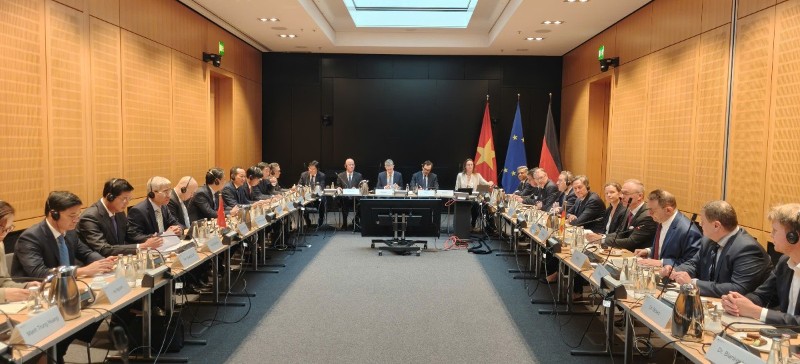
Vietnam values Germany’s strengths in science and technology, technical standards, safety management, the railway industry, export finance, and human resource development, and wishes to establish substantive, long-term communication channels between state management agencies and the business communities of both countries in the railway sector.
Vietnamese Deputy Minister of Construction Bui Xuan Dung made such a statement during a working sessions with German authorities and leading corporations, which took place as part of his delegation's working visit to Germany from September 21 to 22.
Among the German authorities and leading corporations attending the working session were Deutsche Bahn (DB), Siemens Mobility, the Federal Ministry for Digital and Transport, and the Federal Ministry for Economic Affairs and Climate Action.
At the event, the two sides exchanged experiences, and measures for fostering cooperation, and promoting technology transfer to support Vietnam's North–South High-Speed Railway Project.
Deputy Minister Dung noted that the North–South High-Speed Railway is a national mega-project, for which an investment policy had been approved by Vietnam’s National Assembly. Spanning approximately 1,541 km with a dual-track standard gauge of 1,435 mm and a design speed of 350 km/h, the projected line features 23 passenger stations and 5 freight stations, with fundamental completion slated for 2035.
According to the Deputy Minister, Vietnam is currently at a critical juncture in preparing the project’s feasibility study report. Therefore, researching and selecting technologies that are modern, synchronized, safe, efficient, and well-suited to conditions of Vietnam—alongside managing life-cycle costs, structuring project management, training human resources, and building independent operations and maintenance capabilities—will play a decisive role in ensuring the long-term effectiveness of the project.
He further noted that in the coming years, Vietnam will simultaneously execute several key railway projects, including the North–South high-speed line, international rail connections, and urban rail systems. He therefore urged German partners to explore substantive cooperation options with Vietnam that extend beyond supplying products, equipment, and services to embrace technology transfer, workforce training, the development of Vietnamese enterprises and supply chains, and the step-by-step establishment of their capacity to manufacture, operate, maintain, and master railway technologies in Vietnam.
During the visit, the delegation conducted a field inspection at Berlin Central Station (Berlin Hauptbahnhof) to study its operational model, station management, and multi-modal integration connecting high-speed rail, regional rail, and urban rail with other modes of public transit.
The delegation also attended InnoTrans 2026—the world’s leading international trade fair for transport technology and railways—which convened approximately 3,170 exhibitors from 59 countries.
At the trade fair, the delegation visited exhibition booths and engaged in direct discussions with leading rail industry enterprises, including Deutsche Bahn (DB), Siemens Mobility, Alstom, SNCF International, Vossloh, CRRC, and Škoda, along with infrastructure, signaling, and telecommunications solution providers such as Ericsson and PORR.
The enterprises shared operational expertise in high-speed rail management, infrastructure maintenance, train dispatching, safety protocols, supporting industry development, and training engineers and specialists for operations and maintenance.


 Google translate