


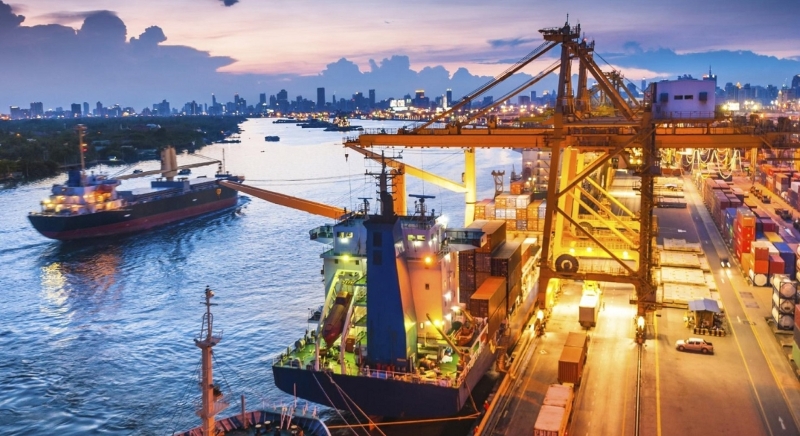
Vietnam's total import-export turnover continued to grow positively in the first half of April 2026; however, the trade balance recorded a deficit of $4.25 billion, the highest per-period level since the beginning of the year.
According to Vietnam Customs, this development reflects a surge in demand for production inputs while also contributing to pressure on the overall balance of payments.
Preliminary reports show that in the first half of April, total domestic import-export turnover reached approximately $47.37 billion, up 14.89% compared to the first half of March 2026. By the end of mid-April 2026, the total trade value this year reached $297.06 billion, a 22.83% increase over the same period in 2025.
Regarding exports, the total value in the first half of April hit about $21.56 billion, up 5.94% compared to the first half of March, bringing the cumulative export turnover this year by the end of mid-April to $144.58 billion—a 20.86% year-on-year increase.
Although the growth was not dramatic, the export structure showed notable shifts among commodity groups. The processing and manufacturing sectors continued to play a leading role with many large-scale items.
Sustained export growth within the Foreign Direct Investment (FDI) sector indicates that these enterprises are stabilizing production and effectively capitalizing on international orders.
On the import side, the total value for the first half of April reached approximately $25.81 billion, a 23.61% jump from the first half of March. From the beginning of the year to mid-April, cumulative import value hit $152.48 billion, up 28.83% year-on-year.
Imports remained largely concentrated in production materials and raw inputs, underscoring Vietnam's role in the global production chain.
In the context of supply chain disruption risks and geopolitical fluctuations, there is a clear trend of increasing input stockpiles to ensure production schedules. This surge in imports may signal a recovery in export orders in the coming periods.
Overall, trade in the first half of April 2026 followed two parallel trends: maintaining a foundation in the processing and manufacturing industries while being significantly impacted by fluctuations in the high-tech and energy sectors.
In the short term, export turnover could improve rapidly if global market demand recovers and major corporations ramp up production. However, in the long term, the heavy reliance on the FDI sector and a few key industries remains a challenge, requiring Vietnam to diversify its export structure and enhance the capacity of domestic enterprises to achieve more sustainable growth.





 Google translate