


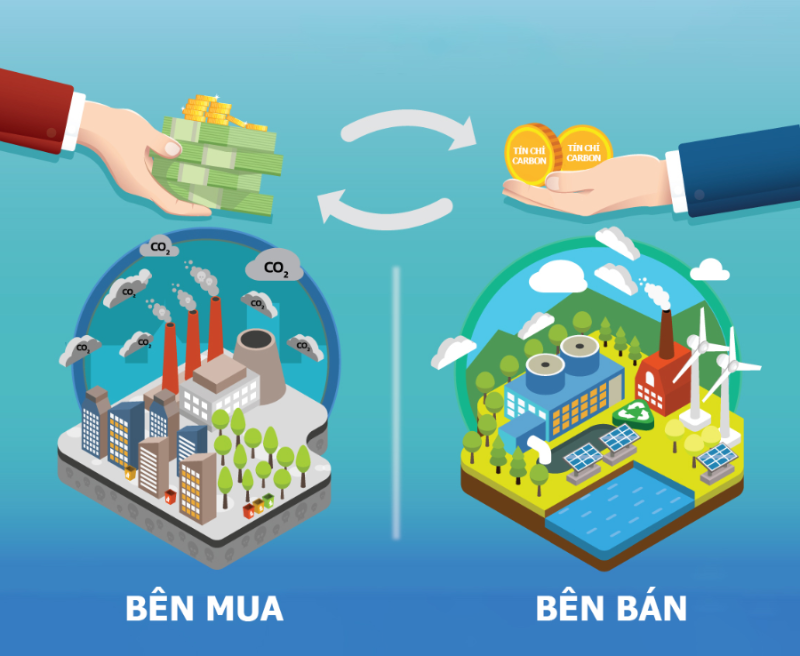
The Government has issued Decree No. 112/2026/NĐ-CP, to be effective from May 19, 2026, establishing the first legal framework for the international exchange of greenhouse gas (GHG) emission reduction results and carbon credits within the scope of the Paris Agreement.
Regarding transfer ratios, the Decree is designed to simultaneously attract investment and ensure the fulfillment of national GHG emission reduction commitments. Under the new regulations, various emission reduction activities are specifically classified and linked to international transfer limits.
For the category of GHG reduction measures and activities involving new, high-cost technologies that have seen limited implementation in Vietnam, the maximum transfer ratio is set at 90%.
Specifically, this 90% rate applies to programs and projects such as geothermal power, offshore wind, off-grid solar power under 15MW, wave and tidal energy, and the production of green hydrogen, green ammonia, and methane biogas.
This group also encompasses the application of Carbon Capture, Utilization, and Storage (CCUS) or Carbon Capture and Storage (CCS) technologies in industrial processes, construction materials production, and energy sectors; direct air capture of CO2; waste-to-energy incineration; landfill gas recovery and utilization; and biofuel production.
Meanwhile, a maximum transfer ratio of 50% applies to measures and activities that have already been deployed in Vietnam but require additional financial and technological support.
This 50% limit is designated for programs and projects such as combined cycle gas turbine (CCGT) power using imported LNG, biomass power, nearshore wind, and renewable energy or energy efficiency projects previously registered under the Joint Crediting Mechanism (JCM) or transitioned from the Clean Development Mechanism (CDM) to the Article 6.4 mechanism (Paris Agreement).
In cases where international transfers do not involve a corresponding adjustment, the maximum transfer ratio is fixed at 90% of the total GHG emission reduction results or carbon credits issued for a specific reporting period across all categories of programs and projects.
The issuance of Decree 112 is considered a significant step toward Vietnam’s deeper integration into the global carbon market, while simultaneously establishing a legal corridor for businesses to access green finance and emission reduction technologies in the coming period.



 Google translate