


In the summer of 2026, Pizza 4P’s, a Vietnam-born restaurant brand, will open its doors in Brooklyn, New York - one of the world’s most competitive dining markets. For the brand, the move reflects a broader ambition to bring a philosophy shaped in Vietnam to a global audience. Founded in Ho Chi Minh City in 2011, Pizza 4P’s has grown across Asia by blending Japanese hospitality with a strong focus on sustainability and community. Its arrival in New York marks a milestone not just for the company but for Vietnam’s increasingly outward-looking food and beverage (F&B) sector.
At almost the same moment, meanwhile, a very different story is unfolding back home. Burger King, one of the world’s most recognizable fast food chains, has quietly exited Hanoi after more than a decade of operations. Its remaining footprint in Ho Chi Minh City has shrunk to just a handful of outlets. Online ordering channels have gone dark. A once-promising expansion has turned into a steady retreat.
And in Hanoi’s Old Quarter, another chapter has closed. Moca Dining, a fine-dining restaurant that had operated for 30 years and built a loyal following with its Indochinese-inspired ambiance and fusion menu, has shuttered without fanfare. Its farewell message spoke not of failure but of memories of a journey that had simply reached its end.
Those three stories have had very different outcomes, but together they point to a deeper shift: Vietnam’s F&B sector is not just growing, it is being fundamentally reshaped.
Growing market, uneven outcomes
Vietnam’s F&B market is projected to reach around $80 billion by 2030, growing at approximately 8-10 per cent annually, according to the “Winning Vietnam’s F&B Transformation 2026-2030” report from transcosmos. However, growth at the market level has not translated evenly across businesses. The report indicates that only about 14.7 per cent of F&B operators recorded revenue growth. This divergence suggests that demand remains intact, but performance is increasingly uneven.
The imbalance has led to what industry participants describe as a restructuring phase. Rising costs, tighter cash flow, and operational inefficiencies have forced weaker operators to exit, particularly during 2025, which has been characterized as the year of “purification”.
The economics of operating F&B outlets in major cities have become more challenging. According to the report, opening a new restaurant can require investment of $120,000-150,000 per outlet, while rental costs in central Ho Chi Minh City range from $120-150 per sq m. These figures increase the financial risk associated with expansion.
At the same time, input costs continue to rise. Wage growth, higher raw material prices, and regulatory compliance requirements, including e-invoicing and stricter food safety standards, have added to operating expenses.
As a result, expansion through physical footprint is no longer the primary growth strategy for many operators. Instead, nearly 68 per cent of surviving businesses are focusing on restructuring, with an emphasis on improving efficiency, cash flow, and operational discipline. This shift has implications for both domestic and international players. Standardized expansion models, particularly those dependent on high fixed costs, are becoming harder to sustain in the current environment.
Advantages of scale
The restructuring process is creating clearer distinctions between different types of operators. Chain and franchise models are gaining an advantage due to their ability to centralize procurement, standardize operations, and leverage shared marketing. These factors contribute to measurable efficiencies, including lower cost of goods sold, improved labor productivity, and reduced waste through data-driven inventory systems.
By contrast, independent operators face more constraints. The report highlights rising wages, raw material inflation of 12-15 per cent, and declining outlet numbers, particularly in major urban centers. The result is a gradual consolidation of the market, with scale and operational systems becoming more important determinants of competitiveness.
Changes in consumer behavior are reinforcing these structural trends. Delivery services are expanding rapidly, with gross merchandise value (GMV) projected to increase from $1.8 billion to $9 billion over the years to come. While dine-in remains dominant in terms of market share, its growth rate is comparatively slower.
The expansion of delivery is closely linked to the dominance of digital platforms. GrabFood and ShopeeFood account for the majority of transactions, and platform participation has become a prerequisite for market access.
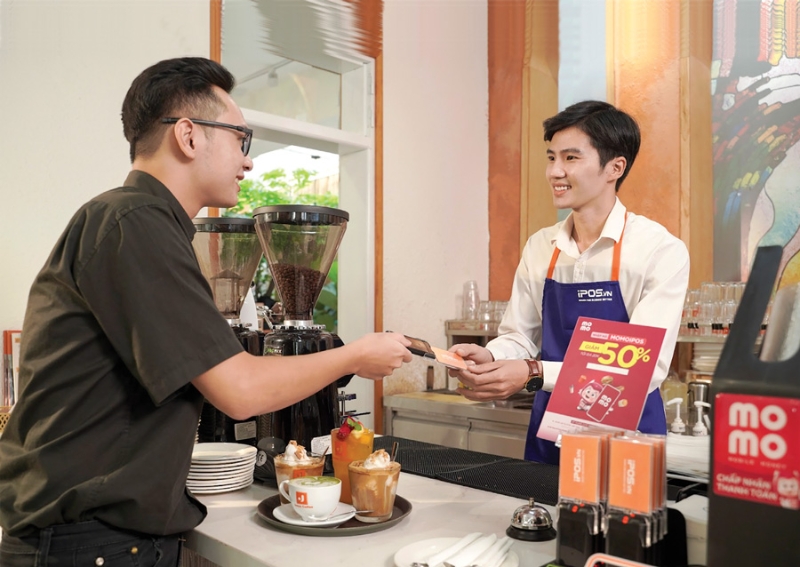
The report notes that around 53 per cent of consumers actively use food delivery platforms, while 75 per cent rely on e-wallets or QR-based payments. Digital ordering is increasingly integrated into everyday consumption patterns.
This shift has altered competitive dynamics. Visibility within platform ecosystems, through rankings, ratings, and fulfillment speed, has become a key factor in driving demand. Up to 80 per cent of customer discovery occurs within apps rather than through traditional marketing channels. For businesses, this creates a dependency on platform algorithms and fee structures, which can affect margins and limit direct customer engagement.
Reshaped by new models
In response to rising costs and shifting consumer expectations, a range of new operating models is gaining traction across Vietnam’s F&B sector.
Among the most prominent is the cloud kitchen model, which enables businesses to operate delivery-only brands without the need for prime retail locations. Startup costs can be reduced to between $30,000 and $50,000 - significantly lower than traditional dine-in formats - while a single kitchen can support multiple virtual brands.
The model has attracted increasing investment, with operators such as CloudEats and Air Kitchen expanding their presence in recent years. However, the economics remain challenging. Platform commission fees of 25-35 per cent can compress margins, while operators typically require high order volumes to break even. In addition, reliance on delivery platforms limits ownership of customer data and brand visibility, making differentiation more difficult.
At the same time, hybrid concepts are emerging as traditional café operators move into full-service dining. Brands such as The Running Bean and Trung Nguyen Legend have expanded beyond beverages to offer broader menus, aiming to increase average spending per customer. The approach reflects growing demand for combined work, dining, and social spaces.
However, the transition is not without trade-offs. Food typically carries lower margins than beverages, while kitchens require additional space and staffing. The report notes that profitability can decline as operators balance F&B offerings, and there is a risk of brand dilution if the core identity becomes less distinct.
Another model gaining attention is farm-to-table, driven by rising consumer interest in food safety, traceability, and sustainability. Some operators are developing closer relationships with farms or adopting integrated “farm-food-factory” (3F) systems to shorten supply chains and improve quality control.
Examples include Pizza 4P’s partnerships with local farms and closed-loop sourcing initiatives, as well as smaller-scale operators building brand narratives around ingredient origin. These approaches can support premium pricing and stronger customer loyalty, particularly among urban consumers.
Yet the model also presents operational challenges. Agricultural supply remains subject to seasonality and weather conditions, while investments in cold-chain logistics and certification can increase costs in the short term. Smaller producers may also struggle to ensure consistent volume and quality, limiting scalability.
Shifting preferences
Consumer preferences are also becoming more differentiated. Convenience remains a primary driver. The report indicates that 74 per cent of consumers prioritize time-saving and efficiency over price alone. This trend supports the continued growth of delivery and digital ordering.
Health and sustainability are gaining importance as well. Approximately 75 per cent of consumers prioritize health-related factors, and a majority are willing to pay a premium for products perceived as safe, organic, or ethically sourced.
In parallel, there is growing demand for higher-quality dining experiences. The introduction of Michelin recognition in Vietnam has contributed to increased spending in the premium segment, as well as a broader emphasis on quality and differentiation.
The current phase of restructuring is also creating a defined timeline for market entry. The report identifies 2026-2027 as a “golden window,” following a period of market consolidation in 2024-2025. During this period, weaker operators have exited, and competitive conditions are more favorable for new entrants. Beyond this window, as the market becomes more concentrated and regulatory and cost barriers increase, entry is expected to become more difficult.
For international brands, this presents both an opportunity and a challenge. Success will depend less on brand recognition alone and more on the ability to adapt to local conditions, manage costs, and operate effectively within platform-driven ecosystems.








 Google translate