



Completing infrastructure and unlocking capital flows - the two core pillars of the science, technology, and innovation ecosystem - are simultaneously receiving a powerful boost from public investment. Experience shows that most countries leading in science and technology have benefited from significant, large-scale, and sustained public investment.
In the US, foundational technologies such as the internet and GPS originated from publicly-funded programs before becoming the backbone of the digital economy. In China, large-scale investment programs in 5G infrastructure, data centers, and AI have helped create fertile conditions for businesses to grow. The common thread is that public investment is directed toward foundational fields that are high-risk and initially less attractive to private capital.
Funding and commercializing
Vietnam has recently taken similar steps. For the first time, resources for science, technology, innovation, and digital transformation have been prioritized on a large scale, with some VND95 trillion ($3.65 billion) expected from the State budget. This is not merely a matter of increasing spending. Investment policy is now aimed at ending fragmented allocation and concentrating resources on core technologies, with the goal of mastering advanced technologies and generating tangible breakthroughs.
A series of specific mechanisms and policies governing public investment funds have been issued since late 2025. Across these regulations, a spirit of accepting controlled risk to promote innovation has been embedded.
In October 2025, Government Decree No. 264/2025/ND-CP on the National Venture Capital Fund and local venture capital funds officially took effect. Deputy Minister of Science and Technology Bui Hoang Minh said the State would proactively invest and accept risk to accompany businesses, supporting research, technology development, and product commercialization.
By March this year, Decree No. 77/2026/ND-CP on the organization and operation of the National Technology Innovation Fund (NATIF) had expanded support instruments for the science, technology, and innovation ecosystem, ranging from grants and commissioned tasks to financial support for technology application, technology transfer, technological upgrading, and innovation. Notably, for projects that fail to meet objectives or incur asset losses but comply fully with regulations, the Fund will not seek reimbursement of disbursed capital.
Most recently, the Ministry of Science and Technology issued Decision No. 2103/QD-BKHCN dated April 13, 2026, approving the “Excellent Doctoral Research Support Program for 2026-2030”. Under the plan, some 100 outstanding doctoral candidates will be selected annually and granted research funding of up to VND1 billion ($38,460) per person per year for a maximum of three years.
Meanwhile, the Vietnam National Foundation for Science and Technology Development (NAFOSTED) continues to serve as the backbone of basic research funding through an internationally-benchmarked review mechanism, helping raise the quality and global integration of Vietnamese science.
A recent draft proposal to establish a National AI Development Fund, prepared by the Ministry of Science and Technology, also envisions capital in the tens of trillions of VND. The Fund would be established by the government, operate on a non-profit basis, remain outside the State budget, and be managed by the Ministry. It could finance up to 70 per cent of total project costs and support up to 50 per cent, depending on the nature and scale of each project.
Investing to complete infrastructure
At the same time, public investment is being accelerated across three critical layers of infrastructure. First is digital infrastructure. Vietnam has already adopted a development strategy extending to 2030. As of February, the country had deployed nearly 40,000 5G base stations, covering around 90 per cent of the population and serving nearly 23 million subscribers. Submarine fiber-optic cable networks have been identified as the backbone of international connectivity. Vietnam currently participates in six undersea cable routes with total capacity of 80 Tb/s and continues to invest in new links.

For computing and data infrastructure, policies encouraging the development and use of shared data resources are gradually being translated into action. National Data Center No. 1 has officially entered into operations, while National Data Center No. 2 is scheduled to break ground this year, creating an important data foundation for research and technology development. Major localities such as Hanoi are building AI data centers and shared cloud computing infrastructure, including projects at the Hoa Lac Hi-Tech Park, to support the AI and semiconductor sectors.
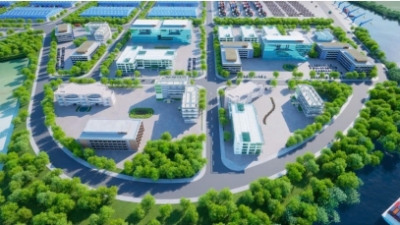
Regarding research and innovation infrastructure, high-tech parks, national key laboratories, and innovation support centers are being expanded. Vietnam is currently developing a plan to build a system of research centers, testing centers, and national laboratories for strategic technologies. The country has around 16 national key laboratories established over different periods. However, reports indicate that much of the equipment and facilities are outdated by two to three generations compared with international standards, weakening research, testing, and access to advanced technological directions.
Against this backdrop, the 2026-2030 period has been identified as a turning point for restructuring the nation’s science and technology infrastructure. The focus is no longer on expanding quantity, but on deep modernization through investment in, upgrading of, and the efficient operation of nine national key laboratories and three concentrated research and testing centers directly serving strategic technologies.
Under this approach, selected facilities will receive synchronized investment linked to eleven national strategic technologies. The State is also expected to apply special financial mechanisms, guaranteeing 100 per cent of regular operating expenditures during the first five years while targeting the creation of 20 strong research groups and the training of 1,000 PhDs tied to key investment programs.
Technology sectors are characterized by long investment cycles, high risk, and high failure rates - factors that often make private investors cautious in the early stages. This is precisely the gap public investment is meant to fill. However, experts note that the challenge lies not only in the scale of investment but also in coordination. If infrastructure is built without links to business demand, the risk of idle investment emerges, where facilities exist but remain underused due to a lack of companies and related research activity. Conversely, if funding alone is prioritized, the ecosystem may lack the technological, data, and infrastructure foundation needed for sustainable development.
Therefore, building key laboratories and innovation centers should not only serve research purposes but also become launch pads for bringing technology to market. Every investment should aim toward concrete products with commercial potential. In that sense, the “dual push” - combining infrastructure investment with funding for research and innovation - is not only important but essential for forming a complete technology ecosystem.
As Politburo Resolution No. 57 calls for breakthroughs in science, technology, and innovation, Vietnam is gradually strengthening both its institutions and public investment resources. The remaining question is not only how much to spend, but how to spend it in ways that create spillover effects - where every public dollar attracts multiple private dollars, and every investment project becomes a link in a long-term development ecosystem.






 Google translate