



Vietnam rose five places to 50th globally in the 2026 Global Startup Ecosystem Index Report released by StartupBlink, marking the country’s strongest performance since the annual rankings began in 2017. The improvement places it among the fastest-rising startup ecosystems in Southeast Asia and comes as new investment data points to renewed momentum following a difficult period for global venture funding.
Yet while the ranking signals growing international recognition, it also raises a broader question: what is driving Vietnam’s startup rise, and can the country sustain the momentum amid intensifying competition for technology investment and global capital?
Recent data suggests the answer lies not only in startup activity itself, but also in broader shifts across the innovation landscape. Private capital investment is recovering, foreign investors are returning after a period of caution, startup activity is spreading beyond traditional hubs, and sectors such as AI are attracting growing attention. At the same time, investors are becoming more selective, placing greater emphasis on startups with stronger business models and clearer growth prospects.
Gaining momentum
According to StartupBlink, Vietnam and Thailand recorded the strongest growth momentum among countries ranked between 21st and 50th globally; a segment identified as the most dynamic tier of startup ecosystem development. It noted that countries in this group are often growing more quickly than leading startup ecosystems, where expansion naturally slows due to maturity.
At the city level, Ho Chi Minh City recorded one of Vietnam’s most significant gains, climbing 12 places to rank 98th globally and entering the world’s Top 100 startup ecosystems for the first time. The southern city also strengthened its position in several sectors, particularly fintech and blockchain, ranking 60th and 70th globally, respectively. As Vietnam’s largest economic center, Ho Chi Minh City has benefited from a concentration of venture capital firms, financial institutions, technology companies, and digital consumers, helping it emerge as the country’s leading startup hub.
Beyond Ho Chi Minh City, the latest rankings also suggest startup activity is gradually expanding outside of Vietnam’s traditional innovation centers. The northern port city of Hai Phong entered StartupBlink’s global Top 1,000 startup ecosystems for the first time, joining Hanoi, Ho Chi Minh City, and central Da Nang city among the country’s recognized startup locations. While still in the early stages of development, Hai Phong’s emergence reflects broader efforts by local authorities to support innovation and technology-oriented industries.
StartupBlink also recorded increased participation by Vietnamese organizations and local authorities in its ecosystem partner network, including the Vietnam National Startup Support Center (NSSC), the Da Nang and Hai Phong City People’s Committees, the Startup & Innovation Hub of Ho Chi Minh City, and Startup Hai Phong.
Its improved ranking comes as Vietnam continues to position technology and innovation as important pillars of long-term economic development. Policymakers have increasingly emphasized digital transformation, high-value manufacturing, and innovation-led growth as the country seeks to strengthen its position in regional and global supply chains.
However, rankings alone provide only a partial picture of ecosystem development. While startup activity and institutional support have expanded, the long-term strength of an innovation ecosystem also depends on the availability of capital, the ability of startups to scale, and the development of viable exit opportunities for founders and investors. Recent investment data indicates progress in several of these areas.
Capital to return selectively
Vietnam’s startup ecosystem is showing signs of recovery after several years marked by weaker global venture activity and tighter financing conditions. According to the Vietnam Innovation & Private Capital Report 2026, released jointly by the National Innovation Center (NIC), the Vietnam Private Capital Agency (VPCA), and Boston Consulting Group (BCG), the country’s private capital market recorded its strongest rebound in years in 2025.
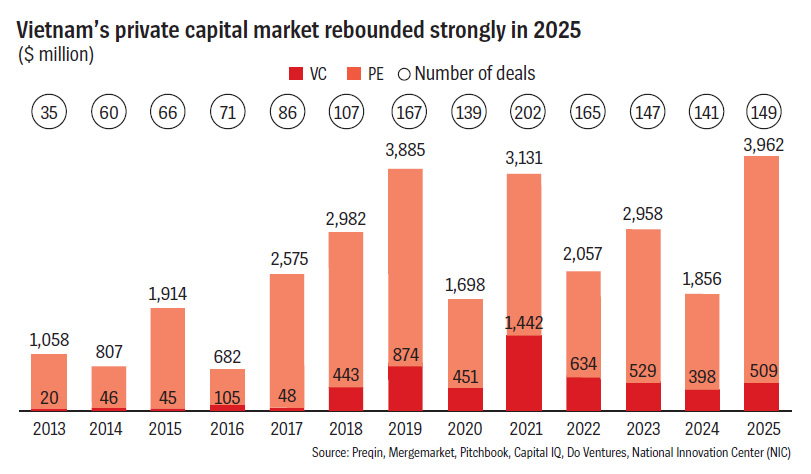
The report revealed that total private capital investment reached approximately $4.5 billion across 149 deals, with private equity (PE) rising to a record $4 billion and venture capital (VC) rebounding to $509 million. The recovery followed a period of adjustment in global technology investment, during which higher interest rates, inflationary pressures, and slowing economic growth prompted investors to become more cautious about startup valuations and funding strategies.
According to the report, Vietnam’s rebound broadly reflected wider recovery patterns across Southeast Asia, where investor activity has gradually strengthened after several years of volatility. However, the latest funding cycle differs from earlier periods of rapid expansion, when abundant liquidity supported aggressive growth strategies across the region’s startup ecosystem.
Although total venture capital increased by 28 per cent in 2025, deal volume declined to 103, suggesting investors are concentrating funding into fewer but larger investments. The report noted that investment activity remained relatively stable in Pre-A and Series A rounds, while later-stage financing strengthened, contributing to the highest level of C+ deals since 2022.
The trend points to a more selective investment environment, with investors placing greater emphasis on profitability, operational performance, and business sustainability rather than expansion at any cost.
The number of private equity investors more than doubled to 48; the highest level recorded in nearly a decade, while US and European investors made a notable return. Singapore continued to maintain a strong position in Vietnam’s venture capital ecosystem, reflecting its role as a regional financial and startup hub.
The return of international investors is particularly important for Vietnam’s startup sector because foreign capital has historically played a significant role in supporting startup growth and scaling. In addition to funding, international investors often bring operational expertise, market access, and global networks that can help Vietnamese startups expand beyond the domestic market.
The recovery in investment activity may therefore reflect growing confidence not only in Vietnam’s startup ecosystem, but also in the country’s broader economic outlook and policy environment.
Next challenge
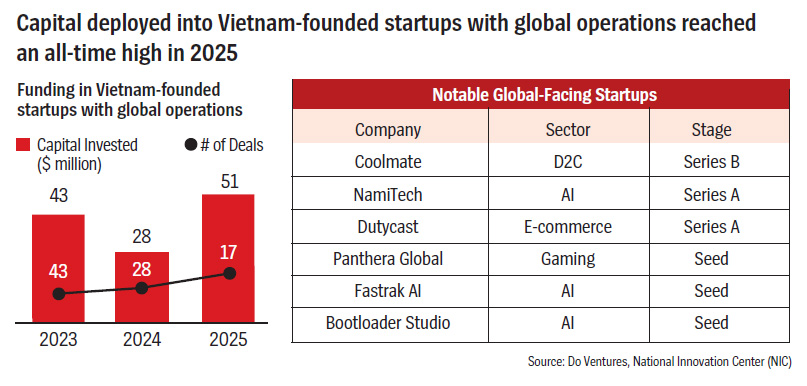
Alongside recovering investment activity, sectoral shifts are beginning to reshape Vietnam’s startup landscape. According to the report, AI-related investment increased 13-fold between 2023 and 2025, reaching an all-time high and emerging as one of the fastest-growing areas of investor interest.
The increase reflects broader global momentum around AI adoption, while also highlighting growing confidence in Vietnam’s engineering talent base and digital economy. Beyond AI, the report identified healthcare, retail, and climate technology as among sectors attracting stronger investment attention in 2025. Investor interest in those sectors reflects longer-term structural trends, including urbanization, changing consumer behavior, sustainability requirements, and rising healthcare demand.
Those developments suggest Vietnam’s startup ecosystem is gradually broadening beyond sectors that previously dominated startup activity, including fintech, e-commerce, and digital consumer platforms. While those segments remain important, investors are increasingly exploring opportunities tied to industrial upgrading, climate adaptation, and technology-enabled services.
At the same time, stronger financing pathways are becoming increasingly important as startups seek to scale. The report pointed to the role of deeper capital markets and stronger exit mechanisms in supporting startup growth over the coming years. In particular, the report highlighted an improving outlook for Vietnam’s public markets, including a stronger IPO pipeline expected in 2026 and 2027, which could help expand financing options for fast-growing companies.
According to the report, Vietnam is expected to benefit from its planned FTSE Emerging Markets reclassification next September, while potential future inclusion in MSCI Emerging Markets indices could eventually unlock larger institutional capital flows.
Despite the positive momentum, several challenges remain. Access to later-stage funding remains more limited than in more mature startup ecosystems, while competition for highly-skilled technology talent, particularly in AI and deep technology, continues to intensify.
Commercialization capacity, R&D capabilities, and stronger links between startups, universities, and larger enterprises also remain areas requiring further development. Strengthening those foundations may become increasingly important as Vietnam seeks to move beyond early-stage ecosystem growth toward building globally-competitive technology companies.
Vietnam’s rise in the StartupBlink rankings signals growing momentum, but the longer-term challenge will be converting that momentum into a deeper innovation ecosystem capable of producing stronger technology companies and more durable economic value.









 Google translate