


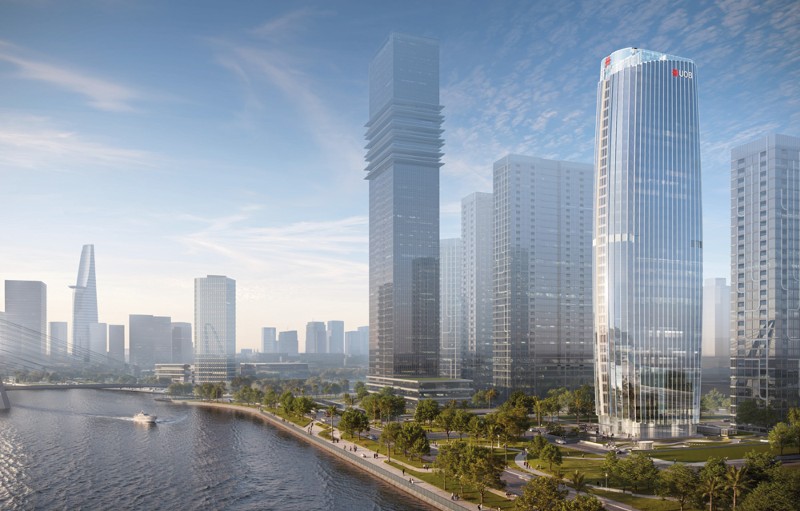
Vietnam has entered one of the most consequential phases of its economic development since “Doi Moi” (Economic Renewal) began nearly four decades ago. After building one of Asia’s fastest-growing economies through export-led manufacturing, FDI, and an expanding workforce, the country is now pursuing a more ambitious objective: achieving high-income status by 2045.
Reaching that goal, however, will require a different growth model. For decades, Vietnam’s development was driven by abundant labor and strong capital inflows. But as demographic trends shift, infrastructure needs expand, and the economy moves toward higher-value industries, the challenge is no longer simply attracting investment, it is deploying capital more effectively to raise productivity and sustain long-term growth.
It is against this backdrop that Vietnam is accelerating plans to establish International Financial Centers (IFC) in Ho Chi Minh City and Da Nang. Rather than simply creating new financial districts, policymakers, financial institutions, and international experts see the IFCs as platforms to connect global capital with Vietnam’s real economy, deepen domestic financial markets, and support the country’s transition to a more innovation-driven economy.
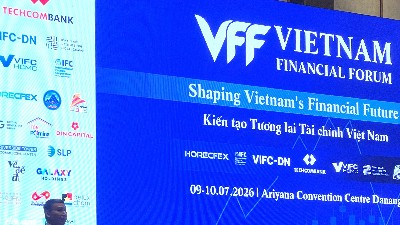
Speaking at the Vietnam Financial Forum (VFF) 2026, participants broadly agreed that Vietnam’s opportunity lies not only in attracting more investment but also in building the legal, regulatory, and financial infrastructure needed to mobilize and allocate capital on a much larger scale.
Why an IFC matters
Vietnam’s traditional growth model is reaching an inflection point. The country’s working-age population is beginning to decline, while workforce participation is already high. According to Mr. Jens Lottner, CEO of Techcombank, sustaining rapid economic growth will therefore depend on improving productivity rather than expanding the workforce. “The only way to achieve 10 per cent GDP growth is to increase hourly productivity,” he said.
According to estimates he presented at the Forum, Vietnam will require around $1.1 trillion in capital formation over the next five years. About $400 billion will be needed to restructure the country’s capital stock, alongside $150 billion for transport infrastructure, another $150 billion to upgrade manufacturing, and roughly $110 billion to support the green energy transition.
Even assuming continued growth in traditional funding sources, including bank lending, government spending, FDI, and domestic capital markets, Vietnam could still face a financing gap of around $200 billion.
The question is no longer simply how to attract more investment into Vietnam, but how to finance increasingly complex projects that require larger pools of long-term capital.
“Banks are essential and important, but banks alone cannot carry the entire burden of a national ambition,” said Mr. Jeffrey Singer, former CEO of the Dubai International Financial Centre and member of the VIFC Advisory Council. Rather, he argued, Vietnam’s next stage of development will require deeper capital markets, larger institutional pools of capital, and a stronger financing ecosystem. He also stressed the importance of creating “a clear path for your venture capital and your private equity companies to have exits.”
At the same time, Mr. Jochen Biedermann, Managing Director of the World Alliance of International Financial Centers, emphasized that international ambitions must be built on strong domestic foundations. “Before you can become a successful IFC, you have to become a successful domestic financial center, fulfilling the needs of your national economy, of your local corporates in terms of financing and giving investment opportunities to the people,” he said.
In that sense, an IFC is not simply another channel for attracting foreign investment. It is intended to broaden the country’s financing options and deepen domestic capital markets to support the country’s next phase of economic development.
More than a financial district
For many observers, the term “International Financial Center” immediately conjures images of towering office buildings, trading floors, and generous tax incentives. But speakers at the VFF argued that an IFC is fundamentally about institutions rather than infrastructure. “Financial centers are cities with an intense concentration of financial activity,” Mr. Biedermann said. “They serve as dynamic clusters with finance, expertise and, more and more, data to drive economic growth.”
Looking ahead, he argued that the next generation of financial centers must be “green, smart, innovative, and inclusive,” while also offering “an excellent quality of life” to attract and retain global talent.
Against that backdrop, Vietnam’s planned IFCs are intended to be much more than another financial district. “The VIFC is not a real estate project,” said Mr. Richard D. McClellan, CEO of the Vietnam International Financial Center in Ho Chi Minh City (VIFC-HCMC). “It’s like a special economic zone for finance, but plus-plus.”
While the VIFC incorporates many of the incentives associated with a special economic zone, Mr. McClellan said its defining feature is a distinct institutional and regulatory framework designed to meet international standards.
The model consists of three core institutions: an Executive Authority responsible for administration, a Supervisory Authority overseeing regulation, and a dispute resolution mechanism comprising an arbitration center and a specialized court. Together, they are intended to provide the legal certainty, regulatory consistency, and investor confidence that international financial institutions typically expect when entering new markets.
The value proposition, however, is not simply the regulatory framework itself. When comparing the VIFC with established financial centers such as London, New York, and Dubai, Mr. McClellan argued that each developed to serve a different economic purpose. London emerged as a capital-export center, while New York grew as a gateway for global capital flowing into the US. Dubai, meanwhile, has evolved into a regional hub through which international capital is intermediated across multiple markets. “The value proposition of the Vietnam International Financial Center is Vietnam itself,” he believes.
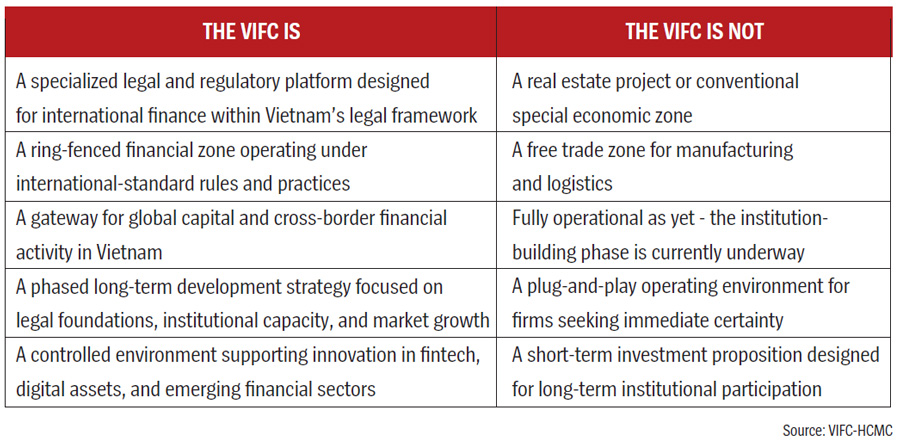
In that sense, the VIFC is intended to become the platform through which international investors gain access to one of Asia’s fastest-growing economies, rather than simply another destination for global financial services.
To support that ambition, the regulatory framework will include internationally-familiar features such as common-law principles, foreign judges, international accounting and financial practices, full foreign exchange convertibility, USD-denominated contracts, regulatory sandboxes for financial innovation, preferential tax policies, and long-term visas for international experts.
Yet Mr. McClellan cautioned against expecting the VIFC to emerge overnight. “This is not a two-year project. This is a ten-year project,” he said.
Rather than a single launch date, the VIFC will be developed through a phased approach. Mr. McClellan described 2025 as “the year of design,” during which the legal framework was established through National Assembly Resolution No. 222/2025 and the implementing decrees. The current phase focuses on building the organization itself, recruiting personnel and developing the initial regulatory framework.
“What we should expect to see over time is a gradual build-up, where we unblock one regulation, one product, one financial service at a time, gradually over time,” he said. The first wave of regulations will focus on operational licensing, banking, asset management, infrastructure funds, corporate and municipal bonds, and regulatory sandboxes. As each framework is introduced, additional financial products and institutions will be allowed to enter the market.
For Mr. McClellan, that measured rollout is essential to building a financial center capable of supporting Vietnam’s long-term ambitions. “We’re going to do it incrementally, so that we can do it in the way that’s going to best serve the development of Vietnam’s financial system, but also Vietnam at large.”
Putting capital to work
Closing Vietnam’s financing gap will require more than additional capital. It will require a different way of mobilizing and allocating it.
According to Mr. Lottner, the challenge is not simply raising more money. It is creating a financial ecosystem capable of matching global investors with increasingly sophisticated investment opportunities. “We need to make sure that capital allocation becomes much more sophisticated than what we’ve had in the past,” he said. “We need to provide local market intelligence. We need to source opportunities. We need to structure those opportunities. We need to assess and transform risk. And ultimately, we need to distribute those opportunities to investors.”
That represents a significant shift in the role of financial institutions. Traditionally, banks have been the dominant source of financing for Vietnam’s economy. But many of the projects underpinning the country’s next stage of development, from transport infrastructure and renewable energy to AI, data centers, and advanced manufacturing, require longer investment horizons, more diverse funding sources, and financing structures that conventional bank lending alone cannot provide.
Mr. Lottner illustrated the challenge with an example. “If you want to build a private airport, that project may require financing over 10 or 15 years,” he explained. “In Vietnam today, if you can raise financing with a maturity of three years, you’ve already done very well.”
Financing long-term infrastructure with short-term funding creates significant refinancing risk for lenders and investors alike. “We need different forms, different products, and different innovations in order to make sure that we can actually resolve some of these issues going forward,” he said.
An IFC provides the platform to develop those additional financing channels. Beyond commercial banks, the ecosystem would include asset managers, infrastructure funds, institutional investors, securities firms, insurance companies, and, increasingly, retail investors. “If we want to mobilize this amount of capital, retail participation will also become important,” Mr. Lottner added. “Institutional money alone will not be sufficient over the long term.”
At the same time, the IFC is expected to help international investors navigate Vietnam’s investment landscape by providing greater regulatory familiarity and stronger market infrastructure. Many overseas investors, Mr. Lottner noted, are already interested in Vietnam but remain uncertain about how to participate. “Many of our international customers, including multilateral institutions, international banks, and asset managers, ask us what opportunities we are seeing because they’re not yet sure how they should approach Vietnam,” he said.
Domestic financial institutions face constraints of their own. Many of the projects emerging in Vietnam’s next growth phase are simply too large for banks to finance on their own. As Mr. Lottner put it, “We have a lot of growth opportunities that we know we can’t put in balance sheets because they’re just too big, with too much concentration risk. It doesn’t fit the tenors.”
For that reason, he sees local banks playing a different role within the VIFC, not only as lenders but also as intermediaries that identify opportunities, structure transactions, and connect Vietnamese projects with international sources of capital. “We believe we can play the role of a pathfinder for capital,” he said. “We can identify opportunities. We can help determine what is bankable and investable for both sides.”
In that sense, the IFC is intended not to replace Vietnam’s banking sector, but to broaden the country’s financing toolkit, bringing together banks, capital markets, and institutional investors into a more integrated financing ecosystem.
Two centers, one ecosystem
Rather than developing a single IFC, Vietnam has adopted a dual-center strategy, with Ho Chi Minh City and Da Nang taking on complementary roles. According to Mr. McClellan, they will reinforce one another rather than compete.
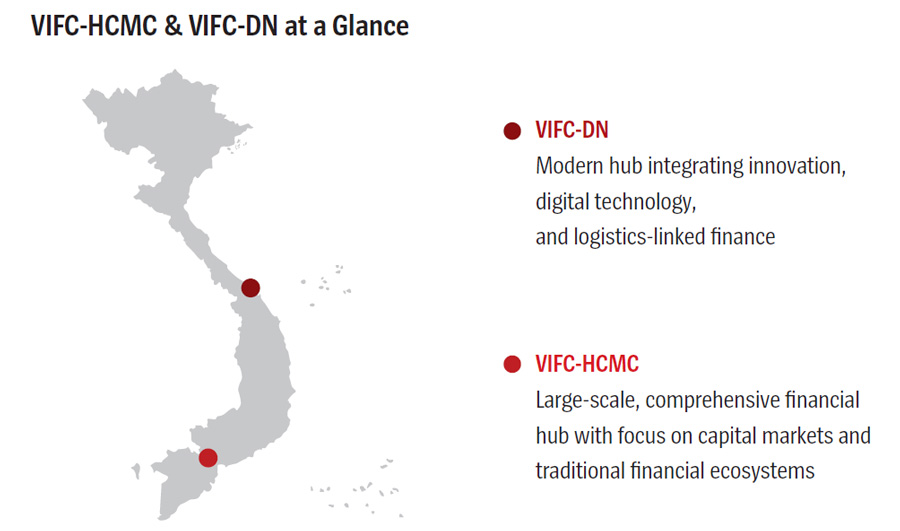
In Ho Chi Minh City, the focus will be on building a broad-based IFC anchored in capital markets. “We’ll be working in capital markets at large,” he said. “We’ll be going for both breadth and depth across most product categories, really building on the strength of Ho Chi Minh City as it stands today.” The city already hosts Vietnam’s largest financial institutions and stock exchange, providing a natural foundation for developing a full-scale international financial ecosystem.
Da Nang, meanwhile, is expected to develop a more specialized role. According to Mr. Kevin Iwanaga, Director, Strategy & Engagement, at the Vietnam International Financial Center in Da Nang (VIFC-DN), rather than replicating Ho Chi Minh City’s strengths, Da Nang aims to position itself around digital finance, green finance, and international connectivity.
“VIFC-DN is not simply about creating another financial zone or administrative platform,” he explained. “It’s about building a modern financial gateway that connects global capital with Vietnam’s real economy.”
To achieve that, Da Nang has identified five initial priority areas: tokenization, carbon credits and green finance, commodities exchange, funds and asset management, and bonds. While some of these overlap with Ho Chi Minh City’s priorities, Mr. Iwanaga emphasized that Da Nang will bring “a little bit of a fintech twist,” using digital technologies to create new financial products and broaden access to capital. “The objective is not simply to launch markets,” he said. “It’s to create trusted infrastructure that attracts institutional capital and channels it into productive real-economy assets, enterprises, and transition projects.”
That approach reflects Da Nang’s broader ambition to convert Vietnam’s strengths in manufacturing, infrastructure, exports, tourism, energy transition, and technology into investable capital market products. “Vietnam has the growth momentum,” Mr. Iwanaga said. “VIFC-DN, together with Ho Chi Minh City, can provide the market infrastructure.”
Viewed together, the two centers are intended to function as a single ecosystem rather than two separate financial hubs. Ho Chi Minh City will provide the scale and institutional breadth and depth of financial services, while Da Nang will focus on innovation, emerging financial products, and new market infrastructure. By combining those complementary strengths, policymakers hope to create a financial ecosystem capable of mobilizing global capital while supporting Vietnam’s long-term economic transformation.
Built on trust
If Vietnam’s IFCs are intended to mobilize global capital, speakers at the Forum agreed that their long-term success will depend on more than preferential tax policies or modern office towers.
For Mr. Singer, the foundation of any successful financial center is trust. “Businesses don’t scale in a poorly-regulated environment,” he said. “They don’t invest. They stay out of those markets. However, with good regulations, businesses can take good risks. They can allocate their cash flows, and they can plan for the future with confidence.”
Drawing on his experience in Dubai, he said the emirate’s response to the 2009 debt crisis demonstrated why “good regulation is good business.” By establishing a transparent restructuring process based on internationally-recognized legal principles and common law, Dubai was able to rebuild investor confidence and regain access to international capital markets.
“Good regulation creates trust to survive stress and to enable businesses to thrive,” he continued. “Good regulation will not prevent a crisis from occurring. Crises will always occur. However, good regulation enables good financial centers and companies to weather those storms.”

Financial centers are cities with an intense concentration of financial activity. They serve as dynamic clusters with finance, expertise and, more and more, data to drive economic growth.
He also cautioned that regulation must remain practical and accessible. “Good regulation is simple,” he said. “If you don’t understand it, you don’t follow it.”
Looking beyond regulation, Mr. Biedermann argued that financial centers must also be built with an eye on the future. He pointed to structural trends reshaping global finance, including AI, tokenization, and open finance, and said future competitiveness will depend on how financial centers adapt to these changes while maintaining strong institutions. “Future-proofing is not a new identity; it’s strengthening what already makes the financial center durable,” he said.
Ultimately, speakers argued that Vietnam’s opportunity lies not in replicating London, New York, or Dubai, but in building a financial center suited to its own stage of development and economic ambitions.
Vietnam’s greatest advantage is not the IFC itself but the economy it is designed to serve. As Mr. Singer put it, the country already has what he described as “one of the most enviable economies in the world right now.” The task ahead is to build the regulatory infrastructure capable of matching that growth and attracting long-term international capital. “My invitation to you is to match that incredible ambition and growth with the regulatory infrastructure that will enable international investors to fuel a lot of the growth that you require,” he told the Forum. “Vietnam has the opportunity to meet the majesty of this moment.”



 Google translate