


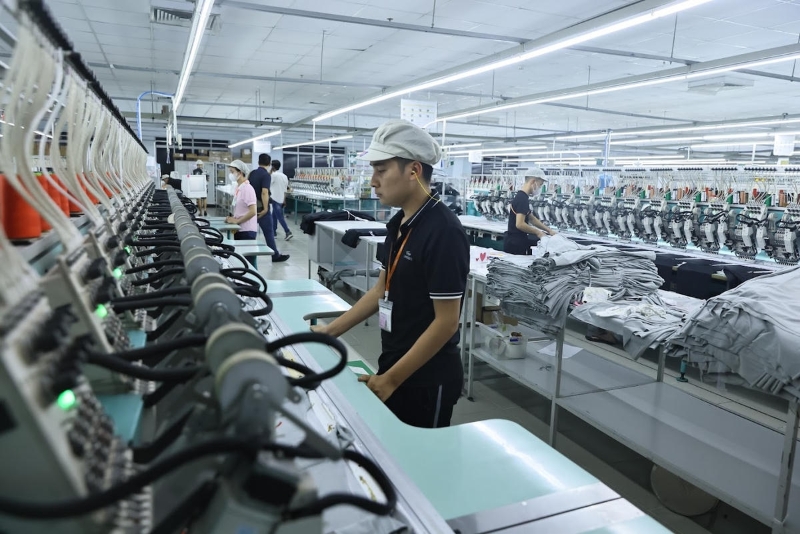
Despite considerable external uncertainties in 2025, FDI flows into Vietnam were a notable highlight, with total registered capital remaining high, at $38.42 billion, and total disbursed funds reaching $27.62 billion; the highest level in the 2021-2025 period.
According to the latest announcement from the Ministry of Finance, total newly-registered FDI in the opening two months of 2026 stood at $3.54 billion, up 61.5 per cent year-on-year. Disbursed FDI, meanwhile, was estimated at $3.21 billion, an increase of 8.8 per cent.
The results reaffirm Vietnam’s enduring appeal among international investors and underscore the important role of the FDI sector in boosting the country’s export growth and expanding the size of its economy.
Strong start to 2026
Building on the momentum from 2025, Vietnam’s FDI attraction in the first two months of this year continued to show encouraging signs. A series of newly-announced projects, alongside expansion plans by existing investors, indicate that international businesses remain confident about the prospects in Vietnam.
In January alone, several large-scale FDI projects were licensed in cities and provinces nationwide, creating notable highlights for the investment landscape as the year got underway. North-central Ha Tinh province stood out in particular. Though it recorded only one new FDI project in the period, it led in capital, with more than $380 million.
Ho Chi Minh City followed in terms of capital, with 182 newly-licensed projects and $189.81 million in registered capital, then nearby Dong Nai province, with 13 new FDI projects and capital of $182.26 million.
Alongside the dynamism of new FDI projects in various localities nationwide, the optimistic sentiment of the foreign business community has further reinforced prospects for continued inflows into Vietnam.
According to the Business Confidence Index Q4 2025 report from the European Chamber of Commerce in Vietnam (EuroCham), half of European businesses in Vietnam plan to prioritize expanding and diversifying their investment activities in 2026, while 41 per cent intend to increase investment in technology, automation, and AI.
Experts believe that strong FDI inflows are likely to continue in Vietnam this year, building on the positive results of 2025 and the existing growth momentum. Mr. Alexander Ziehe, Chairman of the German Business Association in Vietnam (GBA), noted that amid geopolitical volatility and adjustments in global trade policies affecting supply chains, Vietnam has maintained stability along with long-term growth prospects. “For the European business community, particularly German investors, Vietnam continues to be viewed as one of the most promising markets in ASEAN this year as well as in the medium and long term,” he said.
In addition, improvements in infrastructure connectivity, transport capacity, and access to land for production and business activities are expected to create further space for Vietnam’s long-term growth. Despite persistent uncertainties in the global economic environment, the foreign business community continues to maintain confidence that Vietnam is increasingly asserting its role as an important link in their long-term expansion and growth strategies in the region.
Shifting to high-quality FDI
The FDI wave in 2026 is expected to be increasingly concentrated on high-quality projects with strong technological content, high added value, and significant spillover effects. Vietnam is no longer focused solely on attracting large-scale capital flows, and is gradually shifting towards a strategy centered on high-quality FDI, with an emphasis on innovation and advanced technologies, green transformation, stronger value chain links, higher localization rates, and sustainable development.
Notably, when considering investment in Vietnam, international investors are increasingly setting higher requirements rather than focusing solely on traditional factors such as support in land rental costs or tax incentives. Questions being raised today revolve around longer-term and more sustainable criteria, such as whether electricity supply is environmentally-friendly, whether domestic supply chains have sufficient depth to support production, whether administrative procedures are stable and predictable, and whether Vietnam’s technical workforce can meet requirements.
Mr. Ziehe added that many companies within the German business community have already achieved significant success investing in Vietnam. However, to sustain and attract additional high-quality investment, Vietnam still needs to further improve a range of fundamental factors, including industrial parks, logistics infrastructure, workforce quality, and the establishment of a transparent, stable, and enforceable legal framework, rather than relying solely on financial incentives. “In particular, addressing administrative bottlenecks will play a key role in helping businesses operate more efficiently and fully unlock the potential of the Vietnam market,” he emphasized.
Meanwhile, Mr. Mickaël Driol, CEO of Mekong Partners, said FDI inflows into Vietnam in 2026 are likely to maintain a positive trajectory but will become increasingly selective. Investment decisions are now more cautious and accompanied by stricter conditions. Rather than focusing primarily on incentives, he continued, investors are increasingly prioritizing fundamental factors such as stability during project implementation, energy security, alignment with environmental, social, and governance (ESG) standards, and transparency in governance.
Specifically, the structure of FDI inflows will become more important than the sheer scale of capital attracted. High-tech and complex projects in sectors such as electronics, green manufacturing, digital infrastructure, and advanced industrial services are expected to become key drivers of long-term value creation for the economy. Beyond expanding supply chains, these investments also promote the transfer of skills and technologies and enhance Vietnam’s export capacity.
Therefore, to strengthen competitiveness in attracting investment, Mr. Driol believes the Vietnamese Government should place greater emphasis on policy consistency and implementation capacity in the time ahead. In particular, establishing clear roadmaps for land access, utility infrastructure, and project approval processes would help reduce uncertainty and shorten implementation timelines for foreign investors. Energy planning, meanwhile, should move ahead of actual demand, particularly in developing renewable energy, strengthening the power grid, and utilizing transitional fuel sources.
Stronger coordination between localities will also become a key factor in attracting foreign investors, as an increasing number of major corporations are implementing multi-location development strategies in Vietnam. “At this new stage of development, Vietnam will need to enhance its competitiveness in attracting high-quality FDI not only through commitments, but through its ability to deliver those commitments consistently and at scale,” Mr. Driol emphasized.
The amended Law on Investment took effect on March 1, introducing a range of changes aimed at simplifying administrative procedures, reducing conditional business lines, and strengthening business autonomy.
One notable provision allows foreign investors to establish a business before obtaining approval for an investment project, provided they meet market access conditions. The Law also provides a clearer list of projects subject to investment policy approval, replacing previously fragmented regulations.
Procedures for adjusting investment projects have been simplified. Two cases that previously required adjustments to investment policy approval - changes of 20 per cent or more in total investment capital and changes in appraised technology - have been removed.
The scope of special investment procedures has also been expanded. Certain projects in industrial parks, high-tech parks, digital technology zones, and financial centers may now be exempt from a number of administrative requirements.
In addition, investment projects are now permitted to adjust their operating term during implementation, whether extending or shortening it. The Law also abolishes procedures for outward investment policy approval and narrows the entities required to obtain an outward investment registration certificate.
Overall, the amendments are expected to streamline investment procedures, reduce regulatory barriers, and create a more flexible environment for both domestic and foreign investors.






 Google translate