



According to the “Vietnam Domestic Market Report 2025” from the Agency for Domestic Market Surveillance and Development at the Ministry of Industry and Trade, Vietnam’s retail market is estimated at approximately $269 billion, and with a population of over 100 million the country continues to present substantial long-term opportunities.
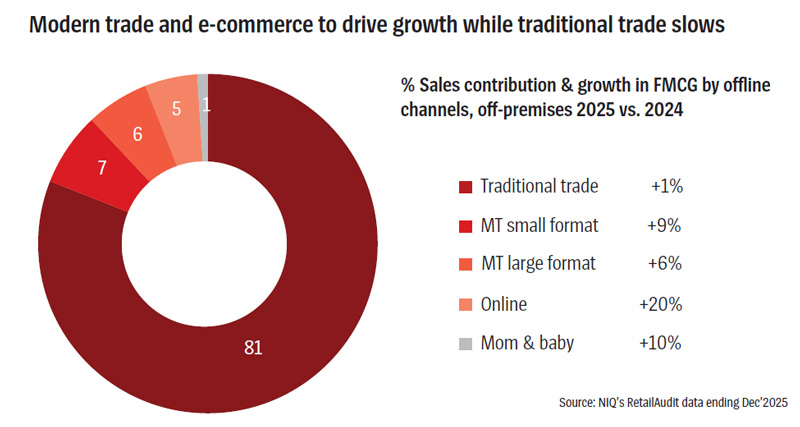
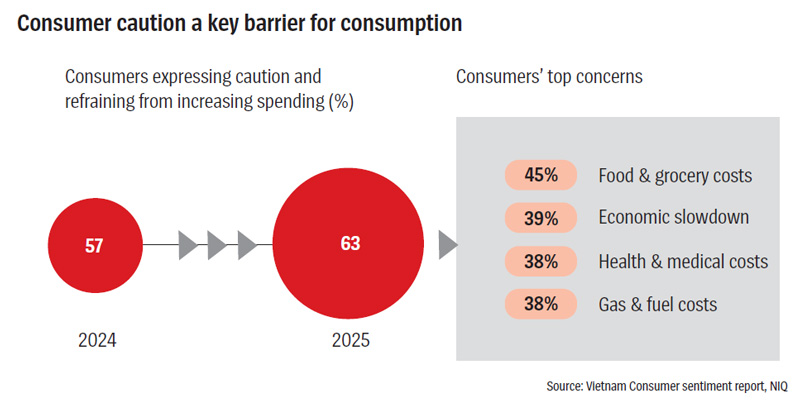
However, data from NielsenIQ suggests that the market structure remains fragmented, with traditional trade channels accounting for around 70 per cent of total retail activity. Its consumer sentiment survey also indicates growing caution, with 63 per cent of respondents planning to limit spending, up 6 percentage points from the previous year, amid rising pressure from essential costs such as food, healthcare, and fuel, as well as global geopolitical uncertainties.
According to Mr. Long Le, Head of Retail at NielsenIQ Vietnam, demand remains subdued as consumers become more cautious in their purchasing decisions, and although they retain spending power are increasingly holding back. He added that many Vietnamese consumers are prioritizing savings for big-ticket items such as housing, motorbikes, and gold, rather than discretionary spending.
Against this backdrop, retail leaders attending the Retail Asia Summit 2026, held in Ho Chi Minh City on April 2, outlined solutions to address structural bottlenecks and better translate the country’s 8 per cent GDP growth into stronger retail consumption.
Supply chain and operational bottlenecks
According to Mr. Mike Reid, Chief Supply Officer at Central Retail Vietnam, fragmented supply chains remain one of the most critical bottlenecks affecting retail performance. While centralized supply chain models can improve delivery reliability, reduce stock-outs (where products are unavailable), and enhance customer satisfaction, adoption in Vietnam remains limited.
A key challenge lies in supplier behavior. Many suppliers continue to favor direct deliveries to multiple retail outlets, believing this approach minimizes costs. However, this mindset often overlooks system-wide efficiency and customer needs. “The challenge in Vietnam is the tendency to preserve legacy ways of operating,” Mr. Reid said, adding that cost-driven supply chain models frequently fail to prioritize end-consumers.
Operational inefficiencies further illustrate this fragmentation. In some cases, suppliers deliver goods using their own pallets but refuse to exchange them at delivery points, forcing manual handling and increasing costs. Minimum order quantity (MOQ) requirements also restrict delivery frequency, leaving smaller stores understocked and reducing responsiveness across the network.
These supply chain inefficiencies are taking place against a broader backdrop of strong but uneven retail growth. As highlighted by Ms. Pratiksha Bhanti, Senior Manager, Transformation - Deals Advisory, at PwC, Vietnam’s retail market has recorded remarkable growth, with the rapid expansion of stores, formats, and channels. However, this growth has not always been matched by profitability. The market is now transitioning from pure expansion to “profitable growth,” where leading retailers are reconfiguring their operating models to regain control and improve efficiency.
Margins are under pressure, particularly among mid-sized and niche retailers, while fixed costs continue to rise. Rental rates in parts of Ho Chi Minh City are now comparable to or even exceed those in Kuala Lumpur, while logistics costs remain elevated amid ongoing geopolitical tensions.
Notably, many retailers are scaling faster than their data systems and governance frameworks can support. This has resulted in “profitability blind spots,” where leadership lacks clear visibility into which business segments are generating value and which are eroding margins.
The disconnect between supply chain operations and data systems further exacerbates these challenges. Fragmented data across subsidiaries and sales channels often leads to suboptimal decisions in merchandising, inventory, and promotions.
Ms. Hoang Thi Thuy Hang, Director of E-commerce at K&G Vietnam and Aristino, added that fragmented data across online and offline channels remains a key challenge. “We need to better leverage and manage our data,” she noted. “That is critically important.” Profitability is often concentrated in a limited number of products, she added, requiring more strategic portfolio management.
In high-value segments such as real estate and automobiles, trust is becoming a decisive factor. Ms. Ruby Hoang, Chief Operating Officer at Cho Tot, said price-led strategies are increasingly unsustainable. “Deep discounting and free shipping cannot sustain long-term growth,” she explained.
Ms. Bhanti noted that these challenges have led to inventory imbalances, where overconcentration on a few core brands results in excess stock for slower-moving products. This ties up working capital and forces retailers to rely on heavy discounting, ultimately eroding margins.
Evolving with customers
Vietnam’s e-commerce sector is currently undergoing a transition. As discount-led growth loses momentum, retailers are shifting toward more sustainable strategies, including loyalty programs, data integration, and AI-driven personalization.
According to Mr. Karim Noui, President of Nguyen Kim, retail is no longer simply about selling products. The rapid rise of AI is reshaping how customers make decisions and what they expect from the shopping experience. “Retail is not changing because of technology, it is changing because customers themselves are changing,” he believes.
Citing data from McKinsey, he noted that around 50 per cent of consumers are already using AI in their purchasing journeys. For instance, when buying a refrigerator, customers increasingly turn to AI tools for advice before visiting a store.
Against this backdrop, Vietnam stands out as a highly-promising market. The rapid expansion of its middle class, which is expected to grow by an additional 36 million people over the next decade, is creating significant opportunities for retailers.
However, Mr. Noui stressed that today’s consumers no longer think in terms of channels. Instead, they interact with brands through multiple touchpoints, from physical stores and websites to e-commerce platforms and social media such as Facebook, Zalo, and TikTok. As a result, retailers must deliver a seamless omni-channel experience that integrates both offline and online environments.
In the consumer electronics segment, the customer journey extends far beyond the point of sale, encompassing consultation, financing, delivery, and installation. “We are no longer just selling products; we are building a comprehensive ecosystem that supports customer decision-making,” he said.
AI plays a central role in this transformation by enabling personalized advice at scale. Looking ahead, Mr. Noui believes competition in retail will increasingly center on the ability to build “decision ecosystems” around customers. Importantly, future competitors may not be traditional players, but agile startups with strong technological capabilities and a deep focus on the customer experience.
AI-driven ecosystem
To address these constraints, experts point to a common direction for improvement: greater integration and system-wide optimization supported by AI.
Mr. Noui noted that retailers must accelerate their transition from traditional models to omni-channel strategies. Online channels, which accounted for around 15 per cent of sales two years ago, have already risen to some 30 per cent, reflecting a clear shift in consumer behavior. Nguyen Kim has also developed chatbot solutions capable of handling thousands of customer queries, from recommending suitable products to estimating operating costs, such as electricity consumption for air conditioners.
That said, digital transformation cannot happen overnight. It requires a phased approach, beginning with building data foundations and improving AI literacy, followed by targeted applications and ultimately a fully-integrated AI-driven decision ecosystem. “AI does not replace people. It enables us to better understand and serve our customers,” Mr. Noui said, underscoring that people remain at the heart of any successful transformation strategy.
Mr. Reid emphasized the importance of centralized supply chains to improve end-to-end efficiency, while Ms. Bhanti highlighted the need for integrated data systems to create a “single source of truth” across operations. Retailers that are adapting successfully are increasingly combining these approaches, aligning supply chain transformation with data integration and operating model redesign.
This includes strengthening discipline in inventory and merchandising through data-driven decision-making, improving visibility over cash flow and working capital, and consolidating back-office functions into shared service centers to enhance efficiency and scalability. Importantly, these changes do not necessarily require large-scale technology overhauls, but rather targeted digital solutions that ensure the right data is available to the right stakeholders at the right time. Simple tools such as automated reporting systems or AI-powered data consolidation platforms are already helping retailers reduce manual workloads and improve decision-making speed.
Ultimately, the gap between growth and profitability in Vietnam’s retail sector is becoming more evident. As experts suggest, closing this gap will depend not only on expansion but also on the ability to redesign supply chains, strengthen operating models, and execute with greater discipline in an increasingly competitive landscape.
According to Mr. Noui, Vietnam’s retail competition is also shifting toward AI-driven customer decision-making and end-to-end service models. He noted that around 50 per cent of customers are already using AI tools, with some 60 per cent relying on such technologies for product guidance. He outlined a three-stage transformation roadmap: beginning with foundational data infrastructure and omni-channel systems, followed by AI-driven personalization through chatbots and virtual agents, and ultimately culminating in a fully-integrated AI-led decision ecosystem.
Competition is also evolving, as traditional players such as the Mobile World Group, MediaMart, and Pico face increasing pressure from ecosystem builders and marketplace platforms. Retailers are shifting from promotion-led strategies to demand identification, leveraging AI to better understand customer needs. Regionally, he noted that around 75 per cent of electronics sales in China are already online, while Vietnam’s online penetration continues to expand, with some operators doubling online sales to around 30 per cent in recent years.
To address structural inefficiencies in Vietnam’s supply chain, Mr. Reid’s team at Central Retail Vietnam has introduced data-driven dashboards to monitor stock levels and supplier performance on a daily basis. However, he emphasized that data alone is insufficient. “Sales teams focus on revenue, and stores on availability, while the supply chain sits at the center,” he said. “A centralized platform is essential to ensure consistency and reliability.”
Equally important is the shift from transactional to collaborative practices. Mr. Reid noted that the company’s relationships with more than 25 logistics providers were previously fragmented and often adversarial. It has since consolidated its network to six strategic partners, supported by longer-term contracts to enhance coordination and efficiency.
At the same time, investment in human capital remains a priority. A dedicated supply chain academy, featuring over 30 training modules, has been launched to strengthen local capabilities. Mr. Reid stressed that supply chain development must outpace retail growth, particularly during peak periods such as Tet, when stock-outs remain a persistent challenge.
Looking ahead, personalization and AI are expected to become key competitive drivers. Growth will increasingly depend on operational efficiency, deeper customer insights, and consistent value delivery, underpinned by favorable long-term fundamentals.
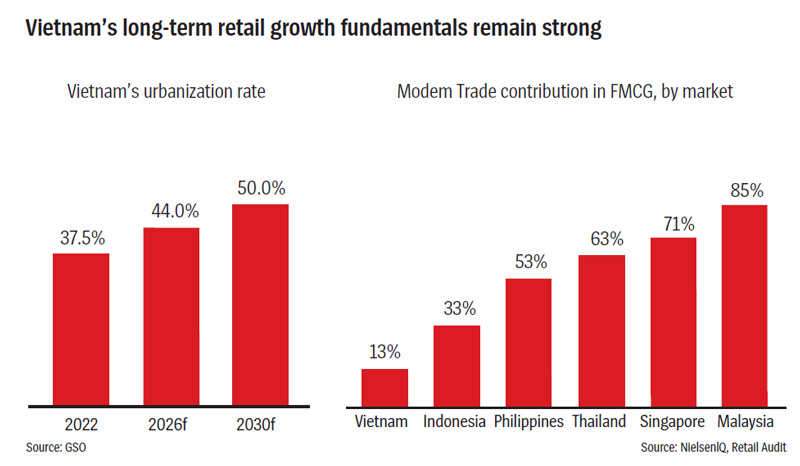
Despite short-term headwinds, Mr. Long maintained that the long-term outlook remains positive, supported by urbanization, rising incomes, and the continued expansion of modern retail and e-commerce channels.







 Google translate