


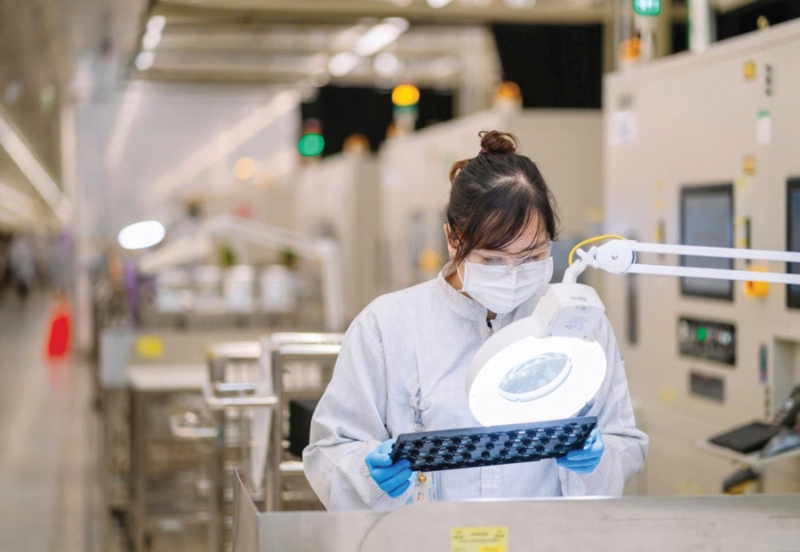
In the context of science, technology, innovation, and digital transformation becoming key growth drivers, the semiconductor industry is increasingly assuming a strategic role in the global value chain, according to the conclusions of the National Steering Committee for Semiconductor Industry Development at its first meeting in 2026.
Vietnam has gradually established a presence across most segments of the semiconductor value chain, with more than 50 chip design companies, around 7,000 engineers, and several major projects in packaging and testing. Total FDI in the sector has exceeded $14.2 billion in 241 projects. In terms of training, more than 166 universities are offering relevant engineering programs, attracting approximately 134,000 new students each year. However, behind these positive figures, the human resources challenge remains significant, particularly given the unique structure of demand in the industry.
Sector shortage
According to Ms. Nguyen Thi Bich Thuy, Director of the Training Center at the Southeast Asia Institute for Advanced Technology (AIAT), the semiconductor industry requires continuous training, retraining, and constant upskilling throughout a professional career. “This is a ‘science of sciences’ industry that requires long-term investment,” she said. “Talent in the field requires between four and ten years of development. From engineers to innovators, they must be nurtured through curiosity, passion, and a constant drive to explore and conquer.”
She added that behind tiny chips lie extremely complex manufacturing processes. “Starting from raw materials to produce wafers, the semiconductor industry must go through hundreds of stages before reaching fabrication,” she explained. “The entire process can involve up to some 30,000 production steps - a figure that illustrates the scale and sophistication of the industry.”
According to forecasts, the world may face a shortage of around 500,000 semiconductor workers in the years to come. However, Ms. Thuy noted that approximately two-thirds of this demand will not be for scientists or high-level engineers, but for technicians - those who directly operate, maintain, and ensure the smooth functioning of production lines. “This is an extremely important workforce that has long been undervalued,” she said. “They are the backbone of semiconductor factories.”
This reality places urgent demands on the education system: it must shift from traditional training models to more integrated, flexible approaches aligned with industry needs. The semiconductor sector itself is inherently interdisciplinary, combining electronics, information technology, mechanical engineering, mechatronics, computer science, physics, chemistry, materials science, environmental science, and environmental technology.
Seizing a “golden window”
Within this global landscape, Vietnam is considered to have significant opportunities to move deeper into the semiconductor value chain. According to Ms. Thuy, its workforce could become a high-quality talent pool that not only meets domestic demand but also demand in major markets such as the US, Europe, and Asia.
However, the key issue is to clearly define Vietnam’s position within the global value chain and, from there, develop an appropriate human resources strategy. One feasible direction, Ms. Thuy believes, is to focus on segments such as design, particularly back-end design, and advanced packaging. “These are areas that align with the electronics manufacturing foundation Vietnam has built over many years,” she said. “In fact, we already have part of the workforce for these segments. What is needed now is upgrading to participate more deeply.”
She sees the next ten years as representing a “golden window” for Vietnam to leverage its young population. To capitalize on this, its education system must undergo strong reforms, particularly through the development of short-term, flexible training programs.
International experience shows that integrated training models have been successfully adopted in many countries. In Singapore, integrated education philosophies have been strongly implemented, even leading to the establishment of specialized universities tailored to the needs of the new economy. Meanwhile, Taiwan (China) stands out as a model of close collaboration between academia and industry in semiconductor workforce training.
From policy to practice
According to Ms. Thuy, Vietnam needs a strategic approach based on forecasting workforce demand from FDI projects. Training institutions should be involved from the investment licensing stage to prepare an appropriate workforce. Strong links between the government, academia, and industry will be key to building an effective training ecosystem.
From a long-term perspective, the foundation of the semiconductor industry lies in basic sciences. Therefore, fostering an interest in science, logical thinking, curiosity, and a passion for research should begin from early childhood through primary and secondary education.
Vietnam has strengths in mathematics, but for more comprehensive development, learners also need to strengthen their practical skills, manual dexterity, and the ability to work with equipment. “Semiconductor personnel need not only strong thinking skills, but also dexterous hands and solid practical abilities,” she emphasized. “These are the factors that shape engineers, technicians, manufacturers, and innovators.”
Professor Augustine Ha Ton Vinh, Chairman and CEO of the Stellar Management Corporation, Training and Consulting Complex, noted that the semiconductor industry, like manufacturing, requires hands-on experience. Learners must directly interact with machinery, observe processes, and perform operations themselves.
For example, Mr. Vinh added, a photolithography machine contains tens of thousands of complex components. If a person only studies theory, it is impossible to understand how it works. It requires hands-on instruction, repeated multiple times, for them to truly grasp it. “If one remains in the academic ivory tower and never steps into factories or engages directly with production, it is impossible to understand how the industry actually operates,” he said.
According to experts, Vietnam needs to invest strongly in practical training centers, while also developing applied laboratories, technology experience centers, and innovation hubs to enable learners to directly access equipment and real-world processes. This would allow students to observe and experience firsthand what semiconductor machinery is. Today’s teaching technologies are highly advanced and optimized, supporting both learners and instructors in accessing practical training through software and virtual learning materials.
From these practical requirements, completing policies and establishing national-level orientations for human resources development has become more urgent than ever. This is not only a matter for training institutions or enterprises, and requires a comprehensive strategy with coordinated participation from the State, academia, and the labor market.
In this context, the conclusion notice from the National Steering Committee for Semiconductor Industry Development at its first meeting in 2026 outlined specific directions. The Ministry of Education and Training is to focus on developing high-quality human resources, continue refining semiconductor integrated circuit training programs, and promote the State - Academia - Enterprise linkage model.
At the same time, semiconductor laboratories will be urgently approved and deployed, with completion expected by May this year. Vietnam also aims to develop overseas training programs, provide scholarships for high-quality talent, and promote retraining and upskilling programs to rapidly expand the pool of engineers and experts in the semiconductor industry.
This reality places urgent demands on the education system: it must shift from traditional training models to more integrated, flexible approaches aligned with industry needs. The semiconductor sector itself is inherently interdisciplinary, combining electronics, information technology, mechanical engineering, mechatronics, computer science, physics, chemistry, materials science, environmental science, and environmental technology.





 Google translate