


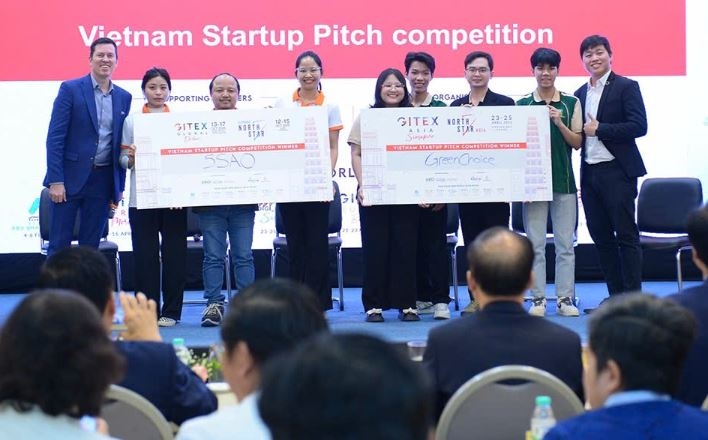
The rise of open innovation is pushing big companies to partner with startups to resolve specialized challenges in areas such as AI and operations. Though large enterprises - both State-owned and private - command vast capital, infrastructure, and foundational technologies, their flexibility and ability to adapt to emerging technologies such as specialized AI, blockchain, and green energy often lag behind the market’s breakneck pace of change. Meanwhile, for startups, this rise means embracing a “fail fast” mindset and targeting niche markets overlooked by industry giants.
Resolving “problem statements”
According to Mr. Nguyen Quoc Huy, Director of the National Innovation Center (NIC), the convergence of these two players is an inexorable, irreversible trend. Large enterprises today do not need financial support from the government in an “ask-give” mechanism; they need a “connection” mechanism. The most effective connection, he said, is not corporate social responsibility (CSR) or charitable sponsorship but business partnerships with startups, where large firms present the “problem statements” and startups deliver the “solutions” through agile technological applications.
A vivid example of this mindset is MoMo. From a simple e-wallet, MoMo has evolved into a super app through an integration-driven strategy. Mr. Nguyen Ba Diep, MoMo’s Co-Founder, said that instead of developing all services in-house, the company is willing to “open its doors” to startups in retail, marketing, tourism, and other sectors to access its user base of about 30 million people. MoMo’s “problem statement” is how to keep users engaged longer on the platform, while the “solutions” come from the diverse, convenient services provided by partner startups. This represents a typical win-win symbiotic model.
Similarly, in smart transportation, the experience of specialized firms such as Tasco and VETC shows that once policy bottlenecks are removed, system connectivity can expand much further. This not only helps companies optimize operations but, more importantly, delivers greater convenience and transparency to citizens - the end users. “Now, who leads whom matters less than whether solutions are delivered quickly, accurately, and effectively,” a representative of a transportation company said.
Rising complexity
Assigning “problem statements” to startups is no longer confined to software or digital services; it is rapidly expanding into manufacturing and support industries - fields traditionally seen as “closed arenas” with stringent standards.
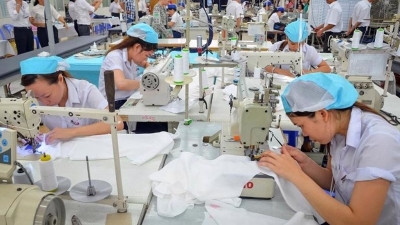
Samsung Vietnam provides a clear example of a localization strategy. With total investment reaching into the tens of billions of dollars, Samsung cannot, and does not want to, manufacture every component itself. The giant’s “problem statement” for the Vietnamese market is highly specific and challenging: it needs suppliers that meet global standards for screws, molds, packaging, and more, all with extremely low tolerances and competitive costs.
These are exceptionally difficult challenges, yet their rigor has become a driving force for strengthening Vietnam’s domestic manufacturing capabilities. Alongside issuing these “problem statements,” Samsung has sent experts to provide hands-on consulting and training, enabling Vietnamese firms to gradually meet requirements. As a result, from having almost no qualifying suppliers, Vietnam now has many companies deeply integrated into Samsung’s global supply chain.
According to a Samsung representative, its success in Vietnam would not have been possible without the country’s ecosystem of small and medium-sized enterprises (SMEs). Vietnamese companies have indeed helped the South Korean giant ease logistics cost pressures and ensure stable local supply.
Experts believe that in the new context, the “problem statements” facing businesses are becoming increasingly complex and directly tied to the international competitiveness of large enterprises. These include digitizing an entire factory’s production processes without even brief operational disruption, or automating industrial waste treatment and greenhouse gas inventories to comply with mechanisms such as the Carbon Border Adjustment Mechanism (CBAM) for exports to Europe and the US.
Such challenges often fall outside the core expertise of traditional manufacturing conglomerates. Instead of establishing costly, high-risk in-house R&D or technology divisions, outsourcing ideas and solutions from deep-tech startups is seen as a more economical and promising model. Startups can offer AI-based carbon measurement solutions, autonomous warehouse robots, and more, helping large enterprises “go green” and “go smart” far faster than through independent research.
Creating momentum
2026 and the years ahead have been identified as a breakthrough phase for Vietnam’s economy. To achieve high growth, major enterprises cannot be satisfied with annual growth of 5-7 per cent; they need powerful catalysts to reach double-digit expansion. Innovation is viewed as one of the key drivers.
However, for partnerships between major “cranes” - especially State-owned enterprises (SOEs) - and startups to truly bear fruit, strong institutional reforms are required. Politburo Resolution No. 57-NQ/TW and, more recently, Resolution No. 79-NQ/TW, on the development of the State economic sector, encouraging State-owned enterprises (SOEs) to invest in and forge links with other businesses along value chains, are expected to provide fresh momentum and a safe legal corridor for innovation.
Previously, the priority placed on preserving State capital made leaders of major corporations hesitant to collaborate with startups, which were seen as high-risk entities. Resolution No. 79, which emphasizes the role of large SOEs in leading smaller companies, has helped remove both psychological and policy constraints. It marks a shift from an administrative, command-style approach to one driven by market development needs. State enterprises are no longer bound by an “ask-give” mechanism but are encouraged to proactively seek solutions from the private sector to optimize performance.
Among pioneering companies, pressure from the rapid surge of AI is forcing them to embrace innovation or risk being left behind. This pressure, in turn, has become a positive driver, pushing enterprises to open up and adopt bold solutions from the startup community.






 Google translate