


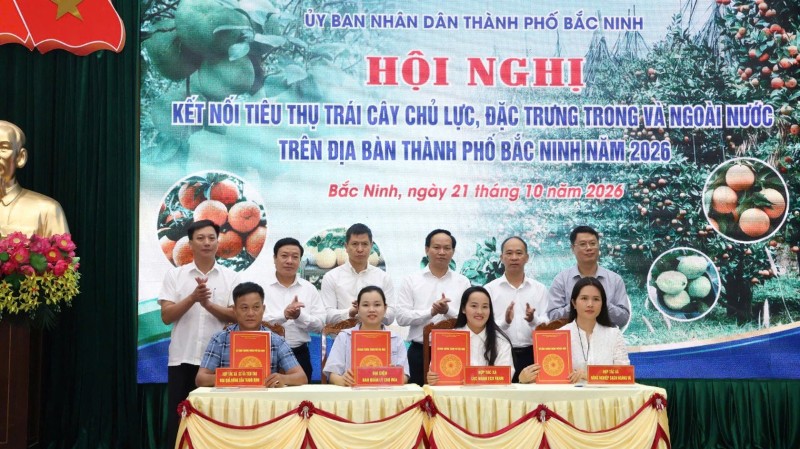
Facing an estimated output of over 118,000 tons of oranges, pomelos, apples, and guavas in late 2026 and early 2027, northern Bac Ninh City is stepping up efforts to connect businesses, distribution networks, and producers to expand consumption and enhance agricultural value.
Such efforts were highlighted at a conference, organized by the municipal People’s Committee on October 21.
The initiative aims to secure off-take channels during peak harvest while establishing stable, sustainable distribution linkages.
According to the Bac Ninh Department of Agriculture and Environment, fruit-growing areas across the city reach 53,739 hectares in 2026. Oranges, pomelos, apples, and guavas account for 11,650 hectares (21.7 percent of total fruit acreage), with projected output reaching 118,525 tons, up 18.7 percent year-on-year.
Pomelo covers the largest area at 5,200 hectares (47,000 tons), with 3,660 hectares (70.4 percent) meeting VietGAP standards. Primary varieties include Dien, Da Xanh, Dao Duong, Suu, and Hoang. Apples span 2,900 hectares (35,090 tons), oranges cover 2,500 hectares (27,600 tons), and guavas account for 1,050 hectares (8,835 tons).
A key advantage is staggered harvesting: pomelos from September to February, oranges from October to December, and apples from November to February, while guavas are supplied year-round. This enables phased promotion and proactive procurement.
However, city fruit exports remain small and unstable. Oranges and apples rely heavily on domestic consumption as export access remains unopened.
The department noted that production remains fragmented, linkages between supply chains are weak, and many producers depend on traders. Additionally, planting area codes and packaging facilities remain inconsistently established.
To address these issues, Bac Ninh aims to shift toward market-demand-driven production by reviewing acreage, output, and quality. Specialized agencies will guide farmers on VietGAP, organic standards, and pre-harvest residue controls.
The city encourages stronger partnerships between farmers, cooperatives, enterprises, and supermarkets before harvest. Trade promotion will combine seasonal fairs, digital platforms, brand building, and experiential orchard tourism.
Priorities also include issuing and managing planting area codes and packaging facility codes, alongside requiring digital farming logs and product traceability.
The Department of Agriculture and Environment recommended that the City People’s Committee allocate resources for safe production zones and marketing support. Local authorities were also requested to negotiate market access and resolve plant quarantine bottlenecks.





 Google translate