


Vietnam’s tourism sector is shifting from a focus on increasing visitor numbers to attracting higher-spending, longer-staying travelers. How should “high-quality tourism” be defined, and what indicators should be used to measure its effectiveness?
First, we need a common understanding that high-quality tourism is a growth model that generates greater economic value per visitor, better experiences, more positive social, cultural, and environmental impacts, and more sustainable competitiveness.
High-quality tourism therefore needs to meet six groups of criteria: economic value; length of stay and visitor engagement; quality of experience; service quality; positive cultural, social, and environmental impacts; and destination capacity.
These criteria cannot be measured through a single indicator, but rather through a set of indicators that clearly reflects a shift from “counting visitors” to “measuring value.” These include total revenue per visitor; average daily visitor spending; average length of stay; tourism value-added per visitor; visitor satisfaction; repeat-visitor rates; the proportion of spending retained locally; and destination sustainability indicators.
In broad terms, high-quality tourism is not tourism exclusively for people with high purchasing power. Rather, it is a model that generates greater value per visitor: longer stays, higher spending, better experiences, broader economic spillovers, and lower impacts on resources, culture, and the environment.
What are the main reasons visitors are not staying longer or spending more, and how can the sector address these bottlenecks?
In my view, the key issue is not primarily that “visitors do not want to spend,” but that the product and service ecosystem does not yet provide enough reasons for them to stay longer and broaden their spending. Five main factors explain this situation.
First, products have not yet reached sufficient depth and maturity. We have abundant resources, but many destinations still operate around a basic model of eating, sleeping, resting, sightseeing, shopping, exploring, entertainment, and taking photos. Meanwhile, products capable of extending stays - such as the night-time economy, artistic performances, shopping, wellness, golf, cruises, MICE [Meetings, Incentives, Conferences, and Exhibitions], sports, and in-depth cultural experiences - remain underdeveloped and insufficiently connected to create a premium experience.
Second, the spending-related service chain remains limited. Third, links between destinations and across the value chain remain weak. Fourth, premium products are not yet sufficiently differentiated. Five-star facilities alone are not enough; they need to be matched by unique experiences in culture, cuisine, heritage, nature, wellness, arts, sports, and events, supported by quality and personalized service.
Fifth, we have not yet fully used data to understand visitor spending behavior. Knowing where visitors come from and how many arrive is not enough. We need to know how many nights they stay, where they spend their money, which products they purchase, why they leave, and what encourages them to return.
Addressing these bottlenecks means giving visitors more reasons to stay, expanding the space for experiences and spending, and designing products around the entire visitor journey. The night-time economy should also be strengthened. This is one of the keys to increasing both length of stay and spending.
We need to develop interconnected destination clusters spanning accommodation, cuisine, shopping, performances, festivals, entertainment, culture, arts, and sports, with activities operating continuously and safely. This would create signature products capable of extending visits.
What differentiated tourism products can attract high-spending visitors, and which segments should the sector prioritize?
The key to attracting high-spending visitors is to deeply understand the range of needs within this market segment. It is therefore not necessarily about developing “expensive” services, but about creating products with high experiential value, a strong distinctive identity, and qualities that are difficult to replicate. This direction is also clearly set out in Politburo Resolution No. 26-NQ/TW dated August 22, 2026, which calls for a decisive shift from growth based on visitor numbers toward quality, value-added, and experience, with a focus on high-spending, long-staying visitors.
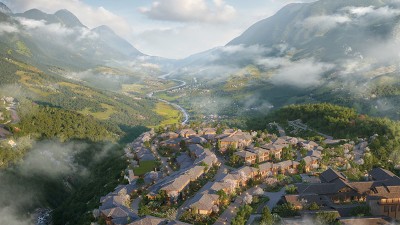
I believe some groups of products should be prioritized. First is luxury leisure tied to unique resources. Vietnam has major advantages in beach and island tourism, mountains, bays, caves, and heritage sites. These should be connected with local, nature, cultural, wellness, culinary, and entertainment experiences. The aim is to develop internationally-competitive beach, island, and mountain resort hubs, particularly in destinations such as Phu Quoc, Ha Long Bay, Nha Trang, Da Nang, Binh Dinh, Khanh Hoa, Da Lat, and Sapa.
MICE and event tourism will also be particularly important because a MICE group typically generates spending on accommodation, meetings, food and beverages, shopping, entertainment, and experiential programs. Other important means of increasing spending is shopping, cuisine, entertainment, and the night-time economy.
Golf should also be developed within a broader “golf destination” ecosystem. Wellness and medical tourism, meanwhile, could become a new “gold mine.”
In addition, businesses need to develop highly-personalized, specialized experiences. This differentiation will be one of the most important strategic competitive advantages, focusing on experiences that are memorable and difficult to find elsewhere.
How can tourism spending be retained more locally to create jobs, incomes, and wider economic benefits?
A very important shift in the way we think about tourism development is to focus on the value tourism leaves for Vietnam’s economy, localities, and people. Politburo Resolution No. 26 addresses this issue by calling for stronger links across the tourism value chain, from travel agencies and transportation to accommodation, services, and local products.
This would increase domestic value and enable Vietnamese businesses to participate more deeply in global value chains. The Resolution also identifies local people as both participants and beneficiaries, while calling for community-based tourism and livelihood support.
We are working to gradually increase the share of visitor spending directed toward local goods and services. Spending on airfares, hotels, booking platforms, and international chains currently accounts for a large share, while spending on local cuisine, “One commune, One product” (OCOP) products, craft villages, arts, community experiences, and local transportation needs to increase accordingly.
A key bottleneck is the weakness of local tourism supply chains. Local people often participate only in lower-value activities, such as selling raw agricultural products or providing basic labor. Another challenge is the lack of data to analyze where visitor spending flows. Unless we can measure the flow of money through the value chain, it is difficult to design policies that increase the share of value retained locally.
To address this and ensure more value is created and retained by local communities, communities need to become “co-creators of tourism products” alongside businesses.
Mechanisms should be developed to connect large businesses, small businesses, and communities, thereby improving the share of value retained locally. This is how tourism can truly become a growth engine, generating spillover effects across the wider economy.
Our goal is not simply to make visitors spend more, but to ensure that every dollar they spend generates greater value for Vietnam’s economy.
This means Vietnamese businesses gain new markets, local governments gain additional revenue, residents gain jobs and incomes, and communities gain greater incentives to preserve their culture and natural resources.
What targets should the tourism sector set for visitor spending, length of stay, and economic contribution, and what key policies are needed to achieve them?
Looking ahead, Vietnam’s tourism sector aims to welcome 45-50 million international visitors and 160 million domestic tourists by 2030, generate total revenue of $80-90 billion, and directly contribute 10-12 per cent of GDP, while focusing on high-value, green, smart, distinctive, and sustainable tourism.
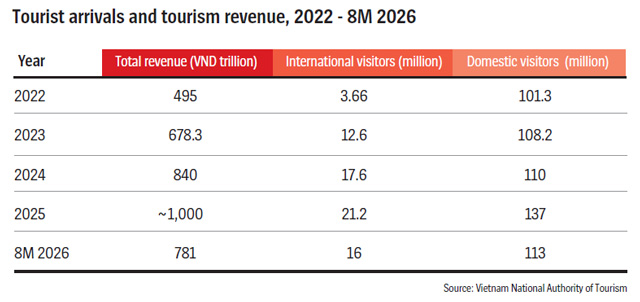
These are overarching targets. Based on them, more specific secondary indicators for average spending, length of stay, and economic contribution can be calculated. Visitor spending surveys, booking and payment data, and destination management data can be used to develop forecasts for the time ahead.
More importantly, we need to change the tourism sector’s “production function,” with an extended value chain serving as a key source of contribution and generating spillovers across sectors including trade, transportation, cultural and creative industries, agriculture, the digital economy, and the night-time economy.
Therefore, breakthrough policies could focus on translating Vietnam’s tourism objectives for the coming period into action through market data management. The goal should not simply be to attract more visitors, but to ensure that each visitor stays longer, spends more, has a better experience, and creates greater value for Vietnam’s economy, businesses, and people.



 Google translate