



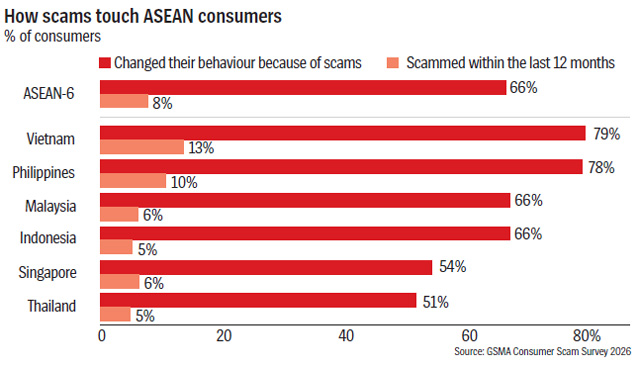
Vietnam is entering a new phase in its digital transformation, in which the challenge is no longer simply connecting people and businesses but ensuring they can participate online with confidence. The country ranked fifth in ASEAN in the 2026 Digital Nations Index from GSMA Intelligence, which assessed digital readiness across infrastructure, innovation, data governance, security, and people. At the same time, the ASEAN Consumer Scam Report 2026, also from GSMA Intelligence, found that Vietnam has the region’s highest recent scam victimization rate among the six markets surveyed, with 13 per cent of consumers reporting that they had been scammed in the past 12 months.
Vietnam is strengthening the policies, infrastructure, and institutions needed for a more technology-intensive economy while consumers are confronting increasingly sophisticated forms of digital deception. Yet the ASEAN Consumer Scam Report 2026 also identified an important strength: trust in Vietnamese institutions remains comparatively high. The challenge now is to turn that trust into a coordinated defense system before unresolved cases begin to erode it.
From connectivity to trust
Vietnam’s digital ambitions are increasingly centered on data, AI, and the wider digital economy. The country has approved its National Digital Transformation Strategy for 2026-2030, with a long-term ambition of becoming a data- and AI-driven digital nation by 2045. The Strategy aims to fully digitalize administrative records by 2030 and raise the digital economy’s contribution to GDP to at least 30 per cent, positioning data and AI as key growth engines.
The broader regional environment is moving in the same direction. ASEAN adopted the ASEAN Digital Masterplan 2030 in January 2026 and the Digital Economy Framework Agreement in May, with the latter designed to support digital trade, cross-border data flows, payments, consumer protection, AI, and cybersecurity. The regional digital economy is expected to grow from $1 trillion to $2 trillion by 2030.
Against this backdrop, digital trust is becoming an economic requirement rather than simply a cybersecurity concern. The 2026 Digital Nations Index report defined trust as confidence that digital systems, services, and the organizations behind them will operate securely, reliably, transparently, and accountably while protecting users’ rights and interests. It links trust to all five pillars of a digital nation: resilient infrastructure, trusted innovation, responsible data governance, security, and people’s ability to participate confidently in the digital economy.
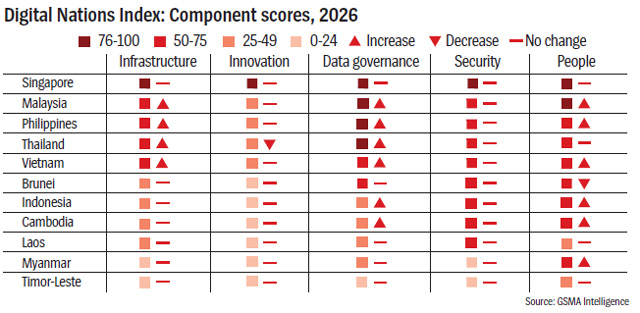
Vietnam’s fifth-place ranking suggests that its digital foundations are advancing, though significant gaps remain. The Index places it in the 50-75 score band for infrastructure, data governance, security, and people, while in innovation it stands in the 25-49 band. All five components showed improvement from 2025.
The infrastructure push is also creating new requirements for resilience. ASEAN already has more than 2,000 data centers across key markets, including in Vietnam, while investment in Southeast Asia’s data center sector could approach $30 billion by 2030. As cloud services, AI, and digital public infrastructure become more important to economic activity, resilience and availability are becoming as important as connectivity itself.
Rising scams
The most striking finding from the ASEAN Consumer Scam Report 2026 is the combination of high exposure and high institutional trust in Vietnam. Thirteen per cent of Vietnamese consumers surveyed said they had been scammed within the previous 12 months; the highest rate among the six markets covered and significantly above the ASEAN average of 8 per cent. Vietnam also recorded the highest recognition of AI techniques used in scams, at 95 per cent.
Despite this exposure, trust in institutions has not fallen in parallel. Some 91 per cent of Vietnamese respondents were aware of government anti-scam programs, 82 per cent were comfortable sharing data with the government, and 62 per cent rated government protection highly; all regional highs. Meanwhile, 76 per cent were comfortable allowing their mobile operator to use their data to detect fraud; also the highest level among the six markets.
This puts Vietnam in an unusual position: it has both a strong need for intervention and a relatively-broad public mandate to act.
But the ASEAN Consumer Scam Report 2026 warned that this trust could weaken if victims repeatedly report scams without seeing meaningful resolutions. Across ASEAN, 68 per cent of scam victims lose money, and 82 per cent of those who lose money recover none of it. Meanwhile, 45 per cent of reported cases remain unresolved. Victims typically report to multiple organizations, including financial institutions, police, digital platforms, and telecom operators.
The problem is therefore shifting from awareness to resolution. Nearly half of victims report scams involving more than one channel, meaning no single organization has a complete view of the case. The report recommends that a case reported at any entry point should be registered once and made visible to the organizations capable of acting on it, rather than requiring victims to repeatedly navigate different institutions.
Unresolved cases can also undermine the trust needed for the next generation of digital defenses. Among reported victims, 52 per cent whose cases had been resolved considered SMS trustworthy, compared with only 32 per cent of those whose cases remained unresolved. Similar gaps emerged in willingness to share personal data with conversational platforms and allow digital platforms to use data for fraud detection.
For Vietnam, where willingness to share data with government and telecom operators is particularly high, preserving that confidence could be crucial.
Securing the digital economy
The 2026 Digital Nations Index report identified four interconnected foundations of digital trust: identity, secure communications, resilient networks, and collective intelligence. Together, they address basic questions users face online - who they are dealing with, whether an interaction is safe, whether the underlying infrastructure is reliable, and how emerging threats are identified and managed.
Mobile operators are particularly important because they sit across all four foundations. They operate communications networks, participate in identity verification, secure infrastructure, and have access to network intelligence that can reveal suspicious activity. The report argued that operators are increasingly moving from being connectivity providers to becoming providers of trust.
For Vietnam, this could mean using telecom infrastructure more actively in fraud prevention. Authentication APIs, number verification, and SIM-change signals can help financial institutions and digital platforms identify suspicious activity, while network-level intelligence can help detect and block fraudulent communications before they reach users.
Vietnam already has an example of infrastructure being designed around resilience. The 2026 Digital Nations Index noted that Viettel had built redundancy into its 5G core, allowing prioritized traffic-slicing layers to support government and emergency-rescue communications during severe coastal typhoons and maintain service continuity when terrestrial links are damaged.
The same principle can be applied to fraud prevention. Instead of relying primarily on consumers to recognize suspicious calls, messages or websites, telecom operators, financial institutions, digital platforms, and government agencies can combine their respective signals to identify risks earlier.
The policy challenge, however, is to make these safeguards targeted rather than burdensome. The ASEAN Consumer Scam Report 2026 found that consumers across the region already experience online transaction friction, at 5.7 out of 10, and would accept a maximum of 6.4 in exchange for stronger protection. Vietnam has one of the narrowest margins, at just 0.5 points, suggesting that additional security measures should focus on high-risk transactions rather than being applied indiscriminately.
Vietnam’s digital transformation strategy sets an ambitious course toward a data- and AI-driven economy, while its position in the 2026 Digital Nations Index shows that many of the necessary foundations are advancing. The ASEAN Consumer Scam Report 2026, meanwhile, highlighted the vulnerability that comes with deeper digital adoption.
The immediate priority is therefore not simply raising awareness. Vietnamese consumers already show high awareness of scams and AI-enabled deception. The greater opportunity lies in creating a system in which reporting is coordinated, outcomes are measurable, funds can be recovered where possible, and trusted data can move securely between the organizations that need it.


![[Interactive]: Economic overview - September 2026](https://premedia.vneconomy.vn/files/uploads/2026/10/06/9e0f403040dd4384ad690004bc1911ab-124594.png?w=400&h=225&mode=crop)




 Google translate