


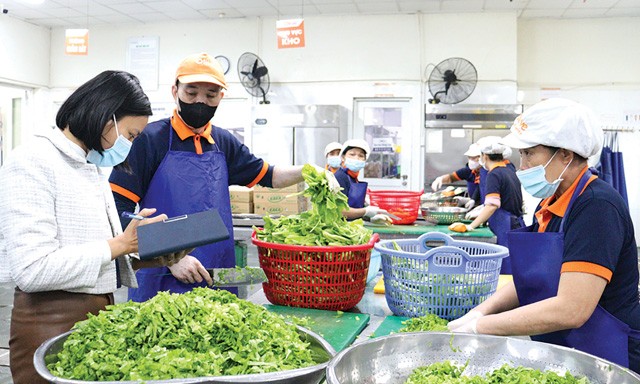
The Law on Food Safety 2010, effective from July 1, 2011, has provided an important framework for food safety and public health around Vietnam. Concerns remain over pre- and post-market controls, food safety in collective kitchens and street food eateries, and uneven testing capacity. A draft revised Law on Food Safety is therefore set to go before the National Assembly during October and will tentatively come into effect on January 1, 2027.
Speaking at a recent workshop on the draft, Mr. Dau Anh Tuan, Deputy Secretary-General of the Vietnam Chamber of Commerce and Industry (VCCI), pointed to a mismatch between risk classification and the level of procedures proposed under the draft. Article 43 classifies food into two risk groups, while Article 46 establishes three levels of procedures. This approach could prevent regulatory resources from being concentrated where they are most needed.
Cost of control
Comparing the draft with the Food and Agriculture Organization of the United Nations’ 2023 guidance on risk classification and the Law on Product and Goods Quality, Mr. Tuan called for a unified three-tier risk classification - high, medium, and low.
He added that requirements such as scientific evidence supporting product claims, R&D reports, and stability studies should apply only to health and wellness foods, rather than being imposed across the board on conventional foods or traditional products made by craft villages and small businesses.
The Vietnam Dairy Association (VDA) expressed similar concerns, saying the new rules could create a pre-market “bottleneck.” Under the current system, self-declaration requires two types of documents while registration requires four, with processing taking up to seven days.
Under the new draft, the number of required documents would increase to 14 and processing times extended to 15 days for self-declaration and 90 days for registration. The VDA warned that many traditional products may not be able to complete the required paperwork and could be forced to suspend operations.
From the perspective of international businesses, the American Chamber of Commerce in Vietnam (AmCham) noted that missing or outdated technical standards could create regulatory gaps and complicate inspection and enforcement.
A representative from EuroCham’s Nutritional Foods Group Sector Committee (NFG) said that if a “product standards declaration” requires a government agency to receive and process the declaration before a product can enter the market, it would effectively create a new form of pre-market control. This would alter the nature of the self-declaration mechanism and increase compliance costs by requiring periodic re-registration.
Risk and compliance history
To address such concerns, Mr. Nguyen Duc Thinh, Deputy Secretary-General of the Vietnam Association of Food Safety Science and Technology (VINAFOSA), stressed that food encompasses a broad range of products, from small-scale agricultural production and fresh foods to packaged industrial products. Each category has different sources of hazards, levels of exposure, and control capacity. Food therefore cannot be regulated through a single approach.
VINAFOSA has called for a gradual shift from managing “all food through a relatively uniform system of procedures” toward classifying risks and applying controls proportionate to those risks. Specifically, it proposes adding a risk-based management principle, with the level of pre-market control and inspection frequency determined by actual risks, product characteristics, and compliance history. It also recommends establishing a national risk classification system as the basis for designing appropriate regulatory approaches.
The Association proposes corresponding levels of control: targeted pre-market controls for high-risk products, while relying more heavily on self-declaration and post-market inspections for conventional packaged foods.
Compliance history should also become a basis for regulatory decisions. Businesses with strong compliance records should face fewer inspections, while violators should be subject to tighter controls.
At the same time, a separate transition pathway should be established for small-scale producers and businesses, with management gradually implemented through mechanisms such as production area codes, cooperatives, wholesale markets, and purchasing entities, rather than immediately imposing requirements designed for large factories.
Ms. Tran Hoang Yen, Deputy Head of the Representative Office of the Vietnam Association of Seafood Exporters and Producers (VASEP), likewise proposed that inspections of export shipments take businesses’ compliance histories into account. Facilities that have implemented management systems such as Hazard Analysis and Critical Control Points (HACCP) or ISO 22000 should be subject to less-frequent inspections.
Speaking at a recent workshop on the draft, Mr. Dau Anh Tuan, Deputy Secretary-General of the Vietnam Chamber of Commerce and Industry (VCCI), pointed to a mismatch between risk classification and the level of procedures proposed under the draft.
In seafood risk management, Mr. Nguyen Nhu Tiep, a representative from the Minh Phu Seafood Corp., emphasized the need to control residues of pesticides, veterinary drugs, and chemicals, and also proposed detailed rules establishing default maximum residue limits for substances for which no specific limits have been set. The law should also clarify conditions for changing the intended use of imported food and procedures for handling rejected shipments that are returned.
Clearer legal responsibilities
Ms. Chu Thi Van Anh, Vice Chairwoman and Secretary General of the Vietnam Alcohol - Beer - Beverage Association (VBA), said the beverage industry supports revising the law but also called for the elimination of duplicate controls. She proposed exempting imported raw materials, additives, and packaging used for internal production from State inspection and declaration requirements when they are not placed on the market. Businesses already have internal control systems and ultimately remain responsible for their finished products.
In addition, facilities certified under GMP, HACCP, ISO 22000, FSSC 22000, and other recognized systems should be exempt from the certificate of eligibility for food safety, the VBA believes.
Regarding the definition of “counterfeit food,” the Vietnam Association of Functional Foods and the VBA called for a clear distinction between labeling violations and serious quality violations.
Ms. Van Anh noted that some micronutrients, including Vitamins B and C, can naturally degrade under hot and humid conditions. The law should therefore introduce permitted tolerances based on Codex standards, which establish international food standards, guidelines, and codes of practice. If nutrient levels decline naturally within permitted limits, the product should not automatically be classified as “counterfeit food.”
For incidents involving food safety, the VBA proposed assigning responsibility according to each stage of the control chain: manufacturers should be responsible for production and labeling defects, while distributors or retailers should be responsible for storage and circulation after handover. The concept of “joint liability” should also be clearly defined to prevent the shifting of risk between parties.
From the perspective of the functional food industry, Mr. Do Viet Ha, Director of the Thai Minh High Technology JSC, proposed that the draft clearly separate functional foods as a distinct category and specify Good Manufacturing Practice (GMP) and Good Distribution Practice (GDP) standards to create a transparent legal framework for fair competition.
One of the key issues raised collectively by industry associations is the implementation timeline for the revised Law on Food Safety. With the date of effect tentatively scheduled for January 1, 2027, the VBA considers the timeframe too tight. It has proposed delaying implementation by at least six months from the date of promulgation, while allowing existing registration and self-declaration dossiers to remain valid for at least 36 months so that businesses have sufficient time to transition.





 Google translate