


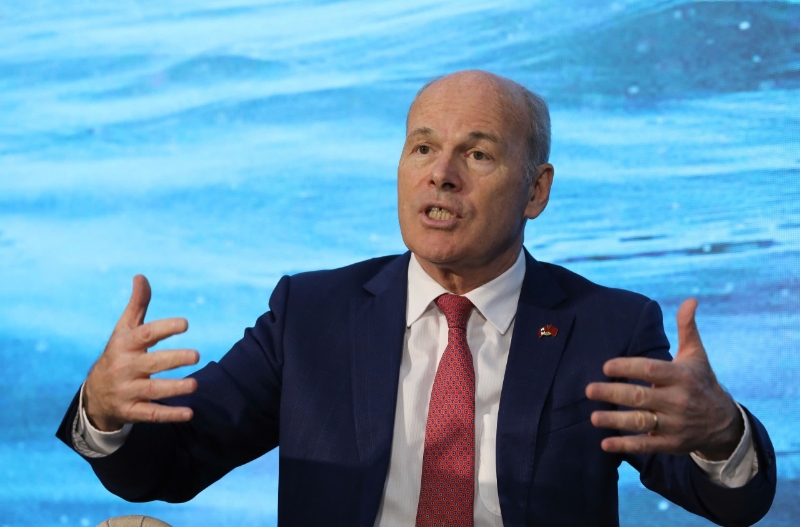
With more than 70 years of experience in the nuclear sector, Canada is among the few countries with capabilities spanning the full nuclear value chain - from uranium mining and reactor design to plant operation and waste management. The country is also emerging as a global leader in the development of small modular reactors (SMRs), a technology expected to play a major role in the future of clean energy.
In an interview with Vietnam Economic Times / VnEconomy, H.E. Mr. Jim Nickel, Canadian Ambassador to Vietnam, shared insights into Canada’s nuclear capabilities, the role of SMRs in the global energy transition, and opportunities for cooperation with Vietnam across the nuclear value chain.
Your Excellency, Canada has a long-standing and well-established nuclear power industry. Could you give us an overview of its development and current role in Canada’s energy mix? Additionally, could you share the Government of Canada’s current policies and strategic direction regarding nuclear power development in general, and in particular the deployment and promotion of small modular reactors (SMRs)?
Thank you very much. Canada has a very long history of involvement in the nuclear industry. In fact, we have approximately a 70-year history in the nuclear sector. It began with pioneering research carried out in Canada, including early scientific work related to radioactivity and the foundations of the nuclear age.
By the 1930s, Canada, through the National Research Council of Canada, had begun designing its first reactor concepts. In the 1940s, Canada built one of the early research reactors in the world.
Following that period, Canada went on to build one of the world’s first commercial nuclear power generation systems-the CANDU reactor. The CANDU reactor has since become a world-class and globally recognized nuclear technology.
Today, there are 46 operable CANDU and CANDU-derived reactors operating worldwide, in countries as diverse as China, South Korea, India, Argentina, Romania, and Canada itself. Domestically, Canada currently operates 17 CANDU reactors. These reactors generate approximately 12,700 megawatts of electricity. That represents around 13.5 percent of Canada’s electricity consumption.
Of course, in addition to power generation, the nuclear industry also contributes in many other areas, including medicine. Canada has extensive capabilities in nuclear medicine. There are more than one million radiological scans conducted using nuclear technologies, and thousands upon thousands of people receive radiation therapy for cancer treatment and other medical applications. So the medical dimension of the nuclear sector is also an important industrial and social contribution, in addition to electricity generation.
Canada has now developed extensive experience across the sector, including: scientific research, reactor design, manufacturing, operations, regulation, safety systems, workforce development. Because of this long experience, Canada today is a trusted global partner for many countries that are developing nuclear capabilities.
You also asked about small modular reactors, or SMRs. Based on the strength of 70 years of nuclear expertise, Canada has now moved from the concept stage of SMRs to actual deployment and commercial construction. With respect to conventional reactors such as CANDU, a company called AtkinsRéalis is the private sector company that licenses and builds CANDU reactors, while the Government of Canada retains ownership of the technology rights.
On the SMR side, in the province of Ontario-where Toronto is located-Canada is constructing the first commercial SMR in the G7 at the Darlington site. Canada is, in many respects, leading the OECD countries in the deployment of commercially viable SMRs. We are currently building the first of four GE Vernova Hitachi BWRX-300 SMRs, in Darlington, Ontario. Much of the engineering work is being carried out by Laurentis Energy Partners, an affiliate of Ontario Power Generation.
This is being developed in collaboration with GE Hitachi, demonstrating international cooperation as well. This will be the first SMR of its kind in a G7 country. We expect that reactor to be connected to the grid and supplying electricity at the end of 2030.
So the Government of Canada sees nuclear energy-including both conventional reactors and SMRs-as an essential part of a clean, reliable, and secure future energy system.
What are the key strengths of Canada’s nuclear sector, particularly in terms of technology, safety, and operational experience?
This is an interesting question. I believe Canada is uniquely positioned in the global nuclear industry because we possess the full value chain of the nuclear sector within one country.
Upstream, Canada has some of the largest uranium deposits in the world. From uranium mining and milling, to conversion and refining, to fuel fabrication, to reactor technology and engineering services, to plant operations and electricity generation, and even to the long-term storage and management of radioactive waste-Canada has capabilities across the entire lifecycle. From mining to spent fuel management, we have the technology, the expertise, and the operational experience.
We are very happy to share that knowledge and experience with international partners.
Canada also has a number of highly capable companies that have developed through this industry over many decades. These companies are active in areas such as: engineering services, manufacturing, reactor operations, regulatory systems, safety systems, environmental management, feasibility studies, project development. As I mentioned earlier, Canada has built dozens of CANDU reactors internationally. That means we have not only domestic operating experience, but also practical international experience in transferring technology and helping other countries develop nuclear industries.
Another important strength is education and workforce development. Canadian universities and colleges have faculties and research centers dedicated to nuclear science, nuclear engineering, safety systems, and advanced reactor technologies. They support: professional training, research and development, innovation, next-generation workforce development. This helps Canada remain at the forefront of the global nuclear industry.
On the small modular reactor side, Canada has already begun international cooperation. For example, we are working with Estonia in Europe to support its SMR development plans. The Canadian company involved there is Laurentis Energy Partners from Ontario, which provides engineering services related to SMRs. That is one of our first international efforts to help another country develop SMR capability. So Canada is open to collaboration, and we are always looking for strong partners.
How does Canada see the role of nuclear energy-including both conventional nuclear power plants and advanced technologies-in the global energy
We see nuclear energy as a very important part of both the global energy transition and the need for long-term energy security. You can look at this from several perspectives: sustainability, geopolitics, economic growth, net-zero objectives, industrial competitiveness
Nuclear power is highly relevant in all of these areas. That includes both traditional large reactors and new-generation small modular reactors. For Canada, there are two especially important dimensions.
First: Sustainability, Canadian nuclear energy provides reliable zero-emission electricity generation. That makes it a very valuable tool in reducing emissions while maintaining stable baseload power.
Second: Energy Sovereignty, for a country such as Vietnam that seeks secure and sovereign control over its energy future, nuclear energy can be highly strategic. For example, with CANDU technology, reactors use natural uranium rather than enriched uranium. That means cooperation can include not only reactor technology, but also fuel fabrication capability. So a country can gain additional sovereignty over its energy supply by having more control over both power generation and fuel supply. I think that is a very important point. Even in Canada, there has been renewed interest in nuclear power as a clean and reliable source of electricity.
And when I look at Vietnam’s Power Development Plan VIII, I can see that Vietnam is also considering nuclear power as part of its future energy mix. I believe that is a very wise strategic decision.
Building on that foundation, Canada is also recognized as a global leader in small modular reactors. Could you briefly introduce Canada’s capabilities in this field, and what are the key advantages of SMRs compared with traditional nuclear power plants?
Yes, as I mentioned earlier, Canada has now moved from the concept stage of SMRs to actual deployment and construction. We are leading the pack within the OECD. Canada is the only country in the G7 currently building a commercial small modular reactor. We are able to do this because of our 70 years of experience in the nuclear field. We have the expertise in Canada. We have the skilled workforce. We have the research and development background required to deliver these projects successfully.
We are currently constructing the first of four SMRs in the province of Ontario. By 2030, these facilities will be connected to the grid and delivering electricity.
You also asked about the advantages of SMRs compared with traditional large reactors.
There are several important advantages. Compared to conventional reactors, SMRs offer lower upfront capital requirements; phased and scalable deployment, including more diversified and easier sitting options; and the ability to deliver power in smaller, more flexible increments.
With a very large conventional reactor, site selection is a major undertaking. SMRs provide more options and can be deployed in a wider range of locations.
Third, they can support smaller grids. Where grid capacity is more limited, an SMR can still provide an appropriate and reliable power supply. This may be useful for: smaller communities, industrial zones, remote regions, mining or resource developments
Like large-scale nuclear plants, SMRs can also provide dependable low-emission baseload power. But they do so with greater flexibility and modular deployment options. These are some of the major advantages of SMRs.
Your Excellency, how can Vietnam and Canada cooperate across the nuclear value chain-from conventional nuclear power to SMRs-including technology, operations, and human resource development?
Canada is very keen to cooperate with trusted partners who are interested in developing nuclear capabilities. Vietnam is certainly one of those important partners. Canada has already taken initial steps in this regard. In November 2025, Canada hosted a nuclear industry workshop in Hanoi. We invited relevant Vietnamese ministries and agencies, PetroVietnam, EVN, and private sector stakeholders. From the Canadian side, participants included: AtkinsRéalis, the company that licenses CANDU technology; Laurentis Energy Partners, involved in SMR engineering and deployment; The Organization of Canadian Nuclear Industries; Canadian universities and colleges active in nuclear research and training; Suppliers across the nuclear value chain
The purpose of that workshop was to present Canadian capabilities and begin practical discussions with Vietnamese stakeholders. I think that was an important first step. Another area where Canada can assist is regulatory development.
As you know, nuclear power requires a sophisticated legal and regulatory framework. Canada has deep experience in this area through the Canadian Nuclear Safety Commission, which oversees nuclear safety and regulation domestically. That expertise has also been shared with other countries.
So regulatory cooperation is another natural area for Vietnam-Canada collaboration.
We have also brought leading Canadian companies, especially AtkinsRéalis and Laurentis Energy Partners, to meet Vietnamese stakeholders and discuss Vietnam’s future needs in the nuclear sector.
Through these exchanges, we can better identify where Vietnam wishes to go and how Canada can best support that journey.
With Vietnam opening opportunities for private sector participation in Small Modular Reactor (SMR) projects , how do you see the role of Canadian companies? And Are Canadian companies ready for technology transfer or joint development of nuclear projects, including SMRs, in Vietnam?
Yes, I believe there is considerable potential. Naturally, developing a nuclear industry takes time. There are many elements involved, including: technology, skilled manpower, financing, regulatory systems, industrial supply chains, long-term planning.
I understand that Vietnam is committed to moving forward in the nuclear field. What Canada can do as an initial step is deepen consultations, discussions, and information sharing between Canadian companies, Canadian institutions, the Government of Canada, and Vietnamese counterparts. Through that process, we can identify: Where the opportunities are; Where gaps may exist; What capabilities need to be strengthened and How partnerships can be structured? Those discussions can include technology, manufacturing, workforce development, regulation, and financing. Canadian companies are certainly ready to participate in those conversations and explore practical cooperation models.
Finally, what message would you like to send to Vietnamese businesses and policymakers regarding cooperation with Canada in the energy sector?
Canada, as I said earlier, is an energy superpower. We have conventional energy resources. We have renewable energy. We have clean technologies that help reduce emissions. We are doing significant research and development in the energy field. We have highly experienced companies operating across the sector. And, of course, we have substantial natural resources to share with the world.
As Vietnam’s economy continues to grow rapidly, as manufacturing capability rises to higher levels, and as demand for energy continues to increase, I believe we should work together on reliable, secure, and clean sources of energy for Vietnam’s future.
Canada could be a very strong partner for Vietnam in this regard.
We look forward to continuing discussions with the Government of Vietnam, private companies, and other interested stakeholders. Whether in: oil and gas, LNG, carbon capture, utilization and storage, renewable energy, conventional nuclear power, small modular reactors (SMRs). I believe we can build a mutually beneficial partnership.


 Google translate