


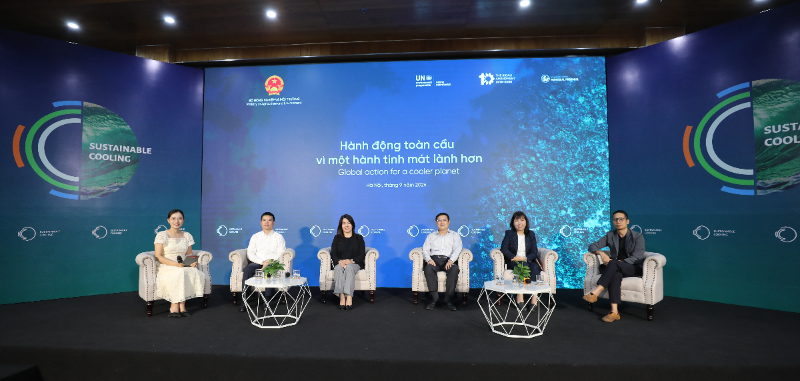
At a seminar titled “Global Action for a Cooler Planet,” co-hosted by the Department of Climate Change under the Ministry of Agriculture and Environment, the Vietnam Economic Association, and Tap chi Kinh te Viet Nam /VnEconomy/Vietnam Economic Times on September 14 to mark World Ozone Day 2026 (September 16), experts and industry leaders highlighted strategic pathways to address rising cooling demand through technological innovation and energy efficiency.
Assoc. Prof. Dr. Nguyen Viet Dung, Vice Rector of the School of Mechanical Engineering at Hanoi University of Science and Technology, emphasized that cooling demand is expanding rapidly alongside global warming, urbanization, industrialization, and the rapid rise of digital transformation and tech industries.
According to him, electricity consumption for cooling currently accounts for over 25 percent of Vietnam’s national total, and without effective control measures, the sector could account for nearly 10 percent of national greenhouse gas emissions by 2030.
Dr. Dung noted that over the past two decades, the market experienced double-digit annual growth during the first ten years, expanding at nearly triple the rate of Vietnam’s average GDP growth. Over the last decade, while growth has moderated slightly, it remains nearly double the global average for the cooling sector.
According to power consumption data, cooling consumes 25.5 percent of Vietnam’s total commercial electricity output, a figure that could triple by 2030 without intervention - aligning with International Energy Agency (IEA) projections that global cooling will account for 25 to 30 percent of commercial electricity output by 2030 or 2035, outpacing traditional industries.
From the equipment supplier perspective, Ms. Nguyen Thi Le Thanh, Director of Daikin Air-Conditioning Vietnam, acknowledged the rapid changes in air conditioning technology and market dynamics under pressures to save energy, reduce greenhouse gas emissions, and ensure cost-effective operational management.
“The future of the air conditioning industry is not only about providing a comfortable and convenient environment for users, but also about contributing to reduced power consumption and supporting sustainable development,” Ms. Thanh said, adding that “These factors are driving air conditioner manufacturers like us to invest heavily in advanced technologies to lower energy demand as well as environmental impacts.”
Complementing these technological advancements, Mr. Nguyen Cong Thinh, an expert in built environment, energy efficiency, and green buildings, highlighted key opportunities for energy optimization across physical infrastructure.
Drawing from scientific research and international project audits, he noted that electricity used for ventilation, cooling, and air conditioning currently accounts for 40 to 60 percent of a building’s total energy consumption. Implementing smart cooling solutions, green building standards, and energy-saving designs thus offers immense potential to reduce power loads, cut operational costs, and accelerate Vietnam's transition toward a sustainable, low-carbon economy.


 Google translate