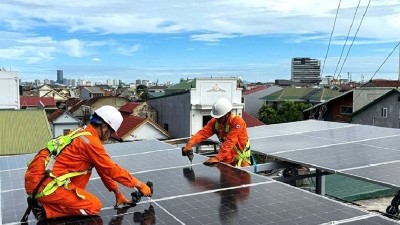
As Vietnam strives to become a regional green finance hub, the demand for "green" real estate projects—characterized by energy efficiency and environmental friendliness—is expected to escalate in the near future.
Mr. Nguyen Thanh Nghi, Politburo Member, Secretary of the Party Central Committee, and Chairman of the Central Commission for Policy and Strategy, delivered remarks at the recent national scientific conference on how Vietnam can redesign its development model to achieve high-income status by 2045.
The central city of Vietnam has a strong interest in learning about climate finance mobilization mechanisms, green bond development, carbon credits, and disaster risk insurance solutions—areas where Luxembourg possesses extensive expertise.
Strengthening cooperation among ASEAN cities is not only an inevitable necessity but also a crucial driver for realizing a resilient, creative, and sustainable ASEAN Community.
The sea should not be viewed solely as an area for resource exploitation or sectoral economic development. It must be recognized as a strategic national development space where economic growth, national defense, security, science and technology, and international integration converge, said Party General Secretary and State President To Lam.
Vietnam must overhaul its development model based on science, technology, and digital transformation, while ensuring the safety of the ecological environment in order to achieve rapid, sustainable growth and high-income status, Party General Secretary and State President To Lam said in his article.
Experts attending a seminar told Vietnam Economic Times / VnEconomy that small modular reactors (SMRs) could strengthen Vietnam’s energy security, support decarbonization, and open new pathways for technology, workforce, and industrial development.