


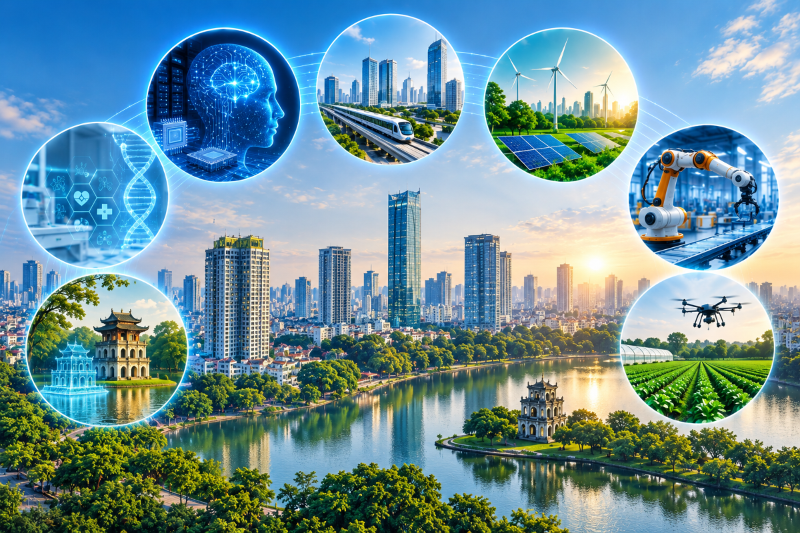
Under Decision No. 4884/QD-UBND dated September 10, 2026, signed by Vice Chairman of the Hanoi People’s Committee Truong Viet Dung, a list of priority sectors for innovation support and innovative startup support in the capital city for the 2026–2030 period has been announced.
The list comprises seven priority sectors:
First, digital technology, artificial intelligence, information and communications technology, and quantum technology, including artificial intelligence; big data; digital twins; cloud computing; edge computing; the Internet of Things; blockchain; quantum computing; information security; cybersecurity; data protection; and digital identification, authentication and trust.
Second, digital government and smart cities, including digital public services; data-driven urban governance; smart parking; e-ticketing; technologies for the management, operation and exploitation of urban railways; intelligent traffic management; urban logistics; and charging infrastructure.
Third, environmental technology, carbon-emission reduction and climate change adaptation, including environmental monitoring and early warning systems; waste treatment; resource efficiency; greenhouse gas emission reduction; development of carbon markets; clean energy; energy efficiency; flood and natural disaster warning systems; green urban solutions; green transport; and climate change adaptation.
Fourth, manufacturing technology, automation and new materials, including robotics; automation; sensors; embedded systems; 3D printing; smart manufacturing; semiconductor chip design, testing and packaging; and biomaterials, green materials and advanced materials.
Fifth, smart healthcare and applied biomedical technologies, including artificial intelligence for diagnosis, treatment and health management; smart medical devices; biosensors; biotechnology for healthcare; preventive medicine; and telemedicine.
Sixth, digital cultural industries and smart tourism, including creative design; digital communications; the digitization, preservation and exploitation of digital heritage; digital museums; smart tourism maps; virtual reality and augmented reality; and cuisine, traditional craft villages and products showcasing Hanoi’s cultural identity.
Seventh, high-tech agriculture and biotechnology, including smart agriculture; precision agriculture; the application of high technologies in the production, harvesting, preservation and processing of agricultural products; biotechnology for breeding, biological products, and the preservation and processing of agricultural products; as well as traceability and quality and food safety control.





 Google translate