


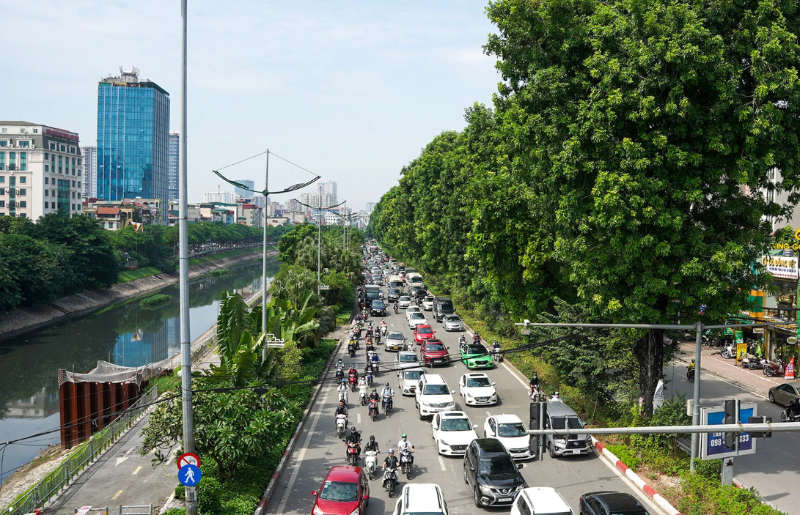
The Hanoi Department of Construction has submitted a report to the Hanoi People’s Committee regarding the renovation and expansion of Ring Road 2, encompassing both elevated and ground-level sections from Nga Tu So to Cau Giay (Lang Street), with an estimated total investment of over VND21 trillion (nearly $804 million).
According to the proposal, this is a Group A project and a special-grade road transport infrastructure, slated for implementation between 2025 and 2028. Within the total investment, site clearance costs account for a significant portion, approximately VND 17 trillion (nearly $651 million), while the remainder is allocated for construction and related items.
The Department of Construction has evaluated two primary investment options:
Option 1: Construction of a viaduct (elevated bridge). The centerline of the elevated section would align with the planned centerline of the ground-level road. The proposed cross-section is approximately 53.5 meters for the ground road and 19 meters for the elevated bridge. This option is highly regarded for ensuring synchronization with urban planning, providing convenient traffic connectivity, being suitable for domestic construction capabilities, and requiring lower investment costs.
Option 2: Construction of a large-diameter tunnel. This would be combined with a specialized drainage system for flood prevention.
According to the department, option 2 faces numerous technical and logistical challenges. Therefore, following a detailed analysis, the department has recommended option 1 (the viaduct) as the optimal choice for investment.
Furthermore, the department suggested that the project initially be implemented through public investment using the city budget to accelerate progress. At a later stage, the city could consider converting the project to a Public-Private Partnership (PPP) model to diversify capital sources.





 Google translate