


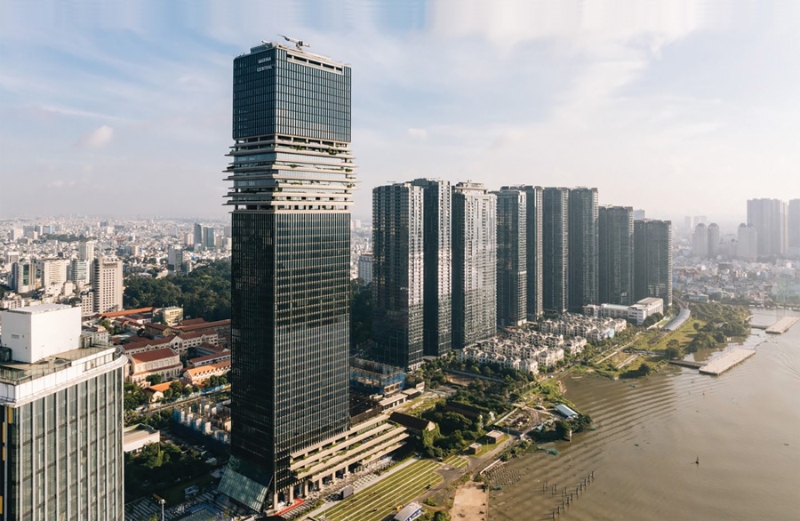
Ho Chi Minh City has accelerated its efforts to establish itself as a regional and international financial hub since the International Financial Center (IFC) in the southern city was officially launched on December 19, 2025. Throughout this journey, the British Consulate General and the British Chamber of Commerce Vietnam (BritCham Vietnam) have provided specialized support and strategic engagement. Building on this momentum, the Consulate General, BritCham, and Dragon Capital co-hosted the UK-Vietnam Open Conference on the International Financial Centre (IFC) 2026 in Ho Chi Minh City on March 25, with the theme “Financial Market Infrastructure.”
Addressing the Conference, Ms. Alexandra Smith, British Consul General in Ho Chi Minh City, underscored that the development of IFCs in Ho Chi Minh City and central Da Nang city represents an extraordinary opportunity for Vietnam, but their success depends on getting the foundations right from the outset. A truly competitive IFC rests on three core pillars: a robust legal framework, a credible and independent regulatory system, and sophisticated market services that enable the trading and mobilization of capital, attract high-quality foreign investment, and position Vietnam as a dynamic and trusted hub within the global financial system.
International alignment with local standards.
“The term ‘international’ in IFC refers to the ability to attract global capital, reflecting Vietnam’s own ambitions,” according to Ms. Angela Knight, Chair of the Astana Financial Services Authority (AFSA) in Kazakhstan and Member of the Astana IFC (AIFC) Management Board. “Drawing on my AIFC experience, I emphasize the importance of an independent regulator that coordinates effectively with both the financial center and national authorities.”
Kazakhstan operates a dual legal system. The AIFC was established under a special constitutional law that allows a distinct legal regime for financial services, including civil and commercial matters. The legal framework provides the foundation, while regulation delivers specific rules, supervision, and enforcement to ensure market integrity and stability.
The adoption of English law, combined with an independent court and regulator, has created a structure designed to attract international investors. The AFSA aligns elements with international standards, including Basel Committee guidelines and the International Organization of Securities Commissions (IOSCO), the International Association of Insurance Supervisors (IAIS), and the Financial Action Task Force (FATF) standards. The regulator focuses on capital markets, asset management, and fintech, engaging closely with international bodies to stay up to date and ensure compliance across jurisdictions. Local context is considered, but FATF rules are strictly enforced.
Independence is safeguarded through board composition, where most members are not affiliated with the government or the financial center. Public consultation supports transparency. All proposed rules are open to stakeholder input, with regular updates to keep the regulatory framework responsive to market developments.
From Vietnam’s perspective, a truly competitive IFC rests on three core pillars, as Consul General Smith noted above.
The first is a robust legal framework. A modern IFC requires transparency, stability, and predictability to inspire investor confidence, best reinforced through English common law. Around 40 per cent of international commercial contracts worldwide are governed by English law, highlighting its clarity and global recognition. The UK has collaborated with Vietnam’s Supreme Court and advisory groups from TheCityUK to shape the IFC court in Ho Chi Minh City.
The second is a credible regulatory framework. An independent, transparent, and well-resourced regulator is essential to oversee complex financial activity, attract institutional investors, and align Vietnam’s markets with international standards.
The third pillar focuses on market services that enable efficient capital flows. Vietnam has the opportunity to accelerate growth by developing specialized trading platforms, including commodity derivatives exchanges. The UK is providing technical support, drawing on international models, particularly London, to facilitate hedging, investment, and price discovery across commodities, energy, green bonds, and other sustainable instruments.
Together, these three pillars form the backbone of a competitive IFC. With these elements in place, Ho Chi Minh City and Da Nang can transform Vietnam’s financial landscape and elevate the country’s position in global markets.
Building a modern commodities market.
At the Conference’s panel discussion entitled “Commodity and Derivatives Markets - Market Practice and Institutional Perspectives,” experts examined the key foundations required for the development of modern commodity markets, particularly derivatives markets, in close connection with the legal framework, regulatory architecture, and market infrastructure supporting the development of Vietnam’s IFC. Speakers noted that the commodity market, particularly agricultural products, is facing a lack of synchronization between output and prices.
According to Mr. Dominic Scriven, Chairman of Dragon Capital, the core challenge in Vietnam’s commodity markets does not lie in production capacity but in how the market is organized to ensure more transparent and efficient price discovery mechanisms.
By way of example, he spoke of the coffee sector, where farmers and businesses in many cases still face structural information asymmetries, resulting in situations where “they have volume but no price” or the opposite. This reflects a structural weakness in the market, where price signals do not yet fully capture supply and demand dynamics.
He also stressed that the long-term objective is to transform fragmented competition between market participants into a collective advantage for the entire value chain, thereby improving market efficiency, transparency, and overall value creation within the commodities ecosystem.
From a strategic advisory perspective, Mr. Vincent Chin, Senior Partner at Boston Consulting Group, observed that Vietnam’s agriculture sector is highly-competitive but remains fragmented, limiting the overall efficiency of the value chain.
In his view, the issue is not a lack of competition, but rather the absence of a structured mechanism to translate competition into collective market strength. The key challenge, therefore, is to design frameworks that transform competition among producers into a shared market advantage, thereby improving overall resource allocation and operational efficiency.
Mr. Chin highlighted three critical pillars for a well-functioning derivatives market: a reliable settlement system, transparent price formation mechanisms, and a clear legal and regulatory framework to safeguard market integrity. Additionally, he underscored counterparty risk as a key area requiring strict control.
Meanwhile, Mr. Warrick Cleine, Chairman and CEO, Managing Partner - Deal, Tax and Legal Advisory at KPMG in Vietnam and Cambodia, emphasized that market infrastructure is a fundamental determinant of the long-term sustainability of commodity and derivatives markets. “A modern market cannot function effectively without robust clearing and settlement systems, combined with transparent pricing standards,” he said. “These elements are essential to ensure market stability, reduce systemic risk, and enhance investor confidence.”
From a regulatory standpoint, Mr. Tran Huu Linh, General Director of the Agency for Domestic Market Surveillance at the Ministry of Industry and Trade, emphasized the need to strengthen market transparency while continually improving supervisory mechanisms to ensure fairness, stability, and effective market operation.
Some participants emphasized that the design of an IFC must ensure a high degree of internationalization, including the recognition of common law principles, the use of the English language, and adherence to international financial reporting standards, in order to facilitate access for global investors. It was also noted that regulatory frameworks need to be more flexible to accommodate different types of markets, whether financial markets or physical commodity markets.
A modern market cannot function effectively without robust clearing and settlement systems, combined with transparent pricing standards. These elements are essential to ensure market stability, reduce systemic risk, and enhance investor confidence.
The term ‘international’ in IFC refers to the ability to attract global capital, reflecting Vietnam’s own ambitions. Drawing on my AIFC experience, I emphasize the importance of an independent regulator that coordinates effectively with both the financial center and national authorities.





 Google translate