


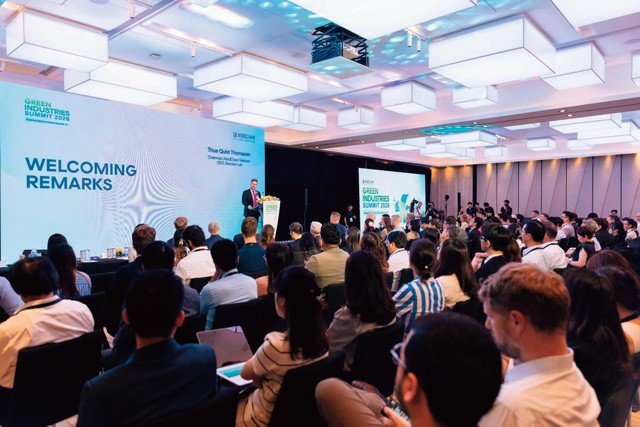
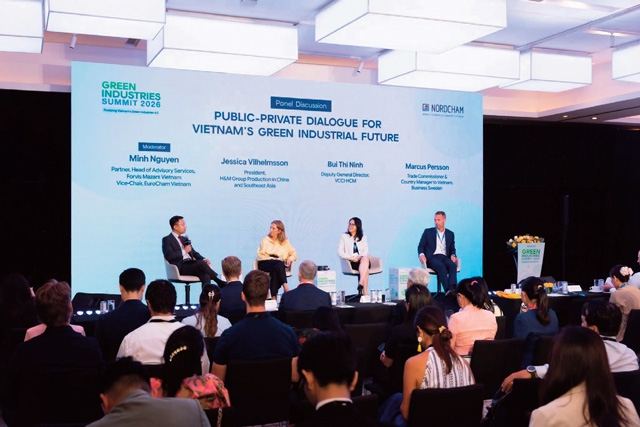
As green standards become more deeply embedded in global investment decisions, narrowing the gap between policy ambition and implementation is emerging as a critical factor in attracting the next wave of high-quality investment to Vietnam. This shift was highlighted during the “Public-Private Dialogue for Vietnam’s Green Industrial Future” panel discussion held within the Green Industries Summit 2026, organized by NordCham Vietnam on September 10, where Nordic businesses looked beyond production costs to assess whether Vietnam can provide the wider ecosystem required for resilient, low-carbon, and increasingly technology-intensive manufacturing.
From attraction to value creation
Vietnam is entering a new phase of FDI attraction, with greater emphasis on the value generated by foreign investment rather than simply the amount of capital committed. Mr. Minh Nguyen, Partner and Head of Advisory at Forvis Mazars Vietnam and Vice Chairman of EuroCham Vietnam, pointed to Politburo Resolution No. 10-NQ/TW on developing the foreign-invested economic sector, issued on June 8, 2026, as an indication of this shift.
The Resolution places greater emphasis on investment quality, technology transfer, value addition, supply chain participation, and stronger links between foreign and domestic businesses. It also calls for investment attraction to move beyond administrative boundaries toward industry clusters, value chains, and innovation ecosystems.
By 2030, Vietnam aims for 75 per cent of FDI capital to come from developed economies, an average domestic localization rate of 45-50 per cent in key industries, and around 10,000 domestic enterprises to participate in the value and supply chains of foreign-invested enterprises (FIEs), including 500 to 1,000 Tier 1 suppliers. The resolution also links FDI attraction with environmental, social, and governance (ESG) standards, the green economy, and Vietnam’s net-zero emissions target.
“These directions are still at a high policy level,” Mr. Minh explained. “The discussion on green industry and dialogue between businesses and investors is therefore the next step in translating those directions into practice.” The more fundamental change, he continued, lies in how FDI is viewed. The focus should not only be on how much capital a project brings, but also on how much value it creates domestically, how it connects with Vietnamese companies, and how it contributes to building production ecosystems.
The policy shift increasingly mirrors changes in how international businesses assess production locations. Mr. Marcus Person, Trade Commissioner and Country Manager in Vietnam at Business Sweden, said labor costs, talent, land, industrial parks, incentives, and logistics remain important criteria. Their relative weight, however, is changing.
Around 25 years ago, China was a major destination for Swedish investment, while Vietnam attracted relatively limited attention. Over the past decade, companies operating in China have increasingly looked to Southeast Asia for additional production locations, putting Vietnam more firmly on the investment map. At the same time, sustainability requirements have moved rapidly up the agenda.
Ms. Jessica Vilhelmsson, Chair of H&M Group Production in China and Southeast Asia, said the clothing retailer has sourced from Vietnam for decades but cost is no longer considered in isolation when deciding where a particular product or production stage should be manufactured. “The opportunity for Vietnam is to move from having strong production capabilities to building a complete ecosystem with a low-carbon footprint,” she said. For apparel, this ecosystem extends beyond garment factories to fabrics, buttons, accessories, raw materials, and other upstream inputs.
The same principle applies across other manufacturing sectors. Production scale alone is becoming a less durable advantage when it is not supported by domestic suppliers, technology, clean energy, logistics, and skilled labor.
Deeper domestic capabilities
The challenge for Vietnam is therefore not simply to increase the number of suppliers, but to increase the value captured domestically.
Some Swedish investments were still directed to Thailand or Malaysia around five years ago because Vietnam lacked certain supply chains and access to advanced inputs and services. “Over the past five years, Vietnam’s supply chains have developed and upgraded significantly in a number of areas,” Mr. Person said.
The next step is to deepen these capabilities so that foreign investors can source more inputs domestically and retain a greater share of value in Vietnam. Mr. Minh said achieving a 45-50 per cent localization rate in key industries would require more than setting a target. Vietnamese companies need earlier information on what foreign investors intend to source, which products are in demand, and which inputs they need to develop.
More effective information sharing between FIEs and domestic suppliers could allow Vietnamese businesses to prepare the capabilities required to participate in supply chains.
According to Ms. Bui Thi Ninh, Deputy General Director of the Vietnam Chamber of Commerce and Industry (VCCI) in Ho Chi Minh City, this is particularly important for small and medium-sized enterprises (SMEs), which account for around 98 per cent of all Vietnamese businesses.
While large enterprises and FIEs generally have stronger capabilities in certification, emissions measurement, and green standards, many SMEs continue to face constraints in access to green energy, information, supply chain connections, capital, and skills.
Workforce quality is another limiting factor. Only around 5 per cent of Vietnam’s workforce is highly-skilled, while 24-27 per cent have received formal training and certification. As production moves toward higher value-added activities, workforce development will need to advance alongside industrial upgrading.
The investment ecosystem also extends beyond factories and suppliers to the regulatory environment. Mr. Person identified policy transparency and predictability as major concerns for Swedish companies considering investment in Vietnam.
Businesses need clarity not only on regulatory requirements but also on how long procedures will take and whether stated timelines can be relied upon. “If the authorities say a procedure takes three months, businesses need to be able to trust that it will be completed in three months,” he said.
Ms. Vilhelmsson cited the Direct Power Purchase Agreement (DPPA) mechanism as an example of how the gap between policy ambition and implementation can affect investor confidence. For international manufacturers seeking to meet increasingly stringent sustainability requirements, uncertainty over access to renewable electricity can become part of the investment calculation. Predictability is therefore becoming a component of competitiveness as countries compete for high-quality investment.
Closing the implementation gap
For Vietnam, the immediate challenge is to translate policy direction into conditions that businesses can act on. Ms. Ninh said expanding clean energy supply and improving comprehensive, continuously updated data and information systems would help businesses make investment decisions.
At the enterprise level, Mr. Minh called for stronger dialogue between FIEs and Vietnamese businesses so that requirements on products, standards, and suppliers can be communicated earlier. Mr. Person also pointed to closer coordination between businesses, universities, associations, and other stakeholders through a “triple helix” or “quadruple helix” model. The objective is to connect different parts of the ecosystem rather than address energy, skills, supply chains, technology, and investment procedures separately.
Politburo Resolution No. 10 similarly calls for a transparent, stable, consistent, and predictable investment environment with lower compliance costs, alongside an integrated ecosystem covering domestic enterprises, industrial parks, logistics, data, energy, high-tech zones, and innovation centers.
International sustainability requirements are often viewed by Vietnamese businesses as an additional compliance burden, but they could also accelerate the development of capabilities that increasingly determine access to global supply chains.
Mr. Minh noted that European regulations such as the Carbon Border Adjustment Mechanism (CBAM) could encourage Vietnam to develop systems compatible with international standards and retain more of the value generated by the green transition domestically.
For Vietnam, the emerging competitive advantage could therefore lie in its ability to offer a green manufacturing ecosystem built around deeper domestic supply chains, cleaner energy, stronger human capital, and a more predictable investment environment. That would give practical substance to Politburo Resolution No. 10’s objectives on FDI quality, localization, and stronger links between foreign investors and Vietnamese enterprises.







 Google translate