


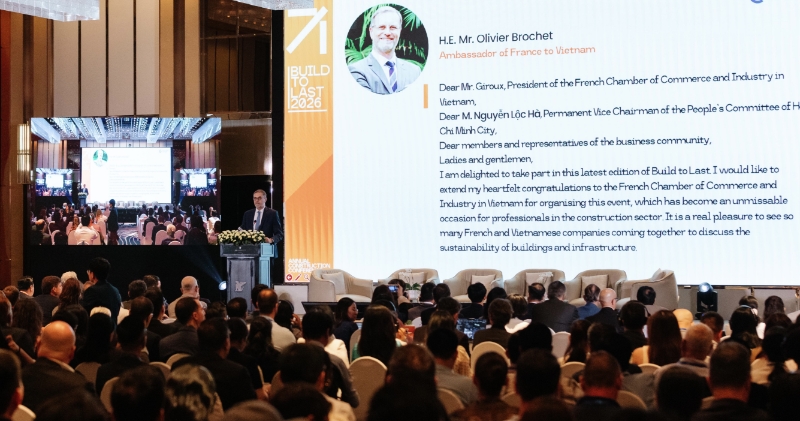
Vietnam’s construction industry remains a key pillar of its economy, contributing some 17 per cent of GDP and posting growth of about 9 per cent in 2025. This momentum is expected to continue, driven by the government’s push to accelerate major infrastructure projects in cooperation with the private sector. Ensuring that these projects meet green standards across responsible architecture, urban planning, public transport, and energy efficiency will be critical for sustainable future and more livable cities.
These remarks were made by H.E. Olivier Brochet, Ambassador of France to Vietnam, at the Build to Last 2026 Conference organized by the French Chamber of Commerce and Industry in Vietnam (CCIFV) in Ho Chi Minh City on April 7.
The gathering aimed to promote dialogue and strengthen cooperation across the construction and urban development ecosystem.
Strengthening climate cooperation
The Ambassador underscored the central role of sustainable construction, alongside strong participation from French and Vietnamese businesses and the international community.
Globally, the construction sector accounts for a significant share of worldwide emissions while contributing around 11 per cent of global GDP and 7 per cent of employment. Beyond its economic importance, the sector directly affects quality of life, underscoring its critical role in addressing climate change and making sustainability both an environmental and socio-economic priority.
According to Ambassador Brochet, the transition toward greener cities requires coordinated effort from multiple stakeholders, including governments, local authorities, businesses, investors, and research institutions. He also emphasized the importance of international cooperation, citing Vietnam and France’s engagement in the Global Alliance for Buildings and Construction (GlobalABC), a United Nations-backed initiative aimed at decarbonizing the building sector.
“Through the French Development Agency (AFD), France is supporting Vietnam in its efforts to adapt to climate change,” he told the Conference. “On the one hand, it has funded several projects aimed at reducing flood risks in various provinces, while on the other it grants loans to Vietnamese public and private banks to support small and medium-sized enterprises (SMEs) investing in the green transition. Finally, it advises Vietnam on the implementation of a carbon emissions trading scheme.”
In terms of climate change mitigation, the AFD signed several financial agreements at the EU-Vietnam Global Gateway Business and Investment Forum in Hanoi on March 24, including support for the Bac Ai pumped-storage hydropower plant, while continuing to invest in power infrastructure, including grid modernization.
From commitments to outcomes
Beyond policy discussions, the conference highlighted broader dimensions of sustainable urban development, including integrated planning, transport and logistics infrastructure, and the adoption of green energy and construction materials.
The role of the private sector in advancing sustainable construction also featured prominently. At the event, French multinational Saint-Gobain announced that its DURAflex fiber cement board plant in central Quang Tri province recorded net-zero carbon emissions for Scope 1 and Scope 2, becoming the first facility of its kind in Vietnam to reach this milestone.
Mr. Hai Nguyen Truong, CEO of Saint-Gobain Vietnam, said the milestone reflects the company’s commitment to translating sustainability goals into concrete outcomes, contributing to Vietnam’s net-zero emissions by 2050 target. Mr. Ludovic Weber, CEO of Saint-Gobain Asia, described Vietnam as a strategic market for the group, noting that the achievement underscores the country’s potential as a hub for low-carbon innovation.
Experts at the Conference also shared insights into the international building standards available in Vietnam. Speaking to VnEconomy / Vietnam Economic Times, Ms. Pearl Mars, Business Development Director - Building and Infrastructure (BNI) & Building Resilience Index (BRI) at Bureau Veritas, noted that while international certifications are being increasingly adopted in the country, the distinction between “sustainability” and “resilience” remains unclear in practice.

“Standards such as LEED and EDGE focus primarily on operational efficiency and energy savings,” she explained. “In contrast, BRI emphasizes a building’s ability to adapt to and withstand risks such as storms and flooding.”
Sustainability and resilience, she continued, address different dimensions of the climate challenge. While sustainability focuses on mitigating climate change, for example by reducing reliance on fossil fuels, resilience is concerned with adapting to increasingly frequent and severe climate-related risks.
In Vietnam, where exposure to natural disasters is significant, this distinction is becoming increasingly important. “After a major storm, the objective is not only for a building to remain structurally intact, but also to resume operations as quickly as possible,” Ms. Mars said. “Each day of disruption represents a financial loss.”
Despite the clear benefits, she added, adoption remains constrained by high upfront costs and limited awareness. Many developers, particularly in storm-prone central regions, remain hesitant to invest in resilience upgrades due to short-term profitability considerations.
Awareness about BRI in Vietnam remains in its early stages, with recognition estimated at around 30 per cent; significantly lower than in Singapore, where it exceeds 90 per cent. As such, Ms. Mars underscored the need for stronger communication efforts to raise market awareness. From an economic perspective, investing in resilience delivers clear returns. Studies show that every $1 invested in resilient construction can save approximately $4 in post-disaster repair and recovery costs.
Looking ahead, she suggested that resilience standards be integrated from the design stage to optimize both cost and effectiveness. However, even existing buildings can still be assessed and upgraded using available frameworks.
 Google translate