


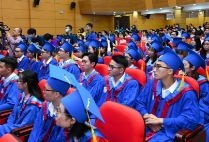
Under Prime Ministerial Decision No. 2711/QD-TTg, signed by Deputy Prime Minister Nguyen Chi Dung on December 15, 2025, the National Strategy for Intellectual Workforce Development during the period of accelerated industrialization and modernization to 2030, with a vision to 2045, has been approved.
The strategy aims to develop the Vietnamese intellectual workforce as a driving force for the development of modern productive forces, leading digital transformation, innovation, and international integration, according to the Government News.
It is intended to serve as a key impetus for Vietnam to achieve its goal of becoming a developing country with modern industry and upper-middle income status by 2030, and a developed, high-income country by 2045, while also contributing to addressing global and regional challenges.
By 2030, the strategy targets to increase the full-time workforce engaged in scientific research, technological development, and innovation to 12 persons per 10,000 people, making it an especially important productive force. The proportion of learners in basic sciences, engineering, and technology is expected to reach at least 35 per cent, including at least 6,000 doctoral candidates and 20,000 individuals enrolled in talent programs.
The strategy also aims to raise the rate of the intellectual workforce in high-tech industries and strategic industries to 25 per cent. At least 40 per cent of participants in employment, research, teaching, and leadership positions in the fields of science, technology, and innovation are to be women and individuals from minority groups.
The strategy targets to attract 1,000 outstanding overseas Vietnamese intellectuals to participate in scholar exchanges, research cooperation, training, and technology transfer in the country through flexible working arrangements.
By 2045, Vietnam will strive to have a strong, high-quality, and well-structured intellectual workforce that ranks among the leading groups in the region and approaches the level of developed countries. This workforce is expected to pioneer in digital transformation, innovation and international integration, serving as a decisive driver of Vietnam's development into a high-income country and contributing to global progress and civilization. A national intellectual ecosystem is envisioned, closely linking the public and private sectors, as well as the domestic and overseas Vietnamese intellectual communities.
Ministries, ministerial-level agencies, sectors, and localities, the Vietnam Union of Science and Technology Associations (VUSTA) and the Vietnam Union of Literature and Arts Associations (VULAA), are responsible for formulating action plans and implementing tasks, solutions, and targets for intellectual workforce development under their management and in accordance with the assignments set out in the National Strategy in Q1, 2026.
The Ministry of Science and Technology shall take the lead in developing a set of criteria to assess the effectiveness of intellectual workforce development, to be completed by the third quarter of 2026. It shall also develop the Vietnam Intellectual Workforce Data System by the second quarter of 2026 and regularly update the database by sector and field.
The Ministry of Public Security shall take the lead, in coordination with the Ministry of Foreign Affairs and other relevant ministries and sectors, in studying, reviewing, and proposing amendments to and improvements of regulations, as well as simplifying administrative procedures related to entry and exit, visa issuance, and residence, with a view to facilitating the attraction of Vietnamese intellectuals, high-caliber international scientists and experts, and their families to work and live in Vietnam.


 Google translate