



At present, electricity demand growth is under significant pressure, compounded by challenges in capital mobilization and non-traditional security risks, such as extreme weather events affecting hydropower supply.
Vietnam’s revised National Power Development Plan VIII (PDP8), approved under Decision No. 768/QD-TTg dated April 15, 2025, outlines a roadmap for nuclear power development, with a planned capacity of 4,000-6,400 MW expected to become operational during the 2030-2035 period, with the possibility of earlier deployment if conditions are favorable. However, it does not yet provide clear regulations for small modular reactor (SMR) technology.
That said, we would reiterate that amid rapidly-rising electricity demand and the increasing need to integrate large volumes of solar and wind power in the years ahead, factors such as flexible modular-scale generation, siting flexibility, and the ability to support renewable energy integration will be critically important.
Our research found that SMRs offer greater operational flexibility than large-scale nuclear reactors. This is a key advantage for integrating variable renewable energy, where output can fluctuate rapidly. More flexible power sources are highly beneficial for the electricity system. Importantly, SMRs are also a zero-CO2 emissions power source, contributing to climate goals.
There are no specific milestones or concrete targets for SMR technology under the revised PDP8 and the National Energy Master Plan. However, Politburo Resolution No. 70-NQ/TW clearly states the need to urgently implement the Ninh Thuan 1 and 2 nuclear power projects, with operations scheduled for 2030-2035, while also developing a nuclear power program based on flexible scales and modular nuclear power plants. Therefore, immediate action is required to translate energy transition milestones into concrete steps associated with SMR development.
We hope that a clearer program will soon be introduced so that when the National Power Development Plan IX is drafted, around 2029-2030, it can establish more concrete milestones for SMR technology, similar to what has already been done for large-scale nuclear power.
* * *

The development of nuclear power is a major task ahead, one that the Party and the State are genuinely committed to and strongly promoting. As I understand it, Party General Secretary and State President To Lam has shown strong interest in nuclear power projects and is eager for Vietnam to move forward and develop genuine operational capabilities.
For professionals like us at the Institute, there is also a strong belief that if Vietnam can successfully implement nuclear power projects and build nuclear capabilities, it would be immensely valuable for the country. Beyond ensuring energy supply and energy security, it would also help advance a wide range of sectors, foster human resources development, and elevate the country to a new stage of development. In reality, countries with nuclear power programs have generally achieved strong levels of development.
SMR technology is an undeniable global trend. Politburo Resolution No. 70 on safeguarding national energy security through 2030, with a vision to 2045, emphasized the development of a nuclear power program based on flexible scales and small modular nuclear power plants.
According to international projections, global nuclear power capacity could double by 2050 compared to current levels, alongside the emergence of next-generation technologies designed to meet higher safety standards following the Fukushima Daiichi nuclear disaster.
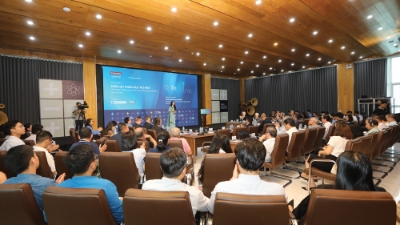
This international seminar demonstrated that human resources, talent, and technical capabilities are the most critical factors. In addition, partners from Russia, Canada, and other countries have expressed readiness to accompany Vietnam on its nuclear power development journey. This is a highly-valuable opportunity. We must seize it by developing programs, plans, and implementation efforts in a serious and systematic manner, as other countries have done.
* * *

We are standing at a historic turning point for the global energy sector. According to reports from the International Energy Agency (IEA), the world is facing not only a climate crisis but also mounting pressure from disruptions to traditional energy supply chains. Against this backdrop, the commitment to achieving net-zero emissions by 2050 has officially become a new “rule of the game,” shaping the entire flow of global trade and investment.
In Vietnam, the challenge of energy security has become a matter of strategic importance. The country not only needs energy to sustain economic growth but also requires a source of power that is genuinely clean, stable, and self-reliant. For this reason, ongoing research into Small Modular Reactor (SMR) models is increasingly linked to the realization of new energy scenarios under the revised National Power Development Plan VIII (PDP8).
Under the long-term roadmap within the energy transition strategy, SMRs are being studied and positioned as a highly-flexible baseload power solution. Far more than simply scaled-down versions of conventional nuclear power plants, SMRs represent a potentially transformative breakthrough expected to balance the dual objectives of the future power system.
On one hand, the technology offers the opportunity to meet the massive and uninterrupted electricity demand required by AI data centers and advanced semiconductor manufacturing chains, both of which depend on absolute reliability and stability. On the other hand, with their ability to adjust output rapidly, SMRs are increasingly viewed as a promising technical solution to help manage the variability and intermittency inherent in renewable energy sources.
Notably, thanks to their integrated design, SMRs offer a high level of inherent safety, significantly minimizing operational risks while strengthening public confidence and long-term strategic trust. From a financial perspective, the model provides notable advantages through lower upfront capital requirements and shorter construction timelines. Its modular approach enables factory-based mass production and on-site assembly, helping ease financing pressure for investors. Combined with deployment flexibility, this advantage allows SMRs to adapt to diverse geographic settings, from concentrated industrial parks to remote and isolated areas.
However, the pathway toward small-scale nuclear power development is not without challenges, including concerns over electricity costs, commercial viability, and the need for a comprehensive legal and regulatory framework. Addressing these issues will require close coordination among policymakers, scientific experts, and implementing businesses.
In the era of AI and digital transformation, the development of next-generation nuclear energy has become an urgent necessity that can no longer be delayed.
To avoid falling behind the pace of global development, Vietnam must move faster by establishing strategic international partnerships. This will be key to accessing core technologies, studying best practices in safety governance, and preparing a highly-skilled workforce. Launching cooperative programs now would create significant opportunities for Vietnam to leapfrog development stages, narrow the gap with more advanced economies, and strengthen its position on the regional nuclear energy map.
* * *

The year 2024 marked the moment when the world truly returned to nuclear energy. At COP28, more than 20 countries jointly committed to a landmark goal: tripling global nuclear power capacity by 2050.
The next five years will be an acceleration phase for the nuclear power industry. We are moving beyond theory toward the rapid deployment of projects. Decarbonization and energy security are no longer simply political goals, they have become matters of survival for many nations. Against this backdrop, governments around the world are not only accelerating investment in small modular reactors (SMRs) but are also simultaneously developing new financing mechanisms and licensing frameworks to shorten project implementation timelines.
By 2030, the world could see between 20 and 30 SMR projects either under construction or in the licensing phase, with a total market size estimated at $100-150 billion. Looking further ahead, to 2050, the world will not simply witness the expansion of a new energy market, but rather a major turning point in the global energy system, where today’s ambitions become tomorrow’s infrastructure.
In my view, four major trends are driving this momentum. The first is the growing need to ensure energy security amid increasingly unstable geopolitical conditions. Recent developments have shown that energy independence has become an urgent priority for many countries. SMRs provide a suitable solution because their flexible design allows nations to exercise greater control over their electricity systems and reduce dependence on international gas markets.
The second trend is the need to decarbonize while maintaining stable operations across heavy industrial production chains.
The third is the explosive growth of AI, a sector consuming enormous amounts of electricity. The rapid expansion of data centers is placing mounting pressure on global electricity systems. Technology companies now require not only clean power but also reliable 24/7 electricity to sustain uninterrupted computing infrastructure. In this context, SMRs are increasingly viewed as one of the most viable solutions to meet these demands. As a result, SMRs are increasingly prioritized for deployment near large-scale data centers to ensure stable and continuous electricity supply.
The final trend is the maturation of global supply chains. By around 2040, the SMR industry is expected to shift strongly toward standardization. As modular manufacturing technologies advance and international licensing processes become more harmonized, construction costs are likely to decline significantly while deployment speeds accelerate on a global scale.
According to forecasts by the International Atomic Energy Agency, by 2050 the world could have between 400 and 600 new nuclear power projects under development or in operation, including approximately 200 SMR projects. The total market size could reach as much as $1 trillion.
* * *

As energy transition becomes a matter of survival, small modular reactor (SMR) technology offers an optimal alternative to traditional energy sources thanks to its outstanding core advantages. First and foremost, the greatest strength of SMRs lies in their reliability.
Unlike wind and solar power, which are intermittent and heavily dependent on weather conditions, SMRs provide a continuous, uninterrupted, and stable electricity supply regardless of day or night or extreme weather conditions. This characteristic is particularly compatible with Vietnam’s climate conditions.
In addition, the technology stands out for its environmental sustainability, producing near-zero emissions while using land extremely efficiently. Its relatively small footprint helps optimize urban planning, significantly reduce the size of safety planning zones surrounding power plants, and enable flexible infrastructure integration across a wide range of applications.
From a practical standpoint, SMRs represent a strategic option because they address major infrastructure and workforce challenges facing developing countries. The technology improves economic and operational efficiency through lower upfront capital requirements and significantly shorter construction timelines compared to conventional reactors. This helps investors minimize financial risks and reduce the burden of borrowing costs throughout project implementation.
Thanks to their flexibility and rapid load-following capability, SMRs can operate effectively even in small, isolated power systems, while also working in coordination with renewable energy sources and large-scale nuclear power plants.
The impact of SMR projects extends beyond technical considerations, delivering substantial socio-economic benefits aligned with the sustainable development goals of the United Nations. For example, a floating nuclear power unit can provide low-emission electricity to approximately 100,000 people while maintaining uninterrupted power generation over an operational lifespan exceeding 60 years.
The technology’s risk management capabilities also allow countries to forecast long-term electricity generation costs with greater accuracy, creating a solid foundation for ensuring national energy security. Ultimately, expanding SMR nuclear power, one of the cleanest energy sources available, would serve as a strong driver for R&D, strengthen domestic capabilities, and contribute meaningfully to global climate action.
* * *

Canada is currently the world’s second-largest uranium producer, with 100 per cent of the country’s commercial uranium mining operations concentrated in Saskatchewan province. The expansion of the nuclear industry in Saskatchewan in particular, and globally more broadly, is expected to create major opportunities for businesses, workers, and suppliers.
Preliminary analyses suggest that Saskatchewan’s nuclear program alone could require between 2,500 and 3,500 highly-trained technical and professional workers. In addition to engineers, project managers, and nuclear operations personnel, demand is also expected to be particularly strong for skilled trades and supporting technical labor.
Nuclear power is also creating substantial opportunities for Saskatchewan’s industrial suppliers, building on the province’s existing strengths in oil and gas, mining, and manufacturing. The Saskatchewan Government is currently supporting multiple initiatives aimed at developing nuclear supply chains at the local, Canadian, North American, and global levels, helping businesses in the province deepen their participation in the value chain.
In addition, several new initiatives have been launched to strengthen nuclear research in Canada. The Global Institute for Energy, Minerals and Society, a collaborative model involving the University of Saskatchewan, the University of Regina, and Saskatchewan Polytechnic, was established in 2025 and is expected to dedicate significant resources to nuclear technology and related supply chains.
Saskatchewan has also taken a proactive approach to collaborating with governments and organizations to advance nuclear energy development. In 2019, Saskatchewan signed an MoU with Ontario and New Brunswick provinces to promote the development of small modular reactors (SMRs) in Canada. In April 2021, Alberta province joined the initiative. By 2022, the four provinces had agreed on a shared strategic plan outlining a roadmap for SMR development.
The plan identifies SMRs as a source of safe, reliable, and zero-emission electricity to support growing economies and populations, while also creating opportunities to bring Canada’s nuclear knowledge, technologies, and expertise to global markets.





 Google translate