


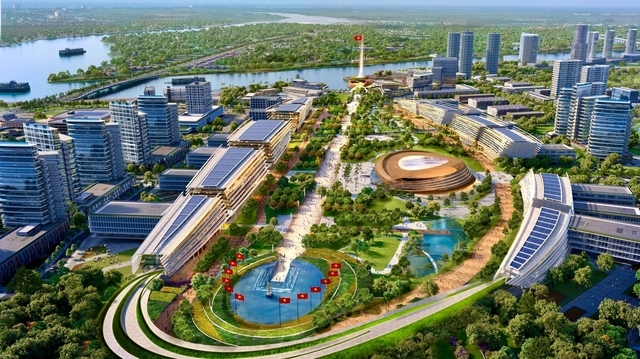
The National Assembly on April 24 passed a Resolution on the establishment of Dong Nai city.
Under the resolution, Southern Dong Nai province will become a centrally-governed city as from April 30, 2026,
This will be Vietnam’s 7th centrally-governed city, after Hanoi, Ho Chi Minh City, Hai Phong, Hue, Da Nang and Can Tho.
The new city will be established on the basis of the whole current southern Dong Nai province, which included Binh Phuoc province after merger last year, and since then borders Ho Chi Minh City, Lam Dong and Tay Ninh provinces, and the Kingdom of Cambodia.
The new city covers an area of 12,737.18 sq.km, with a population of over 4.49 million and 95 commune-level administrative units.
Dong Nai has effectively leveraged its strategic location, historical traditions, and strengths in national defense, security, culture, and society to emerge as one of the country's leading economic hubs.
With increasingly synchronized and modern infrastructure, particularly in transport, industry, services, and logistics, along with the fast-tracked construction of Long Thanh International Airport, Dong Nai possesses all the prerequisites of a dynamic, multi-centered and multi-functional urban area with strong spillover effects across the southern region and the nation.
The establishment of Dong Nai city is expected to create a new growth driver not only for the locality itself but also for the southern region and the country at large. It represents a fundamental shift in development and governance models, aiming to transform Dong Nai into a major urban center capable of sharing functions, strengthening linkages, and fostering coordinated development with Ho Chi Minh City.
Dong Nai is envisioned as a key national growth pole, a regional economic connectivity hub, and an international gateway, while serving as a model of modern, dynamic, and civilized urban development in line with the Politburo's orientation for the country’s southeastern region.





 Google translate