


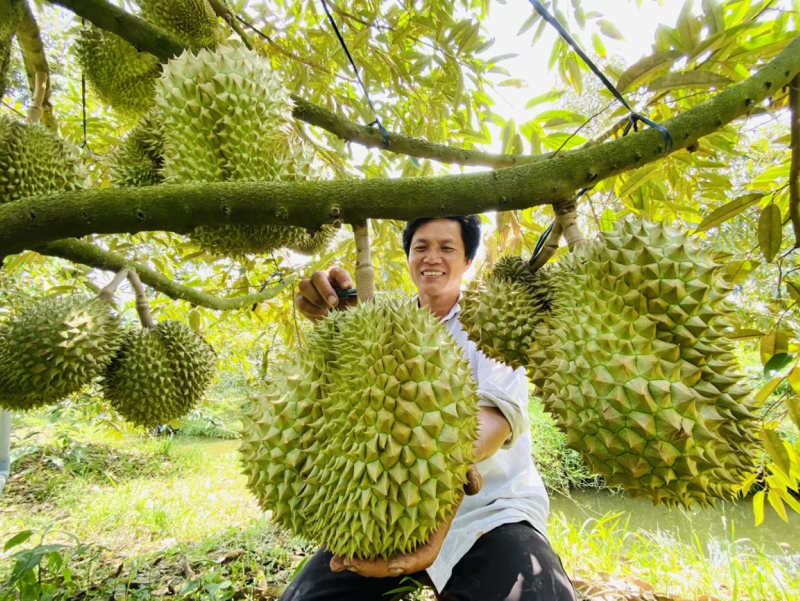
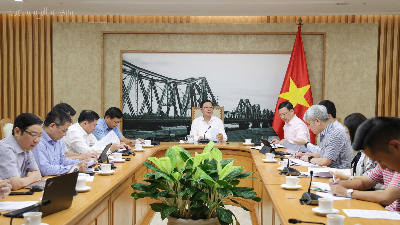
Speaking at a forum on green transition in crop production held in southern Dong Thap province on November 25, Mr. To Van Huan from the Plant Production and Protection Department under the Ministry of Agriculture and Environment said Vietnam's durian area surged from 33,400 hectares in 2016 to 195,000 hectares in 2025, lifting output from 399,000 tons to 1.8 million tons.
In 2025, durian exports reached $3.86 billion, accounting for over 45 percent of the country’s total fruit and vegetable export revenue. In 2026, cultivation is estimated at 200,000 hectares with projected output of 2.08 million tons, led by Lam Dong in area (44,300 hectares) and Dong Thap in production.
In the first nine months of 2026, exports exceeded $3.45 billion, up roughly 25 percent year-on-year, with China absorbing over 95 percent of fresh durian shipments.
However, rapid growth has exposed drawbacks, including premature harvesting, pests, and chemical or heavy metal residues. Authorities are halting area expansion to focus on quality, strict oversight of planting area codes and packing facilities, organic fertilizers, integrated pest management, and VietGAP standards.
At the local level, Mr. Tran Thanh Tam, Director of Dong Thap province’s Sub-Department of Crop Production and Plant Protection, noted that only 692 hectares of the province’s 27,316 harvested hectares hold valid VietGAP certification, equivalent to roughly 2.5 percent.
Following 2025 tests showing excessive cadmium levels in 23 of 115 orchard samples and seven of 45 packing house samples, Dong Thap is zoning production and mapping cadmium risks across 1,724 survey points.
From an industry perspective, Ms. Ngo Tuong Vy, General Director of Chanh Thu Fruit Import-Export Group, highlighted that while Vietnam surpassed Thailand in fresh durian exports to China in 2025 (941,004 tons versus 920,749 tons), declining fruit quality has dragged down farm-gate prices.
Chanh Thu’s average Grade A purchase price fell from VND90,000 ($3.54) per kilogram in 2024 to VND80,000 ($3.15) in 2025 and is projected at VND70,000 ($2.76) in 2026 due to tree over-exploitation and improper input use.
Meanwhile, Mr. Huynh Thanh Loc, Deputy Director of the Center for Technology Transfer at the Southern Horticultural Research Institute (SOFRI), warned of soil degradation from chemical overuse.
A 2025 SOFRI survey found cadmium exceeding 0.05 mg/kg in roughly 60 percent of 63 soil samples and 5 percent of over 300 durian pulp samples under Chinese food safety thresholds. SOFRI has selected seven promising rootstock lines resistant to Phytophthora and salinity up to 2 parts per thousand, while urging soil restoration, Internet of Things (IoT) monitoring, and adherence to national standard TCVN 10739:2026 to curb unripe harvesting and safeguard export competitiveness.



 Google translate