


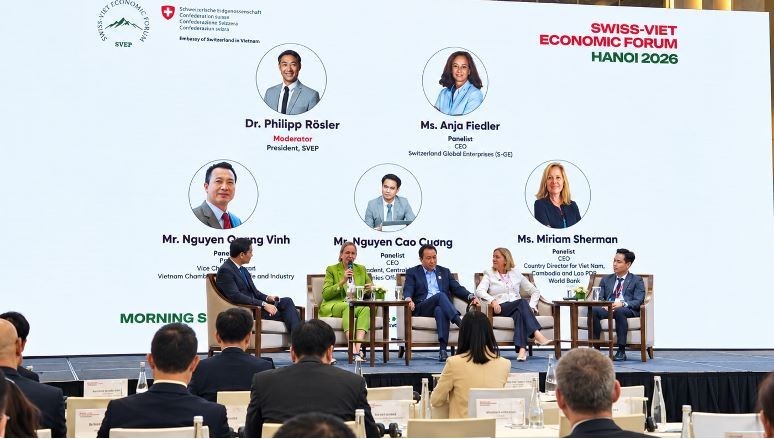
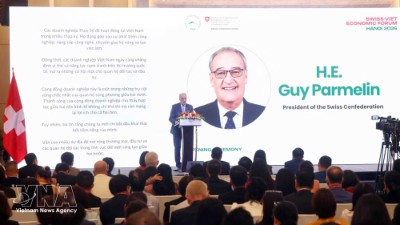
The initiative was highlighted during a roundtable discussion at the Swiss-Viet Economic Forum Hanoi (SVEF) 2026, held from October 18 to 20 on the sidelines of the official visit of Swiss President Guy Parmelin to Vietnam.
The event brought together international financial institutions, trade promotion agencies, and business delegates to explore actionable frameworks following the conclusion of the free trade agreement between Vietnam and the European Free Trade Association (EFTA), which includes Switzerland, Norway, Iceland, and Liechtenstein.
SVEF Chairman Dr. Philipp Rosler posed the central question to the panel, urging businesses from both sides to identify the most significant immediate opportunities to capitalize on once the Vietnam-EFTA FTA takes effect. Panelists emphasized that success extends beyond tariff cuts and market access, requiring strong partnerships, resolution of financial bottlenecks, and standardization of technical infrastructure aligned with global requirements.
Addressing macro-level economic structures, Ms. Mariam Sherman, World Bank Country Director for Vietnam, highlighted a persistent gap in the domestic economy. While Vietnam maintains high economic openness with 17 signed FTAs, an export volume reaching $475 billion last year, and over $50 billion in foreign direct investment (FDI) attracted in the first nine months of this year, the distribution of benefits remains uneven.
According to World Bank data, foreign-invested enterprises represent only 5 percent of total registered companies in Vietnam, yet they generate 73 percent of total export turnover and support approximately 30 million jobs.
During recent international tariff adjustments, FDI exports from Vietnam grew by 38 percent, whereas domestic firms experienced a decline of nearly 10 percent.
Ms. Sherman stressed that Swiss and EFTA corporations play a vital role in knowledge transfer and technical training, helping Vietnamese small and medium-sized enterprises (SMEs) move up the value chain from low-margin assembly and packaging.
To help Vietnamese SMEs overcome financial barriers, the World Bank proposed streamlining customs procedures, expanding supply chain financing linked with local vendor development mandates, and utilizing concessional loans to de-risk private capital in large infrastructure projects.
From a trade promotion perspective, Ms. Anja Fiedler, CEO of Switzerland Global Enterprise (S-GE), noted a doubling in Swiss business inquiries regarding Vietnam.
To relieve capital pressure on joint ventures, Swiss companies can leverage specialized tools, including Swiss Export Risk Insurance (SERV) - which requires only a 20 percent Swiss localization rate, leaving 80 percent capacity for Vietnamese suppliers - and the Swiss Investment Fund for Emerging Markets (SIFEM).
Meanwhile, Vietnamese business leaders noted growing alignment in technology and environmental standards. Representatives from Vietnam’s tech sector, including CMC Group, pointed out that Vietnam offers a young engineering workforce capable of adopting artificial intelligence (AI), cloud computing, and blockchain, complementing Switzerland’s deep-tech and data security ecosystem.
To absorb Swiss investment under new regulations like the EU Data Act and meet 2050 net-zero targets, Vietnamese companies are investing in green infrastructure.
CMC Group, for instance, is advancing a $300 million green data center project for 2027-2028 designed to international cybersecurity and environmental standards.
Panelists concluded that starting with moderate pilot projects will establish feasibility and trust, paving the way for large-scale supply contracts and long-term investments.




 Google translate