


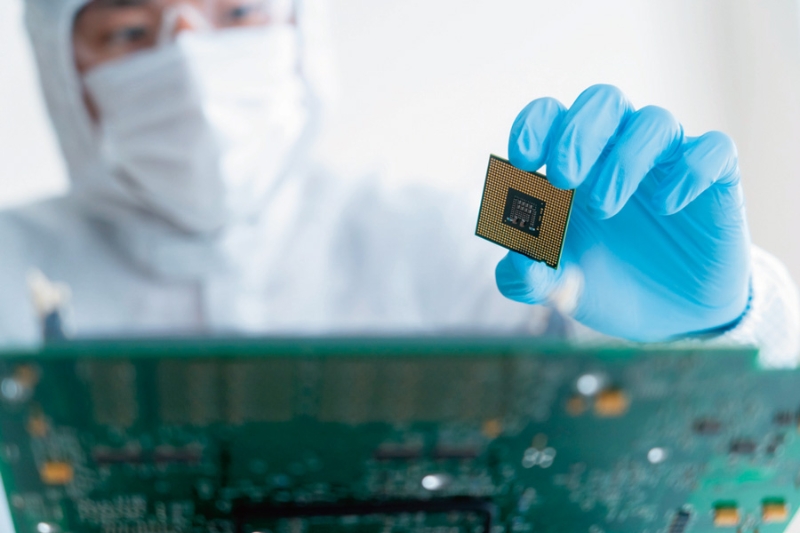
Vietnam is prioritizing strategic technologies to help close the gap with advanced economies. In your view, what conditions does the country need in order to genuinely narrow that gap, particularly in high-tech sectors?
In the current context, strategic technologies carry a very clear meaning: they are core technologies that play a decisive role in a nation’s development capacity and standing. In other words, these are the most important technologies, capable of generating broad spillover effects, driving multiple industries, and helping resolve the country’s key development challenges.

Important resolutions such as Politburo Resolution No. 57-NQ/TW, together with related laws and decrees, have laid the groundwork for promoting science, technology, and innovation.
However, the biggest challenge now is how to translate those directions into concrete action. Put differently, the core issue is finding the right path and mechanisms to move from today’s starting point toward the future goal of developing strategic technologies in order to “catch up” with advanced economies.
What key foundations could enable Vietnam to compete in the technology race, especially in emerging fields such as AI and semiconductors?
In my view, Vietnam has several favorable foundations for participating in technology development.
First is the strategic and legal framework. This is extremely important. The Party and State leadership clearly recognize the role of science and technology in national development, while also identifying both short-term and long-term visions. The issuance of resolutions, policies, and related legal frameworks has created the necessary foundation to promote innovation and attract technology investment.
Second is the confidence international businesses have in Vietnam. Many foreign corporations value Vietnam’s political stability, institutional environment, and investment climate. When major companies establish a presence and operate effectively, they create spillover effects that attract additional investors. It can be seen as a “leading effect,” where pioneer businesses pull others into the ecosystem.
Third is the human factor. Vietnamese people have a strong tradition of valuing education, working hard, and learning quickly. This is a major advantage in new technology sectors, where the ability to learn and adapt is critical.
Fourth is the nation’s aspiration to rise. Throughout history, that aspiration has repeatedly served as a force pushing society forward. The desire to advance and stand alongside other nations is a powerful source of energy for innovation and development.
These can be considered important foundations for Vietnam to participate more deeply in technology sectors. However, opportunities also come with considerable pressure. As countries worldwide accelerate digital transformation and develop new technologies such as AI, Vietnam is also experiencing a degree of FOMO - “fear of missing out”. That mindset sometimes turns concepts such as AI or semiconductors into heavily discussed topics.
Could you explain this FOMO phenomenon more clearly, and what Vietnam should do or where it should begin?
In assessing Vietnam’s technology development path, we are not fundamentally “off course,” because our ability to track and adapt to global trends is strong. However, the biggest barrier is the FOMO mindset. We already have many favorable conditions: sound policies, supportive laws, backing from foreign investors, talented human resources, and a strong national aspiration to advance. Still, progress must be made step-by-step, with carefully chosen priorities and a starting point aligned with our real capabilities.
Rather than rushing into overly ambitious goals, we should first prioritize practical and achievable tasks. Choosing the right starting point not only saves resources but also shows the world and our own people that “we can do it,” helping prevent discouragement and loss of confidence.
The key question is what to do first. Vietnam’s greatest challenge today is accurately assessing its real capabilities so it knows what it can realistically achieve. Once those strengths are clearly defined, the country can map out the right approach and gradually move toward higher goals.
However, this is not simply about choosing easy tasks. What matters is that those tasks fit within the country’s broader development strategy. Vietnam must prove to investors that it has the talent and execution capacity needed, so they can invest with confidence.
The long-term objective cannot be limited to contract manufacturing or working indefinitely for foreign firms. In the spirit of the Law on High Technology, to take effect on July 1, 2026, and the core technology strategy under Politburo Resolution No. 57 on breakthroughs in science and technology, innovation, and digital transformation - which emphasizes gradual technological self-reliance, especially in strategic technologies - Vietnam must aim for autonomy rather than dependence.
When partners transfer machinery, we first learn how to operate it, then repair it, then upgrade it, and finally improve it until it becomes our own core technology. To achieve this, the role of government and businesses is crucial. Vietnam currently has only around five or six large technology groups. But national development cannot depend on just six giants. We need 60, then 600 companies. The era of pride in “screwdriver technology” - simple assembly work - is over. Strategic technology today means big data and AI.
How can Vietnam grow from 60 to 600 companies?
Vietnam needs a mindset of supporting new businesses and visionary startups. The government must accept investment risk: many projects may fail, but if two or three succeed, the effort is worthwhile. Even when the State funds someone’s education and that person later works in the private sector rather than a State agency, society still benefits.
The country should move beyond rhetoric and take concrete action by guiding, strategically supporting, and funding breakthrough ideas. If the Vietnamese Government established multi-billion-dollar funding pools with clear disbursement rules and accountability requirements, it could spark a wave of businesses and scientists entering research and product development.
To build real national momentum, resources should not be concentrated only on a few large conglomerates. Instead, support should be directed toward small and medium-sized enterprises (SMEs) and capable individuals. When people see an ordinary person or a small company succeed on merit with State backing, the spillover effect can be powerful. That is how national momentum is created.
Vietnam’s scientists are highly capable, but many remain too focused on theory. To change that, the government should fund participation in international conferences to broaden perspectives and, more importantly, should place researchers in real factories. Professors and scientists need to be immersed in production environments and work directly with machinery in order to understand and develop suitable technologies.
The semiconductor industry, however, is far more complex than most sectors. It is not simply a matter of buying machines and assembling products. It requires exceptionally high standards of operations, production management, and hands-on experience. It also demands a synchronized ecosystem in which technicians and academics work together, like a symphony orchestra.
Throughout history, that aspiration has repeatedly served as a force pushing society forward. The desire to advance and stand alongside other nations is a powerful source of energy for innovation and development.
What common traits do successful countries in core technology development share, and what can Vietnam learn?
International experience offers many lessons for Vietnam. Japan, for example, pursued sweeping reforms in the 19th century under a clear vision: learn from the West, match the West, and surpass the West. To do so, it translated leading foreign works into Japanese while maintaining the principle of “Western civilization, Japanese culture.” Japan embraced foreign technology while preserving its national identity.
Taiwan (China)’s rise began from basic manufacturing. In its early development stage, many households assembled computer cables. From that base, Taiwan (China) steadily upgraded capabilities, shifted simpler processes elsewhere, and moved into higher-value activities. Today, it is home to world-leading firms such as TSMC and plays a critical role in the global technology ecosystem. This shows that development requires a shared national aspiration and alignment among the State, businesses, and scientists.
Another key differentiator is the human factor and discipline. Technology and products emerge from human needs, while discipline helps turn those needs into practical solutions.
Ultimately, State policy is decisive. Governments must value, identify, nurture, and properly reward talent in order to retain it. Leadership vision and the ability to use talent effectively remain the most important keys to future development.



![[Interactive]: Economic overview - September 2026](https://premedia.vneconomy.vn/files/uploads/2026/10/06/9e0f403040dd4384ad690004bc1911ab-124594.png?w=400&h=225&mode=crop)




 Google translate