


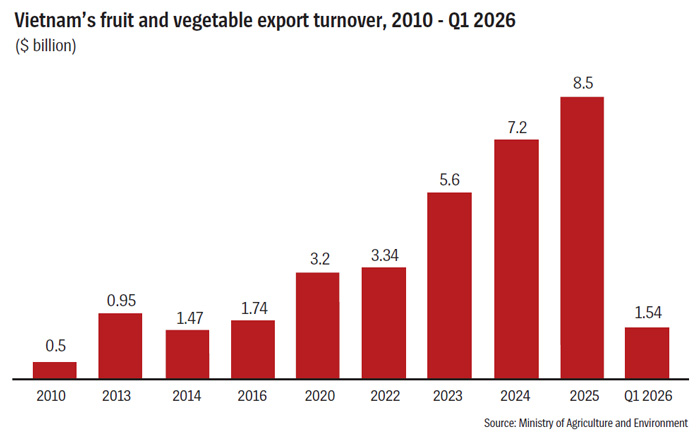
Vietnam’s fruit and vegetable industry has consistently been a bright spot in global agricultural trade over the past 15 years, delivering impressive, steady growth. Export turnover stood at some $500 million in 2010, approached the $1 billion mark in 2013, rose to $1.47 billion in 2014, and reached $1.74 billion in 2016, before climbing to $3.2 billion in 2020 and about $3.34 billion in 2022. A major breakthrough came in 2023, when exports surged to $5.6 billion, driven largely by the official export of durian to China. Momentum continued in 2024, with exports reaching $7.2 billion, before setting a new record of $8.5 billion in 2025.
According to the Ministry of Agriculture and Environment (MAE), Vietnam’s fruit and vegetable export turnover stood at $1.54 billion in the first quarter of 2026, up 32.1 per cent against the same period of 2025. China remained its largest market, accounting for 54 per cent of total exports and posting robust growth of 76.2 per cent, followed by the US (8 per cent, up 21.4 per cent) and South Korea (4.3 per cent, up 4.1 per cent). Notably, among the Top 15 export markets, Cambodia saw the strongest growth, rising 3.7-fold from a year prior.
Heavy reliance
Despite facing technical barriers such as requirements in growing area codes, traceability, and food safety, fruit and vegetable exporters have proactively improved processing, packaging, and storage systems. These changes have helped products overcome market barriers and sustain growth.
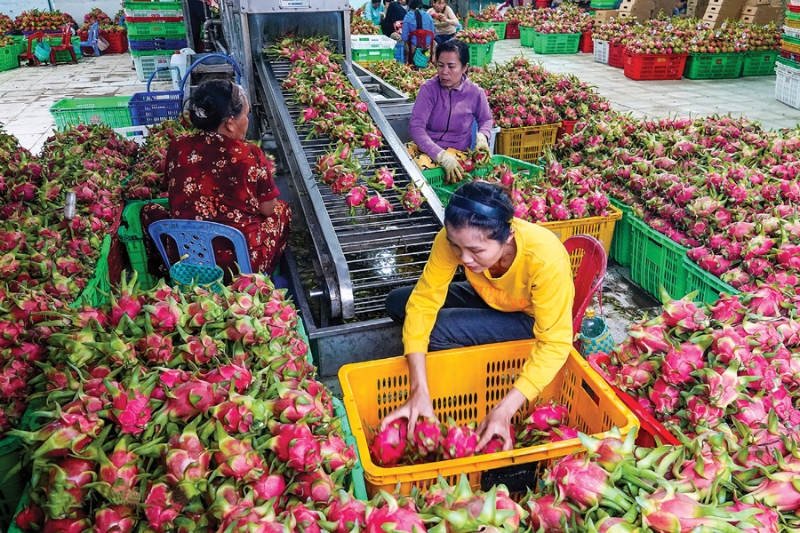
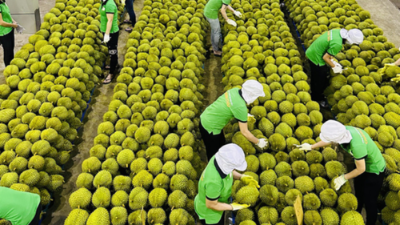
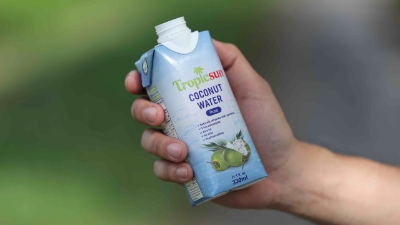
However, the industry still faces sustainability challenges, as growth remains highly dependent on a limited number of products and markets. In 2025, durian generated a record $4 billion in turnover, accounting for nearly 50 per cent of total industry exports, with more than 90 per cent of that value coming from China. Alongside durian, dragon fruit and coconut were among the few products to surpass the $1 billion mark. Meanwhile, many promising types of fruit, such as oranges, longans, lychees, rambutans, mangoes, mangosteens, custard apples, and jackfruit, have yet to achieve export values commensurate with their potential.
Looking ahead, bananas and pineapples are expected to join the billion-dollar export club thanks to stable raw material zones and rising global demand. Bananas are the world’s most consumed fruit and continue to post steady demand growth in Northeast Asia and the Middle East. China, Asia’s largest banana importer, is facing domestic supply shortages and has had to increase imports.
With many growing regions worldwide affected by Panama disease, Vietnam is emerging as an important alternative supplier thanks to its geographic advantages, stable output, and competitive logistics costs. At the same time, expanded growing area codes, greater investment in post-harvest treatment facilities, irradiation centers, and cold storage have enabled Vietnamese bananas to meet demanding international standards.
Processing as a driver
Market access alone will not be enough for Vietnam to achieve its $10 billion fruit and vegetable export target. Though export turnover has risen sharply, most products are still shipped fresh or only lightly processed, with few strong brands in international markets, limiting value-added potential.
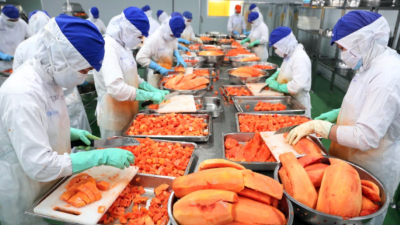
According to the Vietnam Fruit and Vegetable Association (VinaFruit), 2025 marked a notable turning point, with processed fruit and vegetable exports surpassing $2 billion, up more than 42 per cent from 2024 and the highest level on record. Processed products accounted for around 24 per cent of total industry exports, compared with 20 per cent in 2024. This suggests deep processing is becoming a more proactive strategy to raise value while helping businesses better cope with policy shifts, logistics volatility, and stricter import standards.
Among processed products, pineapples led with $360 million, up 55.8 per cent and accounting for 4.14 per cent of total export value. They were followed by passionfruit at $180 million (up 35.3 per cent), pistachios at $176 million (up 32.3 per cent), almonds at $155 million (up 87.1 per cent), and mangoes at $131 million (up 13.3 per cent). The trend shows that products linked to premium consumption segments and stable markets are growing faster.
Pineapples, once a challenging fresh export product, are now gaining momentum through deep processing, with global consumers increasingly favoring juice, frozen products, canned goods, and ingredients for the beverage industry. China consumes around 2.5-3 million tons of pineapples annually, but seasonal domestic supply has driven rising import demand. Meanwhile, the Middle East and Europe are also increasing imports of processed pineapple due to its longer shelf life and stable supply.
Mr. Dang Phuc Nguyen, Secretary General of VinaFruit, said pineapples were among the fastest-growing products in 2025, expanding by more than 55 per cent, highlighting their substantial market potential. With the rapid expansion of processing plants over the past two years, combined with standardized cultivation areas and traceability compliance, Vietnamese pineapples could join the billion-dollar export group in the near future.
Green production
The $10 billion export target is not only a destination but a journey tied to production transformation and value-chain standardization. Ms. Nguyen Thi Thu Huong, Deputy Director of the Department of Crop Production and Plant Protection at the MAE, said Vietnam’s agriculture sector had long focused on boosting yields and expanding acreage, but global markets now demand stricter standards on emissions, traceability, food safety, and sustainability.
To meet these requirements, the crop industry is accelerating green production as the foundation for long-term growth. A low-emissions production plan for 2025-2035 aims to scale up low-emission farming models. So far, nearly 60 models have been deployed across multiple agricultural products, targeting a 15 per cent emissions reduction by 2035 through the optimization of seeds, fertilizers, irrigation, and production inputs.
Green production is also linked to reorganizing agriculture toward larger-scale, concentrated production and stronger supply chain links between farmers, cooperatives, and enterprises. Mechanization, technology adoption, and digital transformation are helping build stable raw material zones.
According to Ms. Huong, while green production is the foundation, value-chain standardization is the key to market expansion. Vietnam currently has 9,357 growing area codes and 1,381 packing facilities serving exports, enabling agricultural products to access demanding markets such as the EU, the US, Japan, Australia, and South Korea.
Mr. Nguyen said 2026 still offers ample space for growth, especially if Vietnam effectively leverages free trade agreements and expands into Halal markets, where demand for tropical fruit is rising quickly. However, sustainable development will require the industry to meet “green, clean, attractive, and transparent” standards, ranging from residue control and traceability to consistent quality. Lessons from 2025, when many durian shipments were delayed due to non-compliance, underscore increasingly strict market requirements.
Vietnam’s fruit and vegetable exports are entering a new phase of development, in which value will no longer depend on short-term growth, but on long-term strategy. According to Mr. Nguyen, with a foundation of green production and a standardized value chain, the $10 billion target could become reality as early as 2026.





 Google translate