


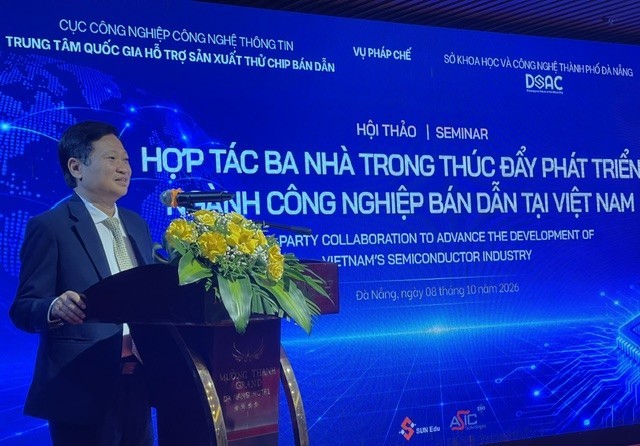
Representatives from government agencies, local authorities across Central Vietnam, research institutes, universities, and semiconductor enterprises gathered in Da Nang on October 8 for a workshop to establish a concrete roadmap for “Triple Helix” collaboration, targeting a finalized priority action list in 2026 and an operational plan for 2027.
The workshop, titled “Triple Helix Collaboration in Promoting Semiconductor Industry Development in Vietnam,” was co-organized by the Authority of IT and Digital Industry under the Ministry of Science and Technology, the Da Nang Department of Science and Technology, and the University of Da Nang.
The event aims to implement Politburo Resolution 57-NQ/TW, the National Semiconductor Strategy approved under Prime Ministerial Decision 1018/QD-TTg, and the Semiconductor Human Resource Development Program approved under Prime Ministerial Decision 1017/QD-TTg.
Speaking at the event, Mr. Nguyen Khac Lich, Director General of the Authority of IT and Digital Industry, affirmed that the Triple Helix model serves as the operational framework to execute the national strategy.
Under the “Triple Helix” structure, the government establishes legal frameworks, supports shared infrastructure, and resolves operational bottlenecks; universities and research institutes train human resources, while generating knowledge and technology; and enterprises define product requirements, invest capital, and commercialize outcomes.
He emphasized that all the three parties must collaborate from initial task definition and resource alignment through to testing and evaluation. He added that regulators aim to direct partnerships around enterprise-led product goals, prioritize utilizing existing infrastructure before investing in new facilities, align training directly with operational needs, and clarify resource-, risk-, and benefit-sharing mechanisms from the outset.
Mr. Lich also revealed that the Information Technology Industry Authority has secured Electronic Design Automation (EDA) software donations, including 300 full-feature licenses from Siemens, to distribute free of charge to universities and tech startups.
From a local government perspective, Mr. Le Son Phong, Deputy Director of the Da Nang Department of Science and Technology, stated that the city is systematically completing its ecosystem covering infrastructure, workforce, enterprise network, research and development, and innovation. High-quality human resource development is identified as a critical driver for both semiconductor and artificial intelligence (AI) industries.
According to Mr. Phong, Resolution 21/2026/NQ-HDND of the Da Nang People's Council has established financial and policy incentives to attract experts, scientists, and high-tech talent in microchips and AI. The resolution strengthens connections between experts, educational institutions, and businesses supporting human resource development and key digital technology product manufacturing across the city.
Building on these mechanisms, Da Nang’s International Integration and Cooperation Plan for the 2026-2030 period, issued under Decision 2689/QD-UBND of the municipal People's Committee, dated June 19, 2026, sets strategic targets to attract major global technology corporations into high-tech sectors, semiconductors, AI, data centers, and innovation hubs. This strategic framework aims to expand international partnerships, mobilize investment, and elevate Da Nang’s position within the high-tech ecosystem.
Consequently, since early 2024, the number of semiconductor design firms operating in Da Nang has expanded from 8 to 26, featuring global and domestic industry players including Marvell, FPT, SkyeChip, and CoAsia Semi.
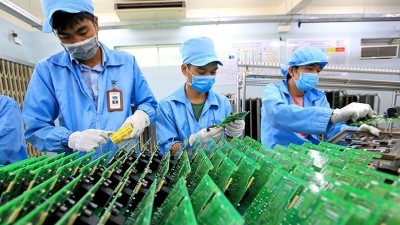
Industry experts noted that Vietnam’s semiconductor sector remains focused on assembly, testing, and packaging (ATP), hindered by fragmented collaboration among government, academia, and industry. Universities lack production-grade design tools and testing labs, while existing research facilities remain dispersed and costly to operate.
To address these gaps, enterprises called for job-ready graduates and specialized labs, while academic institutions proposed a networked shared laboratory system centered at Vietnam National University, Hanoi’s Hoa Lac campus.
Recommendations from the event will inform policy updates to to strengthen "Triple Helix" linkages and deepen Vietnam’s integration into global semiconductor value chains.






 Google translate