


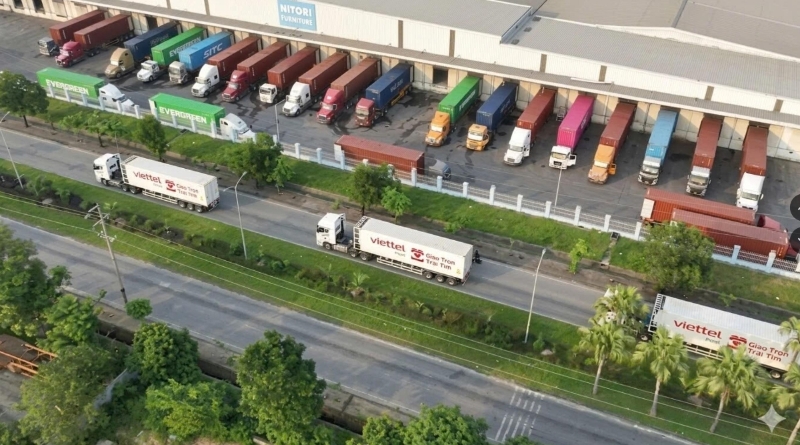
For many years, China has consistently maintained its position as Vietnam's largest trading partner, while Vietnam has also become China's largest trading partner within the ASEAN region. Consequently, the scale of trade between the two nations has continued to expand rapidly.
According to Vietnam Customs (under the Ministry of Finance), total bilateral trade turnover between Vietnam and China is estimated at approximately $252 billion in 2025, a 26.5% increase compared to 2024—the highest level to date. Within this figure, Vietnam’s export value to China is estimated at $69.36 billion, while import at $182.58 billion. The trade involves a diverse range of goods, from agricultural products, food, and consumer goods to electronic components and raw materials for production.
As the scale of trade grows, cross-border logistics has become a cornerstone of corporate supply chains. For many Vietnamese enterprises, particularly in manufacturing and trade, China is not only a major export market but also a vital source of raw materials. Ensuring a stable flow of goods between the two markets has therefore become a prerequisite for maintaining production and fulfilling orders.
In this context, logistics is no longer viewed merely as the transportation of goods. Instead, it is increasingly seen as a holistic supply chain optimization challenge, requiring businesses to strike a balance between transit times, logistics costs, and market responsiveness.
However, operating cross-border logistics presents much more complex requirements than domestic transport.
Beyond legal and customs hurdles, cross-border logistics demands the ability to organize multimodal transport, coordinate cargo in real-time, and possess an expertise in handling situations at border crossings. As a result, not every logistics provider is equipped to participate and maintain efficiency on these international routes.
Recognizing this, and alongside the rise in regional trade, many Vietnamese logistics firms are proactively investing in operational systems and expanding their networks to cross-border routes, gradually deepening their integration into regional supply chains.
According to Mr. Doan Quang Chien, Director of Viettel Logistics, the company’s objective is to build a stable cross-border logistics system capable of efficiently connecting regional transport routes. Amid the continued expansion of Vietnam-China trade, these transport routes will not only help businesses optimize their supply chains but also contribute to strengthening trade connectivity between Vietnam and other markets in the region.


 Google translate