


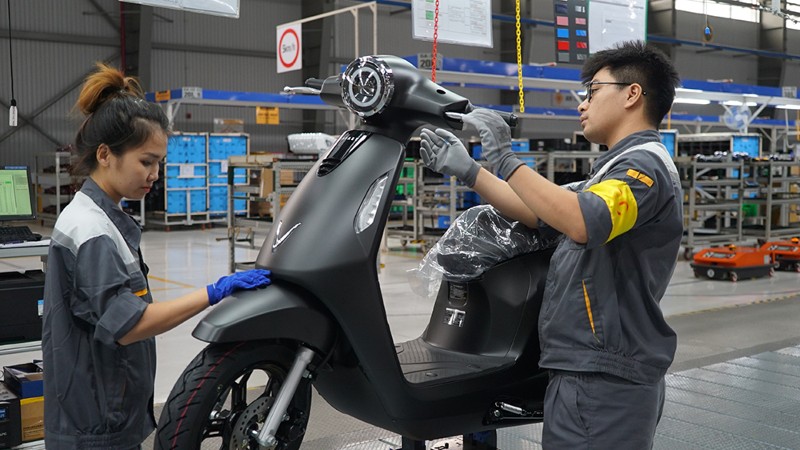
According to the VAMM report published on October 9, total sales volume across VAMM’s six member companies - Honda Vietnam, Yamaha Motor Vietnam, SYM Vietnam, Piaggio Vietnam, Vietnam Suzuki, and Kawasaki Motors Vietnam - reached 686,661 units during the third quarter.
This result represents the strongest growth pace since the beginning of the year, maintaining a steady recovery trajectory for domestic motorcycle consumption. The sales performance provides crucial financial support for manufacturers after a prolonged period of market saturation and intense competition from alternative personal transport segments.
Commercial momentum in Q3 2026 was driven primarily by the peak back-to-school shopping season, combined with aggressive financial promotion campaigns launched by authorized dealerships.
Mass-market automatic scooters and affordable manual motorbikes continued to serve as the primary sales pillars, while sport manuals and premium automatic scooters contributed positively to profit margins across VAMM members.
However, rising sales figures do not indicate that the traditional internal combustion engine (ICE) motorcycle market has escaped structural saturation. With average ownership exceeding 0.7 vehicles per capita in major metropolitan areas, growth headroom through pure quantitative expansion of ICE motorbikes has reached its ceiling.
A decisive factor reshaping Vietnam’s motorcycle landscape is regulatory pressure and new environmental policies. Hanoi’s official pilot and expansion of the Low Emission Zone (LEZ) scheme, alongside stricter urban emissions standards in place as of October 2026, have established a countdown for fossil-fuel two-wheelers operating in inner-city areas.
The policy roadmap to restrict and eventually phase out petrol two-wheelers in urban cores by 2030 is directly influencing consumer purchasing decisions, forcing buyers to weigh traditional petrol models against electric options to avoid future depreciation and traffic restriction risks.
Facing regulatory transition, product portfolios announced by VAMM in its Q3 report reveal a strategic turning point as legacy manufacturers actively join the electrification race.
While the two-wheeled electric vehicle (EV) market was previously dominated by dedicated domestic and international EV brands, VAMM members have formally integrated pure electric models into their official commercial distribution channels.
The growing presence of electric models within VAMM’s product portfolio reflects adaptive strategy under competitive pressure from pure-play EV operators such as VinFast, Yadea, Dat Bike, and Selex Motors. Legacy joint ventures are investing in research and bringing EV models into the domestic market to build supporting ecosystems, gauge consumer sentiment, and prepare for large-scale transition.
Legacy joint ventures face a complex economic balancing act: maintaining revenues from existing petrol models while committing substantial capital to construct integrated charging, battery-swapping, and service networks.
Simultaneously, manufacturers are expanding big-displacement, adventure, and lifestyle motorcycle lineups through brands like Kawasaki, Suzuki, Piaggio, and Honda. As mass-market commuter segments face EV competition, producers are targeting recreational buyers, where traditional engine dynamics retain unique appeal.
Vietnam’s two-wheeler market is projected to maintain modest growth into Q4 due to year-end holiday demand, with full-year 2026 sales expected to exceed 2.6 million units.
However, industry competition is fundamentally shifting from pure unit volume toward energy technology, digital connectivity, and battery ecosystem integration for the 2027-2030 business cycle.





 Google translate