


Many Vietnamese businesses have yet to prioritize carbon credits, while awareness of how carbon markets operate remains limited. Combined with an incomplete legal framework and gaps in measurement, reporting, and verification (MRV) systems, these challenges continue to discourage companies from entering the market.
Experts say Vietnam must move quickly to finalize its regulatory framework, issue clear implementation guidelines, strengthen international cooperation, and improve corporate readiness if it is to convert its carbon reduction potential into commercial value.
Untapped potential
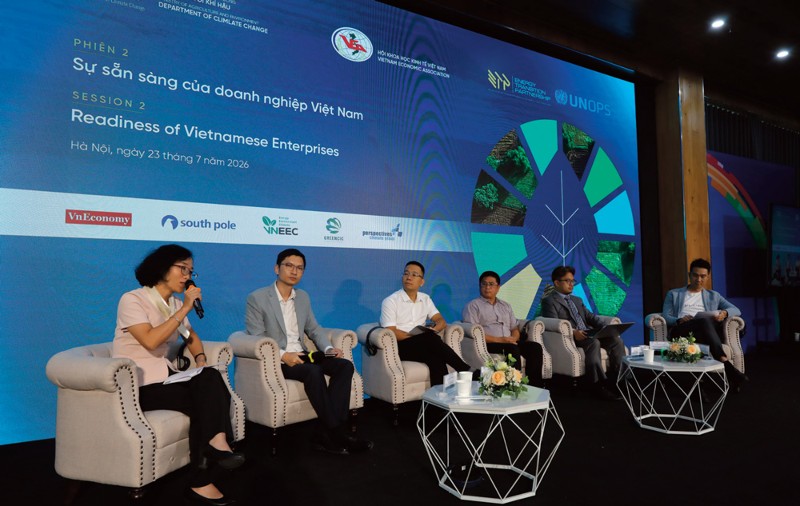
From the perspective of a company that has supported Vietnamese project developers since the early days of the carbon market, Mr. Nguyen Tien Hai, Technical Director at the Vietnam Energy and Environment Consultancy JSC (VNEEC), said domestic businesses, including project owners, consultants, and brokers, have built considerable expertise in developing carbon credit projects under both voluntary and compliance mechanisms.
Vietnam successfully registered its first project under the Clean Development Mechanism (CDM) in 2006. Over the 20 years since, the country has registered more than 270 carbon credit projects through the mechanism, but only around 30 per cent, or some 80 projects, ultimately completed the issuance process and sold credits on the international market, generating actual revenue for project developers and participating stakeholders.
The market experienced a sharp downturn after 2012 as carbon prices collapsed under the CDM. From 2013 onward, however, the voluntary carbon market expanded rapidly, and Vietnamese businesses were quick to participate under leading international standards, including the Gold Standard (GS), Verra’s Verified Carbon Standard (VCS), and, more recently, the Global Carbon Council (GCC).
Commercial performance has been significantly stronger in the voluntary market. More than 70 per cent of the roughly 150 voluntary projects successfully registered in Vietnam have issued and sold carbon credits to international buyers, demonstrating considerably higher commercial success than projects developed under the CDM.
“The experience accumulated over the past 20 years is one of the greatest strengths of Vietnamese businesses,” Mr. Hai said. “Vietnamese consultants, brokers, and project developers are no longer unfamiliar with the technical terminology or the rigorous international validation and verification processes required by the market.”
Despite this progress, Mr. Hai noted that Vietnam’s project pipeline remains modest when compared with major carbon market countries such as China, India, and Brazil. He added that the number of registered projects also falls far short of Vietnam’s own greenhouse gas mitigation potential.
Experts believe Vietnam possesses abundant opportunities to generate high-quality emissions reductions across renewable energy, waste management, low-emissions agriculture, including methane reduction from rice cultivation, forest conservation, green transportation, and industrial production. These sectors have the capacity to produce a substantial volume of carbon credits that could become tradable assets in domestic and international carbon markets.
Many businesses are also beginning to view emission reductions differently. Rather than treating decarbonization solely as a compliance cost, companies are increasingly recognizing it as a strategic investment capable of strengthening long-term competitiveness.
Among the companies leading this shift is Vingroup, whose systematic preparation offers a practical example of how businesses can build the infrastructure needed to participate in future carbon markets.
Mr. Tran Ky Anh, Carbon Credit Transaction Manager at Vingroup, said green growth and sustainable development have become long-term strategic priorities backed by coordinated investments. The group has built an integrated electric mobility ecosystem centered around VinFast, supported by affiliated businesses including V-Green, which develops charging infrastructure, Xanh SM, which provides green transportation services, and VinBus.
More recently, Vingroup has expanded into renewable energy and high-speed rail infrastructure. According to Mr. Ky Anh, these investments not only help reduce emissions across the economy but also create substantial opportunities for future carbon credit generation.

In the future, more countries are expected to participate in the international carbon market. The broader the network of partner countries, the greater the opportunities for Vietnamese businesses to access climate finance, technology, and international markets, thereby accelerating emission reductions and supporting the country’s net-zero ambitions.
“To prepare for the carbon market, Vingroup considers emissions data governance and MRV systems to be fundamental capabilities,” Mr. Ky Anh said. “We invested in data infrastructure from the earliest stages of project development. At V-Green, every charging station is equipped with smart meters connected to a centralized platform that records and stores charging session data in real time to support MRV in accordance with international standards.”
The company has also invested in building internal expertise in greenhouse gas accounting, carbon project development, and monitoring global carbon policy developments. Together, these investments in strategy, digital infrastructure, MRV capability, and human resources have positioned the group to participate confidently as carbon markets continue to evolve.
Persistent barriers
Despite Vietnam’s strong technical potential and growing experience, many businesses continue to face structural barriers that prevent them from participating more actively in international carbon markets.
According to Mr. Hai, the CDM demonstrated that the biggest obstacle was not technical project development but access to buyers. Many Vietnamese developers struggled to connect with credible international purchasers, which explains why only around 30 per cent of CDM projects ultimately generated revenue despite successfully completing project development and registration.
The commercial failure of many projects imposed significant financial costs on developers that had already invested in project preparation, registration, and credit issuance. More importantly, it weakened confidence in the market and discouraged further investment.
Another challenge is the lack of early planning. Carbon credits are subject to the principle of additionality, meaning the potential to generate carbon credits must be considered and documented from the earliest stages of project planning and investment.
Many Vietnamese businesses only begin exploring carbon credits after seeing neighboring projects generate profits. By that point, projects are often already operating commercially or equipment procurement has been completed, leaving developers without evidence that carbon revenue influenced investment decisions. As a result, many projects fail to meet the eligibility requirements for carbon credit registration.
Experts also pointed to weaknesses in MRV implementation. Registering a carbon project and completing the required validation and MRV processes is a lengthy undertaking that requires substantial upfront investment and consistent compliance over many years.
Many businesses underestimate the time and financial commitment required to maintain MRV obligations. Others discontinue projects before completing periodic verification requirements, preventing carbon credits from being successfully issued.
At the same time, international carbon markets are undergoing a fundamental transformation. The market has shifted away from low-cost credits toward high-integrity credits, with buyers demanding stricter standards for additionality, permanence, avoidance of double counting, transparent ownership, and measurable contributions to sustainable development. Without systematic preparation, experts warned, many businesses will struggle to meet these increasingly rigorous requirements.
Institutional support
Speakers at the session roundtable agreed that corporate efforts alone will not be enough to unlock Vietnam’s carbon market potential. Turning emissions reductions into tangible economic value will require stronger institutional support and an operational regulatory framework.
Compared with major carbon market countries such as China, India, and Brazil, the number of carbon credit projects successfully registered in Vietnam over the past 20 years remains modest. Given Vietnam’s own emissions reduction potential, the country still has substantial untapped opportunities to develop projects capable of generating high-quality greenhouse gas emissions reductions.

Mr. Ky Anh said the highest priority is ensuring that regulations governing international carbon credit transactions under Decree No. 112 are fully implemented in practice. This includes establishing workable procedures for project registration and issuing letters of approval for international transfers under Article 6 of the Paris Agreement.
He also called for detailed guidance on implementing the Decree. Vietnam already has a considerable number of projects that meet international standards and are ready to participate in carbon markets, but developers need greater regulatory certainty before moving forward. Vingroup hopes the Article 6 implementation agreement between Vietnam and Singapore will enter into force soon. Such an agreement would allow Vietnamese projects to access growing international demand for high-quality carbon credits while creating the country’s first international transactions.
Mr. Hai agreed that Vietnamese businesses already possess the technical experience, capable workforce, and initiative needed to develop carbon credit projects. What they now need, he continued, is a complete legal framework together with the institutional infrastructure required to register and issue carbon credits efficiently.
He also suggested that the government could support businesses by developing baseline methodologies for certain types of projects.







 Google translate