


Vietnam’s economy is projected to grow 6.8 per cent in 2026 following an estimated 8 per cent expansion in 2025, according to the World Bank (WB)’s “Vietnam Economic Update,” released on May 15. In the report, entitled “Sustaining Reforms, Navigating Uncertainty,” the WB noted that Vietnam entered 2026 “in the strongest position of any economy in ASEAN,” buoyed by strong manufacturing exports, rising FDI, accelerated public investment, and broad institutional reforms. However, it also warned that geopolitical tensions, global trade uncertainty, and a sharp rise in oil prices linked to the Middle East conflict have made the external environment increasingly challenging.
“Softer global conditions are making Vietnam’s external environment more challenging, with the oil shock adding to downside risks,” said Ms. Mariam J. Sherman, World Bank Division Director for Vietnam, Cambodia, and Lao PDR. “At the same time, climate shocks, rapid technological change, demographic shifts, and rising infrastructure needs are reshaping the foundations of long-term growth.” The “real test”, she continued, will be Vietnam’s ability to implement, finance, and sustain reforms while unlocking the full potential of the domestic private sector to create more and better jobs.
Strong momentum carries into 2026
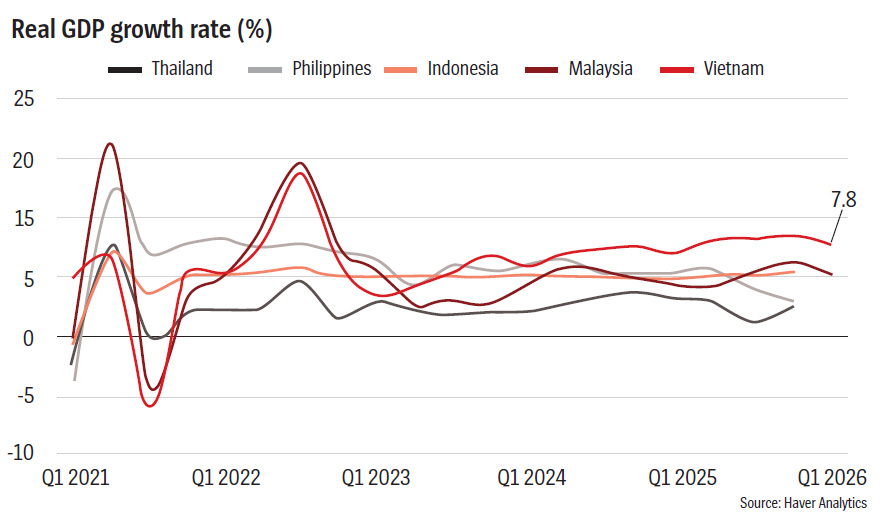
According to the WB, Vietnam maintained strong economic momentum throughout 2025 and into the first quarter of 2026, outperforming many regional peers despite growing external uncertainty. Its GDP expanded 8 per cent last year, up from 7.1 per cent in 2024 and marking the fastest pace among ASEAN economies. Growth remained robust in the first quarter, reaching 7.8 per cent year-on-year; the highest first-quarter growth in nine years.
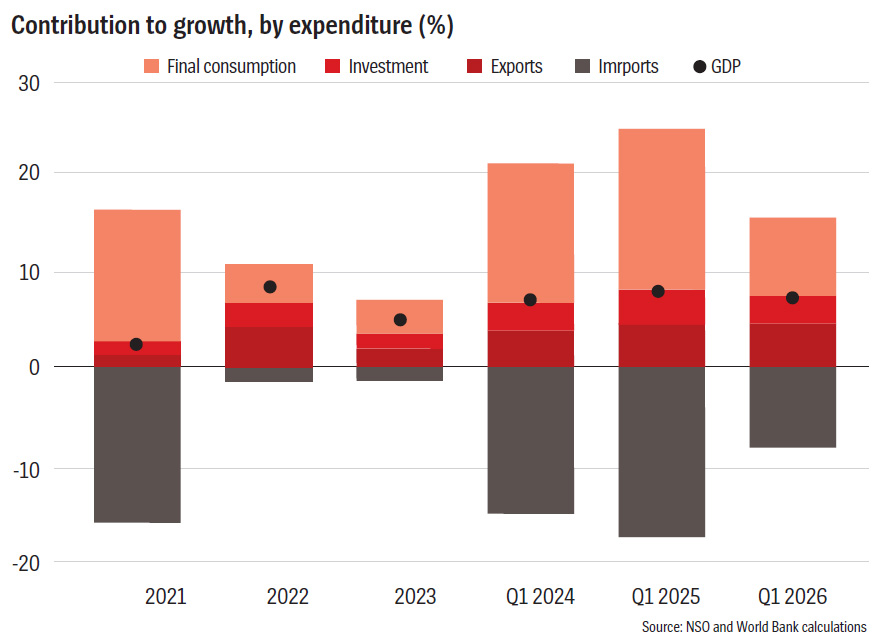
The report added that growth was broad-based, supported by strong manufacturing exports, resilient services activity, and rising FDI, public investment, and household consumption. Investment increased 8 per cent in 2025, reflecting stronger disbursement under the 2021-2025 public investment plan as well as increased FDI linked to regional supply chain diversification.
Exports continued to anchor growth, rising 16 per cent in 2025 to a record $475 billion, equivalent to 93 per cent of GDP, supported by strong global demand for electronics and technology products. Imports also climbed 17 per cent as manufacturers increased purchases of intermediate goods used in export production, resulting in net exports making a modest negative contribution to overall GDP growth for the second consecutive year.
The WB highlighted Vietnam’s growing role in AI-related supply chains as an important source of momentum. According to the report, exports of AI-related goods increased significantly, with their share rising from around 20 per cent of GDP in 2023 to approximately 32 per cent by 2025; among the highest levels globally.
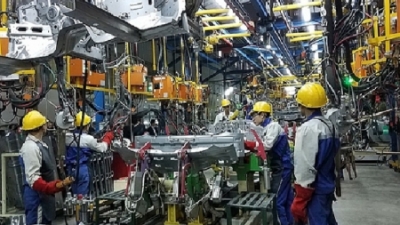
Manufacturing growth reached 9.6 per cent last year and remained elevated at 9.5 per cent year-on-year in the first quarter of 2026, accounting for roughly one-third of overall GDP growth. Manufacturing’s share of GDP also rose, to approximately 25 per cent.
Tourism and services also contributed to growth. International arrivals rose 20 per cent to a record 21.2 million visitors and continued increasing in early 2026, supporting transport, retail, hospitality, and related services.
FDI inflows remained strong amid regional supply chain restructuring. Total registered FDI stood at $38.4 billion in 2025, while disbursed capital rose 9 per cent to a record $27.6 billion. In the first quarter of 2026, newly-registered FDI increased 36 per cent year-on-year to $15.2 billion, with manufacturing accounting for 61 per cent. Major projects included electronics and liquefied natural gas investments from South Korea and Singapore.
External headwinds
Despite Vietnam’s resilient growth, the WB said the external environment has become more difficult in 2026. Its report highlighted the impact of the Middle East conflict, which has triggered the largest oil supply shock in decades and pushed global energy prices up sharply. Higher transportation, logistics, and input costs are expected to weigh on economic activity globally, affecting trade-oriented economies like Vietnam.
Against this backdrop, the WB expects growth in developing East Asia and the Pacific to slow from 5 per cent in 2025 to 4.2 per cent in 2026, while softer global demand could dampen Vietnam’s exports.
Business sentiment has already shown signs of softening. Purchasing Managers’ Index (PMI) surveys in April showed slower manufacturing activity for a second consecutive month as companies scaled back employment and purchasing activity amid declining export orders. The report also noted growing input cost pressures, with manufacturers increasingly passing higher costs through to final goods prices.
Inflationary pressures have intensified as fuel prices rise. Vietnam’s inflation increased to 4.7 per cent in March 2026 and climbed further to 5.5 per cent in April after fuel subsidies were partially withdrawn. The report projected inflation would average slightly above 4 per cent for the full year.
External balances have also come under pressure. Vietnam recorded its first quarterly trade deficit in five years in the first quarter of 2026, at $3.7 billion, as imports rose faster than exports. Meanwhile, the VND has weakened by just over 3 per cent against the USD since the beginning of the year, while foreign exchange reserves remained at around two months of import cover.
Structural challenges
Beyond the short-term risks, the WB emphasized the importance of addressing longer-term structural challenges. The report pointed to persistent imbalances between foreign-invested enterprises (FIEs) and domestic enterprises, describing Vietnam’s economy as increasingly characterized by a “dual economy.” While globally-integrated FIEs continue to drive exports, manufacturing, and productivity growth, the domestic private sector remains fragmented and less integrated into supply chains.
According to the report, enterprises linked to global value chains, including FIEs, account for a disproportionately large share of exports and value-added despite representing only a small proportion of enterprises. By contrast, 98 per cent of domestic enterprises are small or informal, while only 17 per cent participate in exports. Weak links between FIEs and local enterprises continue to constrain domestic value capture and productivity gains.
The divergence between the two sectors has become more visible amid recent trade disruptions. Since changes in US tariff measures, exports by FIEs rose 38.5 per cent while those by domestic enterprises declined 9.8 per cent. Local exporters concentrated in sectors such as textiles, footwear, and wooden products faced significantly higher tariff burdens and weaker shock absorption capacity than FIEs operating in electronics and machinery.
Though business formation remained active in 2025, exits also increased sharply, while newly-established enterprises entered the market at a smaller scale and with lower employment and capital intensity than prior to the Covid-19 pandemic.
Vietnam’s ability to “retain more value domestically, deepen linkages between foreign-invested and domestic firms and raise productivity” will be critical to sustaining growth over the medium term, according to the report.
Reform implementation
Despite mounting uncertainties, the WB stated that Vietnam’s medium-term outlook remains positive, supported by an ambitious reform agenda and large-scale public investment plans.
It noted that, since 2025, authorities have enacted more than 86 laws and 300 decrees aimed at streamlining bureaucracy, reducing regulatory barriers, and modernizing tax, customs, digital governance, judicial systems, and insolvency frameworks. Vietnam is also pursuing the largest administrative rationalization and institutional reorganization since the “Doi Moi” (Economic Renewal) period.
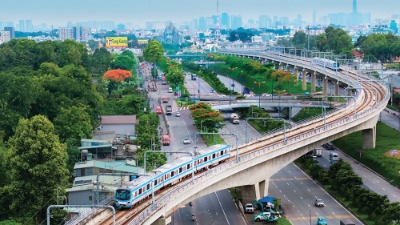
Authorities are planning approximately $320 billion in infrastructure investment over the next five years, focused on logistics, transport, and connectivity, to strengthen competitiveness and long-term growth.
However, the WB stressed that translating reforms into results will require sustained efforts, particularly in ensuring productive investment, adequate financing, and effective implementation. “Done well,” the report stated, these efforts could help Vietnam build “a virtuous cycle of investor confidence, private investment, growth, and resilience,” while supporting the country’s ambition of achieving high-income status in the years ahead.




 Google translate